
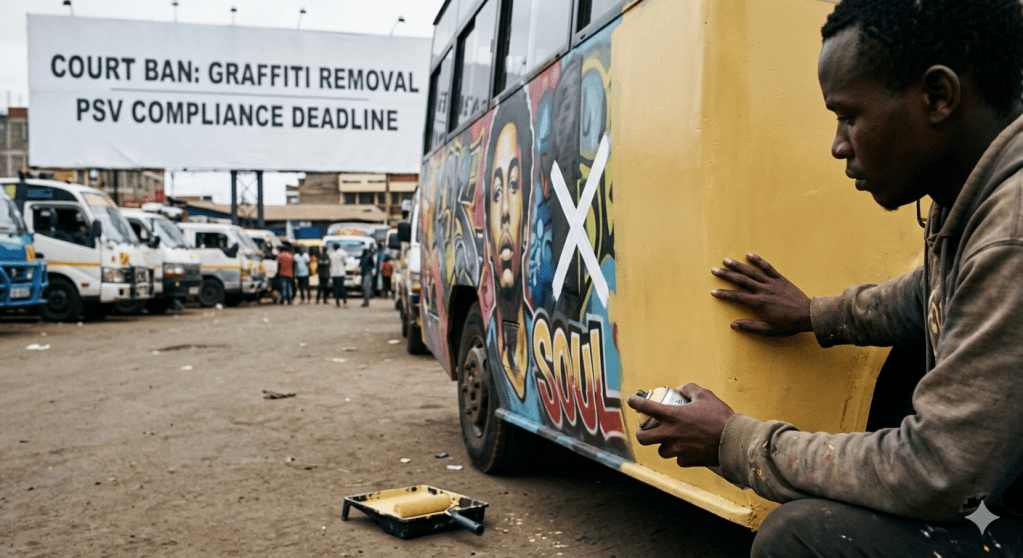
A court just banned the graffiti that made Nairobi’s matatus famous. The artists who created it have nowhere to go. ‘This is not just paint. It is the soul of Nairobi.’
On the morning the court ruled against him, Brian Otieno was standing in a garage in Nairobi’s Industrial Area with a spray can in his hand and a half-finished portrait of Burna Boy on the side panel of a Nissan minibus.
He found out through his phone, the way Nairobians find out about most things now, a WhatsApp message from a friend, then a flood of notifications, then the full ruling shared as a screenshot of a screenshot of a screenshot, the text slightly blurred at the edges but the meaning unmistakably clear. The High Court had dismissed the petition. The National Transport and Safety Authority’s directive stood. As of today, matatu graffiti, tinted windows, neon lighting, and custom interior artwork are effectively illegal in Nairobi.
Otieno put down the can. He looked at the bus. Then he picked the can back up and kept working.
“What else would I do?” he said, when we spoke later that afternoon, the garage around him smelling of paint and exhaust and the particular chemical warmth of a job not quite finished. “This is still a bus that has to roll tomorrow. Someone still has to ride it. I am still here.”
For six decades, Nairobi’s matatus, the informal shared minibuses that carry an estimated 70 percent of the city’s working population every day, have been the most vivid surface in East Africa. They are mobile exhibitions: Tupac beside a Luhya proverb, Lionel Messi mid-sprint above a passage from Ecclesiastes, and portraits of politicians rendered with a photographic accuracy that the politicians themselves have never quite managed to earn. Every inch of bodywork is considered. Every decision about color, placement, and subject carries the weight of taste, competition, and civic pride.
The artists behind them, airbrush painters, graffiti writers, interior designers, and sound-system engineers, form an informal creative economy that, until this morning, was worth an estimated KES 1.2 billion a year. They are largely young. Many have no formal training. Most learned from older craftsmen in the same garages, the same way the craft has always been transmitted: by watching, then doing, then being judged by everyone who rides past.
Brian “Graff” Otieno, the name given to him years ago by other artists in the Industrial Area, a title rather than an accident of birth, has been painting matatus for fourteen years. He started at fifteen, sweeping floors in a garage near Jogoo Road, watching a painter named Mwangi cover a Toyota Hiace in a full-panel portrait of Jay-Z that took four days and stopped traffic twice. He asked Mwangi to teach him. Mwangi told him to come back when he’d learned to draw. He came back two weeks later with a sketchbook full of portraits. Mwangi looked at them for a long time, handed the book back, and said, “Tomorrow. Six o’clock.”
“This is not just paint. It is the soul of Nairobi. We have tourists who come specifically to ride these buses. Where will they go now?” Brian “Graff” Otieno, matatu artist, Industrial Area
The NTSA has wanted to clean up the matatus for years. The arguments are familiar and, taken individually, not unreasonable: tinted windows obscure visibility and can assist criminals; loud exhaust systems cause noise pollution; graffiti can obscure safety equipment markings and make vehicles harder to identify during incidents. The “Michuki Rules,” introduced in the early 2000s by the then-Transport Minister John Michuki, banned matatu art and loud music for similar reasons. The modern fleet eventually reclaimed its decoration after those rules were relaxed, but the legal ground was always uncertain.
The May 2025 enforcement notice and the court ruling that was upheld on 29th April, 2026, do not use the word “culture” once. The judgment talks of statutory obligations, safety requirements, and regulatory compliance. It acknowledges that the petition was framed as a public interest case protecting artistic expression. It concludes that such preferences cannot override safety law. The court found no evidence that operators associated with the Nganya culture had been unfairly targeted.
The painters in the Industrial Area garage read it differently.
“They say ‘safety,’” said Kamau, who has done sound systems and interior upholstery on matatus for nine years, sitting on an overturned paint drum in the corner of the garage, scrolling through his phone. “But every unsafe matatu I’ve ever seen with a cracked windscreen, bald tires, and bad brakes had nothing to do with the art. The art and the safety are separate things. They know that. We know that. This is about something else.”
What that something else is depends on who you ask. Urban planners cite the forthcoming Bus Rapid Transit system, a long-promised, repeatedly delayed network of dedicated bus lanes, as a driver of the push toward uniformity. Nairobi Governor Johnson Sakaja announced in February that BRT Line 5, linking the city center to the airport, was in its final approval stage at the National Treasury. A BRT bus, by design, is standardized. It carries no portraits. It runs on a timetable, not on personality.
“Kigali is the model they’re always talking about,” Otieno said, gesturing vaguely northward. In Rwanda’s capital, transport has achieved near-total uniformity: identical buses, identical colors, and state monitoring. It is frequently held up by Kenyan officials as an example of what modern African urban transport should look like. “They want us to be Kigali. But we are not Kigali. We have never been to Kigali. Nairobi is something else entirely.”
The Nganya Award Festival, held at the Kenyatta International Convention Centre in November 2025, with forty-four categories and ten thousand people, was supposed to feel like a turning point. For one night, the matatu was an officially celebrated cultural object. There were categories for graffiti, sound systems, interior design, and hype crews. The government did not interfere. Social media lit up. International travel writers sent dispatches home about Nairobi’s “museums on wheels.”
Six months later, those museums are being ordered to whitewash their walls.
Brian Wanyama, who founded the Matwana Matatu Culture platform to document and archive matatu art, has spent years arguing that these vehicles are more than transport. “I see art,” he has said in various interviews over the years. “I don’t see cars.” His archive, thousands of photographs of painted buses, documented like works in a gallery, now reads as a kind of accidental preservation effort. A record of something that was always fragile, even when it seemed permanent.
Back in the garage, Otieno is finishing the Burna Boy panel as the afternoon light shifts. He works quickly and confidently without appearing to think. The can moves in short, controlled arcs. The face appears gradually, feature by feature, the way a developing photograph used to emerge from a darkroom, first the outline, then the shadow, then the particular brightness of an eye.
“The bus owner will decide what he wants to do,” Otieno said, stepping back to look. “If he wants to strip it, fine. He has to comply. But today, this bus will go out exactly like this. And everyone who rides it today will see this. And they will remember.”
There is an appeal pending. Otieno’s colleague, Michael Makubo, filed the petition, and his lawyers have asked for fourteen days to appeal to a higher court. The temporary orders keeping the status quo lapse on May 17, unless the Court of Appeal steps in. In the garage, this is known, discussed, and ultimately set aside. Appeals take time. The court was clear. The buses that roll out of here tomorrow morning will, sooner or later, have to change.
The question nobody in the government appears to have asked is what happens to the people who paint them. The matatu art economy has no formal register, no union, no professional body. The painters are not employees. They are paid per job, per bus, per wall. If the demand disappears, if matatu owners facing enforcement decide the risk is not worth it, there will be no redundancy payment. No retraining program. No acknowledgement, in any official document, that the people who made this culture were ever here.
“The BRT will have buses,” Kamau said, picking up a piece of sandpaper and turning it over in his hands. “Clean buses. Government buses. Same color every day. And the people who design them will be in an office somewhere, and they will pick from a menu of approved options, and that will be the art of Nairobi. A menu.”
He did not sound angry, exactly. He sounded the way people sound when they have been expecting something for a long time, and it has finally arrived.
At five o’clock, the garage begins to empty. Painters pack their cans. The compressor shuts off. The Burna Boy panel is dry. The bus, numbered, licensed, and registered, will leave at six tomorrow morning and make its run through Nairobi’s permanent, grinding, brilliant traffic, carrying nurses and students and market traders and office workers who will look at the portrait on the side and feel, briefly, the particular pleasure of riding something made by someone who cared.
Otieno walks the length of the bus one last time, the way a painter walks a finished canvas. He stops at the front, where the route number is stenciled in plain white on a black background, the only part of the vehicle that has always been clean, always legible, always unchanged.
“The route is still the route,” he said. “That much they cannot paint over.”
He picked up his bag, nodded to the remaining workers, and walked out into the noise of the city.





 Sure Media Magazine
Leave a comment