
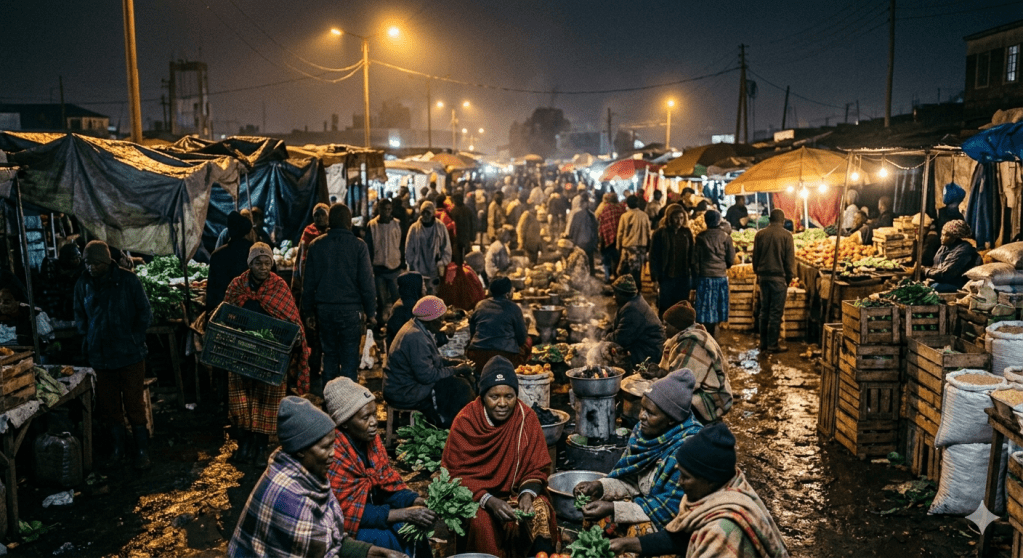
Before the city wakes up, thousands of women are already working. They have no contracts, no insurance, and no safety net. They have each other.
Before dawn
The matatu drops Grace Muthoni at the junction at 3:15 in the morning. She has been awake since 2 a.m. The walk to Wakulima Market takes 11 minutes, and she has made it so many times that her feet know the route without her having to think. She is carrying forty kilograms of sukuma wiki, which she bought in bulk from a farm in Limuru the previous afternoon. She will sell it by sunrise.
Grace is 41 years old. She has been doing this for nine years. She has put two children through secondary school this way, maintained a brick house in Ruiru, and built savings slowly and incrementally in a chama she joined in 2016. She has never had a formal employment contract. She has never filed a tax return, not because she is hiding anything, but because no system has ever asked her to.
“I am not in their numbers,” she says, meaning the government’s. “But I am in the market every day. I feed people. Where does that go?”
The hours nobody sees
Kenya’s informal economy accounts for roughly 83% of total employment, according to the Kenya National Bureau of Statistics. Women dominate its most precarious segments: market vending, domestic work, subsistence farming, and roadside trade. These are the sectors with the longest hours, the lowest margins, and the fewest protections.
At Wakulima, Nairobi’s largest wholesale produce market, the pre-dawn hours belong almost entirely to women. They arrive between 2 and 4 a.m. to secure their spots, sort their produce, and set prices before the morning rush. By 6 a.m., the market is loud and crowded and running on a logic they built.
Grace knows the names of every woman in her row. She knows who is sick, who has a child sitting exams, and who had a bad week and needs a loan she will repay in vegetables rather than cash. This is the informal safety net that policy documents call a gap.
“I am not in their numbers. But I am in the market every day. I feed people. Where does that go?”
The cost of working without a net
In August 2024, Grace fell ill with typhoid. She was hospitalized for five days. The hospital bill was KSh 34,000. She had no health insurance; the National Health Insurance Fund required employer registration that informal workers cannot access without a formal employer. She paid from her chama savings, which took her six months to rebuild.
“If I had been sick for two more weeks, I would have lost everything,” she says. Not dramatically. Matter-of-factly.
This is the financial profile of Kenya’s informal women workers: high output, zero protection, and a single crisis away from poverty. The Social Health Insurance Fund, introduced in 2023 to replace NHIF, has a self-registration option for informal workers. Uptake among market women in Nairobi has been low. Grace knows about it. She has not registered. The monthly premium, KSh 500, is manageable in a good month. In a bad one, it is sukuma wiki money.
What they built instead
By 7 a.m., the market is thinning. The women who came at 3 a.m. are selling their last bundles. Grace counts her money quietly, setting aside the chama contribution first, KSh 1,000, non-negotiable, every week. Then transport. Then lunch. Then what is left goes home.
She is tired in a way that becomes invisible when you have been tired for long enough. But she does not describe her life as hard. She describes it as hers.
“I made this,” she says, gesturing at nothing in particular and everything at once: the stall, the money in her hand, the children in school, the house in Ruiru. “Nobody gave it to me. I woke up at 2 a.m., and I made it.”
The city does not count her. She does not need it to.
But she would like it to try.
Reporting for this article was conducted at Wakulima Market, Nairobi.





 Sure Media Magazine
Leave a comment