
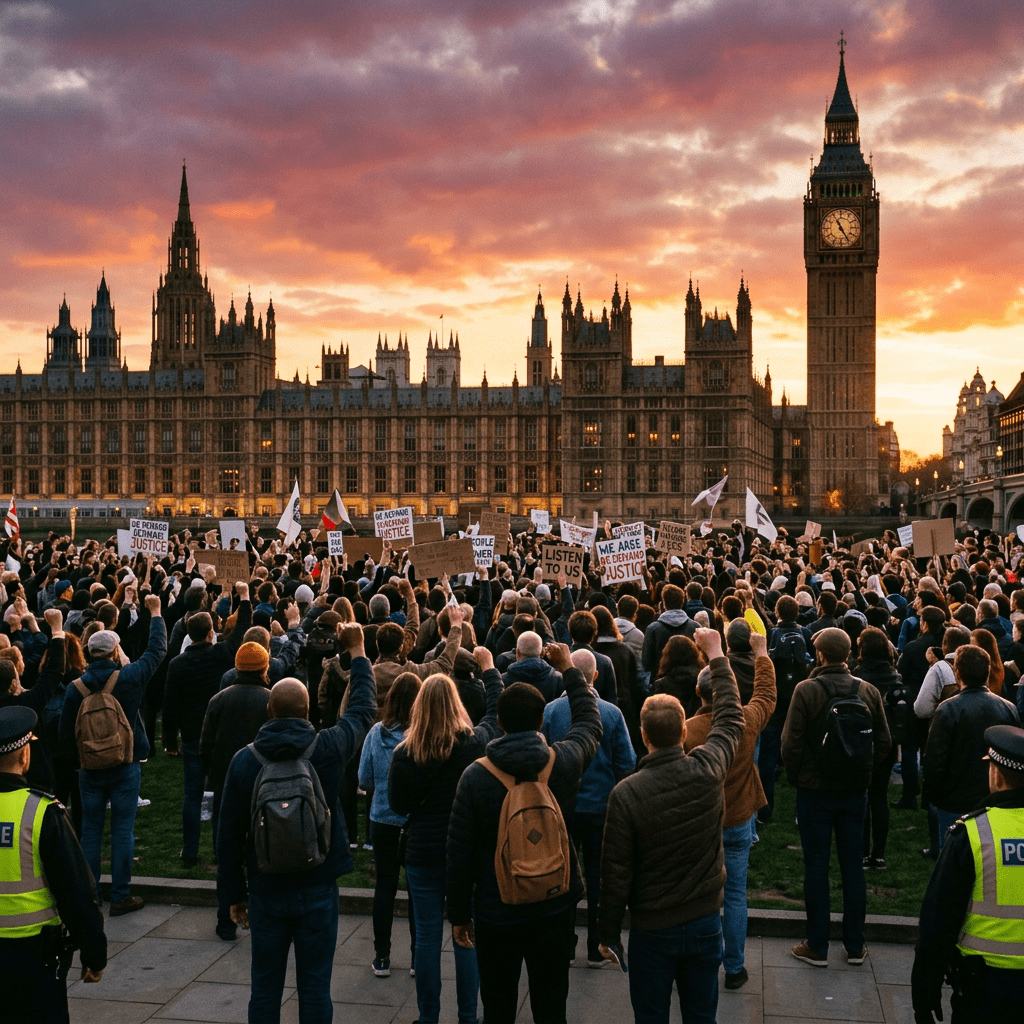
Two years ago, they stormed Parliament and changed Kenya. Now, some are hustling, some are organizing, and some are standing for election. The movement that had no leaders is quietly building one.
Wanjiku used to sleep with her placard under her bed. It said, in neat capital letters: WE ARE NOT AFRAID. She kept it for months after the last march, the way you keep a ticket stub from a concert that changed how you heard music.
She is twenty-three now, sitting in a plastic chair outside a small shop in Kayole, east Nairobi, selling data bundles and phone accessories. The placard is gone, thrown out during a move, she says, and then pauses in a way that suggests it was not quite that simple. “I didn’t want to explain it to people,” she said. “Every time someone saw it, they would ask. And I didn’t always want to answer.”
Wanjiku, who prefers not to use her surname, was on Kimathi Street on June 25, 2024, the day the crowd broke through the police line and walked into the Parliament building. She had taken the matatu from Kayole at dawn. She had never been to a protest before. She had built her anger, slowly and carefully, over months of tracking the Finance Bill on TikTok, its clauses, its implications, the spreadsheets that young Kenyans were passing around like samizdat, annotating the ways it would take money from people who had almost none of it left to give.
“That day,” she said, “I felt like we were something. Like we were actually something.” She looked down at the table between us. “I don’t know what I feel now.”
Two years on from the most significant youth uprising in Kenya’s post-independence history, the question of what happened next is complicated by the fact that so many different things happened next, simultaneously, and not all of them in the same direction.
The immediate results were real. Ruto withdrew the Finance Bill. His cabinet was dissolved. Several of the most despised ministers were gone. These were not small things. In a country where protests had historically been absorbed, dismissed, or crushed without concession, the speed and completeness of the government’s retreat felt, briefly, like proof that something had fundamentally shifted.
Then the protests continued into 2025, and at least 65 people were killed by police. A twelve-year-old girl named Bridgit Njoki was shot through the roof of her own house while watching television. Albert Ojwang, a teacher and blogger who had criticised a police official on social media, died in custody. The Interior Cabinet Secretary praised the police’s “restraint.” Former opposition leader Raila Odinga joined the government. The streets gradually emptied.
“The Gen Z movement is horizontal, organised on WhatsApp, TikTok, and X, with no fixed headquarters, no official spokesperson. That’s what made it powerful. It’s also what makes it hard to sustain.” Political analyst, Nairobi, speaking on background
What the movement is now depends on which part of it you look at. It is, simultaneously, a voter registration campaign, a grief group, a set of WhatsApp chats that still fire at three in the morning, a memory that twenty-somethings in Kayole and Eastleigh and Westlands carry around differently depending on what it cost them personally.
The #TukoKadi campaign, the phrase means “we are here” in Swahili, the “kadi” a play on the Kenyan identity card, began in March 2026 when a young man named Ademba Allans posted a video on social media showing his voter registration card from the IEBC portal and challenging others to do the same. Within a week, the campaign had mobilised thousands of new registrations. Within a month, it had become, by some measures, the most effective youth voter registration drive in Kenya’s history, outpacing, in weeks, what the official electoral commission had managed in months.
The logic behind it is deliberate. The movement knows, has known, since the protests first began, that its long-term leverage sits in the 2027 elections. Kenya has a median age of nineteen. If young people register and turn out in high numbers, no political calculus in the country can ignore them. The protests were a demonstration of power. The ballot is the conversion of that power into something durable.
“We realised that the streets alone were not enough,” said Daniel, twenty-five, who coordinated protest logistics on the Nairobi side in 2024 and now runs a small civic education account on TikTok. He makes short videos explaining proposed bills, government expenditure, and constitutional provisions in Sheng, the fluid street language of Nairobi’s youth, and posts them to an audience of about forty thousand. “We burned a lot of energy. People died. And the system absorbed it, in the end. The real question is: how do you make the system unable to absorb you?”
His answer is the vote. He is also quietly considering running for ward representative in 2027.
By the numbers
Kenya’s youth unemployment stands above 67% according to some estimates. Barely 1 in 10 under-30s holds a formal contract job. Over 120 people died in police crackdowns on protests across 2024–2025. The #TukoKadi campaign has been described by researchers as one of the most wide-reaching voter mobilisation drives in Kenyan history. The 2027 elections are eighteen months away.
But TukoKadi is not the whole story; it is the optimistic thread, and Nairobi has other threads running alongside it, tangled and darker.
James, twenty-six, a former engineering student who dropped out when fees outpaced his family’s ability to pay, was at the 2024 protests. He was also at the June 2025 anniversary protests, where he was hit with teargas on Kenyatta Avenue and arrested in a sweep four hours later, on a street he had already left. He spent eleven days in a holding cell. The charges, property damage, which he denies, were eventually dropped. He has no job. He has debt. He has a WhatsApp group with six friends from the protests, most of whom are in similar positions.
“We changed things,” he said, with a certainty that was not quite pride. “The bill didn’t pass. That’s real. But I still can’t find work. The people who killed Bridgit Njoki are still in their jobs. And Raila is in the government now, which means everything we were marching against has someone on the inside to protect it.” He paused. “So, what did we win, exactly?”
This question, the hardest one, the one that nobody in TukoKadi’s more optimistic spaces fully answers, sits at the centre of what the movement is wrestling with. The protests produced concrete policy reversals. They also produced a government that, by absorbing the opposition, has become significantly harder to oppose. Veteran politician Kalonzo Musyoka has proposed naming June 25 “Gen Z Revolution Day” if the opposition wins in 2027. Critics observe, correctly, that a political class proposing to rename a street after your revolution is a sign that the revolution has been partially digested.
Sungu Oyoo is a community organiser and writer who has been embedded in Nairobi’s activist circles for over a decade. He is also, unusually, running for president in 2027. He is not doing this because he expects to win. He is doing it because the campaign is a form of political education, a way of forcing the movement to articulate what it actually wants in a language that reaches beyond memes and placards.
“The Gen Z slogan of a tribeless movement is genuinely held,” he said, one afternoon in a café near the University of Nairobi, traffic loud through the open window. “But it’s an aspiration that must now grapple with the reality of six decades of tribalism and regional marginalisation. You can’t just say you’re tribeless. You have to build the actual structures that make tribal politics irrelevant. That takes longer than two years. It takes longer than one election cycle.”
He is not pessimistic. He is, he says, a realist who has chosen to act as if optimism is correct because the alternative is to do nothing, and doing nothing is a choice with consequences too.
“You can’t just say you’re tribeless. You have to build the structures that make tribal politics irrelevant. That takes longer than two years.”— Sungu Oyoo, community organiser and 2027 presidential candidate
Back in Kayole, Wanjiku is serving a customer, a teenager wanting fifty shillings of data, and the transaction takes about four seconds, which is approximately how long most of her transactions take. The shop is small, and the margins are thin, and the rent, she notes, went up in January for the third consecutive year.
She knows about TukoKadi. She has registered to vote. She follows several of the civic TikTok accounts, including Daniel’s. She is not, she says, cynical; she uses the word carefully, aware that cynicism is a posture that costs something, a small capitulation dressed as sophistication. But she is not sure what she believes will happen in 2027, and she does not pretend otherwise.
“The problem,” she said, “is that the people who run this country have been running it for a very long time. And every time something happens, every protest, every election, every new thing that was supposed to change everything, they are still there afterward. A bit rearranged, maybe. But there.” She looked out at the street. “We would need to be very patient. Or very many. Or both.”
Both, as it turns out, are what TukoKadi is banking on. The eighteen months between now and the 2027 election are, for the movement’s more organised elements, a period of infrastructure-building: voter registration, civic education, the slow, unglamorous work of converting street energy into ballot numbers. It is less exciting than a march. It is less photogenic than a placard. It produces no images that travel around the world in hours.
It may, or may not, produce a different Kenya.
The statue of Dedan Kimathi stands on the street that bears his name in downtown Nairobi, the Mau Mau leader’s bronze face turned slightly upward, as if watching something approach from a distance. In 2024, protesters gathered at its base before marching to Parliament. In 2025, they gathered there again, then scattered when the teargas came.
On an afternoon in late April 2026, the street is unremarkable. Office workers, hawkers, a matatu idling at the corner with its music turned low. A young woman photographs the statue with her phone, tilts it slightly to get the angle right, and walks on.
The movement is not gone. It is somewhere between the street and the ballot box, trying to figure out which of those two things it is, and whether that is a choice it has to make or a false distinction that older politicians invented to keep it divided. The answer will arrive in 2027. Until then, the work continues: on TikTok, in civic education groups, in the small shops of Kayole, in the patience of twenty-three-year-olds who were once not afraid and are still deciding what comes after that.





 Sure Media Magazine
Leave a comment