
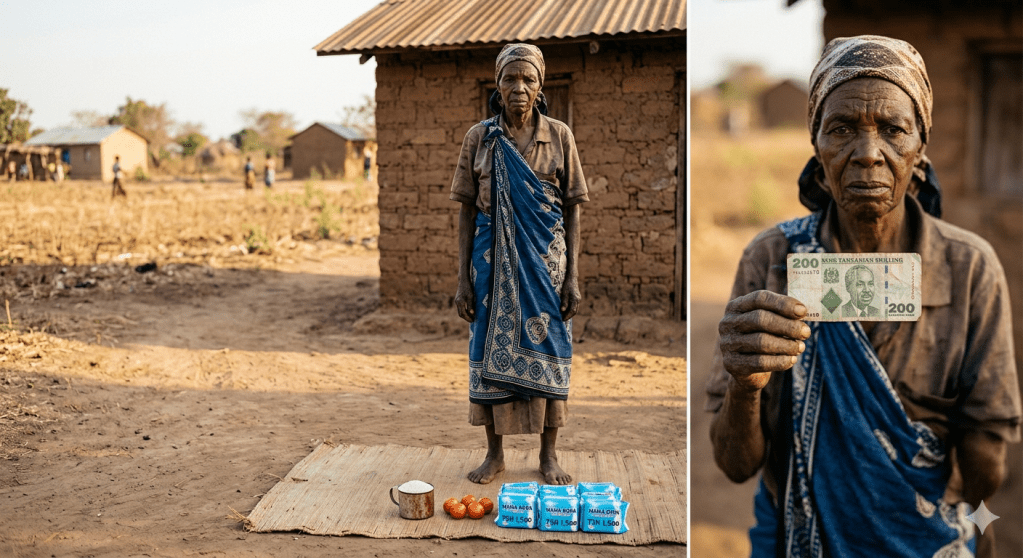
In Kenya, Uganda, and Tanzania, menstruation costs poor women up to 10% of their monthly income. Governments are watching and doing almost nothing.
I. The arithmetic of survival
Every month, Consolata Atieno faces a calculation she has never been able to solve cleanly. She earns approximately KSh 6,000 selling vegetables at Gikomba market in Nairobi, roughly $46. Her rent is KSh 2,500. Her children’s school lunch contributions take another KSh 800. And then there is the cost she does not mention first, the one she has managed through years of embarrassment and improvisation: her period.
A packet of sanitary pads in Kenya costs between KSh 50 and KSh 100, depending on the brand and the shop. Consolata needs at least three packets a month. That is KSh 300, 5% of her income, before she has bought food for herself. In months when work is slow, she uses strips of cotton fabric she washes and dries in secret.
“I don’t tell my children,” she says. “They would feel guilty. It is not their problem. It is just the cost of being a woman.”
II. What the data says
Across East Africa, the financial cost of menstruation falls almost entirely on women and girls, with no policy framework to address it. A 2024 survey by the African Population and Health Research Centre found that in low-income urban households in Nairobi, Kampala, and Dar es Salaam, women spend between 4% and 11% of their monthly disposable income on menstrual products and pain management.
Kenya removed VAT on sanitary pads in 2004, one of the first countries in sub-Saharan Africa to do so. But the tax relief has not translated into affordability. Distribution networks remain thin in informal settlements and rural areas. Counterfeit and substandard products flood markets where formal retail is absent. And nothing in the tax code addresses the lost income that comes with menstrual pain: a 2023 study published in the East African Medical Journal estimated that Kenyan women in the informal sector lose an average of 1.8 productive days per menstrual cycle, largely because they cannot afford adequate products.
At KSh 6,000 a month across 22 working days, each lost day costs Consolata roughly KSh 273. Over a year, that is more than KSh 5,800; almost a full month’s income evaporated not into poverty or laziness, but into a biological function the state has decided is a private matter.
“The tax was removed. The problem was not.” — Gender economist, University of Nairobi
III. Who is paying attention
Uganda introduced free menstrual pads in government schools in 2016. The program, run through the Ministry of Education, has been repeatedly underfunded and inconsistently delivered, but it exists. Tanzania has no equivalent. Kenya’s Dignity Fund, established in 2017 to provide subsidized pads through schools and hospitals, has been consistently underallocated. In the 2024–2025 budget, it received less than 30% of its requested funding, according to figures from the Institute of Public Finance Kenya.
The gap between policy intention and budget reality is where period poverty lives. Health ministries count it as a hygiene issue. Finance ministries do not count it at all. And so women like Consolata absorb a cost that is, in every meaningful sense, a tax on their biology.
“We talk about the gender pay gap as if it were only about wages,” says Dr. Wanjiru Kamau, a gender economist at the University of Nairobi. “But the cost of being a woman eats into income at every level. Period poverty is one of the most measurable examples and one of the least measured ones.”
IV. What accountability looks like
In March 2025, a coalition of Kenyan civil society organizations filed a formal petition to the National Assembly’s Committee on Finance, demanding a dedicated budget line for menstrual health in the 2025–2026 budget. The petition cited the Institute of Public Finance data and a separate analysis showing that fully funding the Dignity Fund would cost less than 0.01% of Kenya’s annual budget.
The petition was acknowledged. A response has not been issued.
Consolata does not know about the petition. She is at her vegetable stall before it opens and back home after dark. Policy, for her, is something that happens to other people.
What she knows is simpler: every month, the money she does not spend on pads is money she can spend on food. And every month, those two things compete.
“It should not be this way,” she says. “Half the world bleeds. Why is it still a secret problem?”
Data sources: African Population and Health Research Centre, 2024; East African Medical Journal, 2023; Institute of Public Finance Kenya, 2024–2025 budget analysis.





 Sure Media Magazine
Leave a comment