
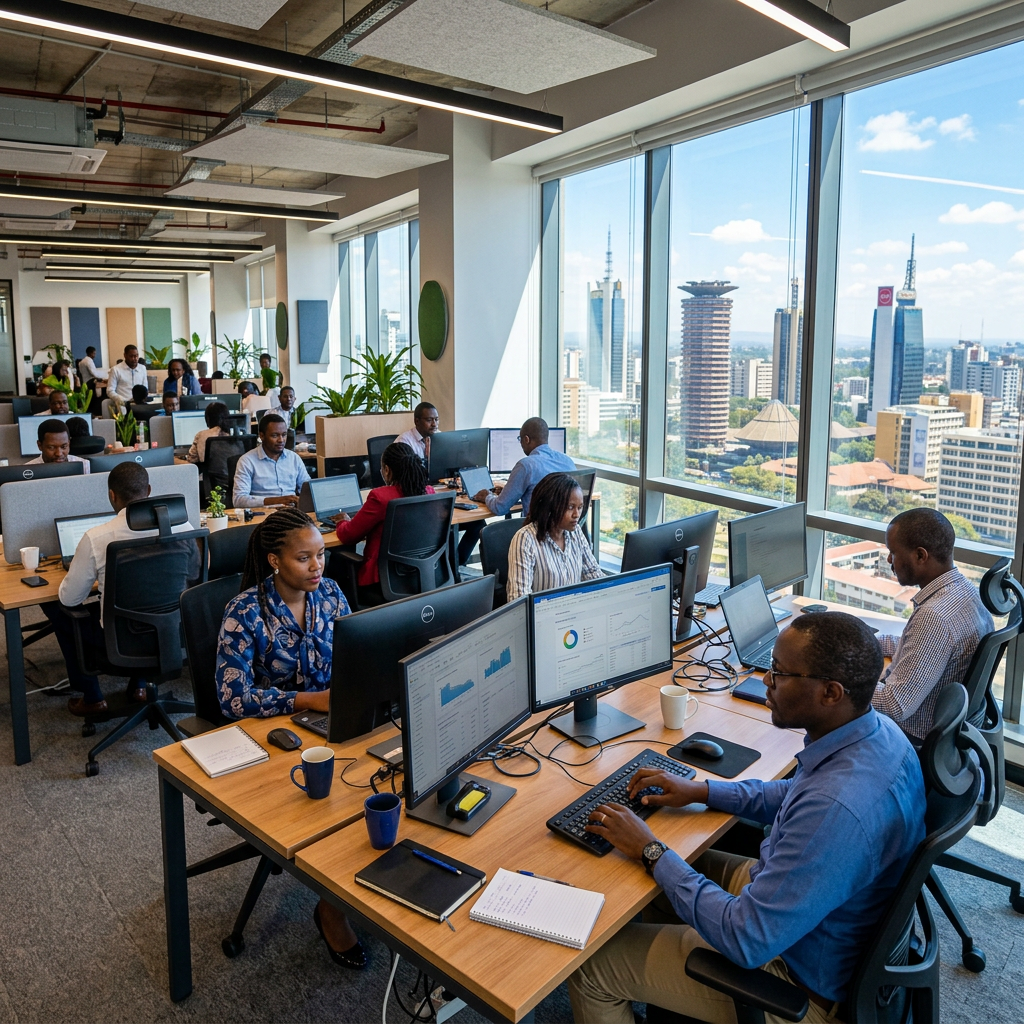
On the outskirts of Nairobi, in a quiet room lined with laptops, a group of young workers spend their day labeling images, reviewing text, and flagging harmful content.
Their task is simple to describe but difficult to sustain: teach machines how to see, read, and judge.
“We are the ones training the AI,” says one worker, who asked not to be named because of non-disclosure agreements. “But no one knows we exist.”
As artificial intelligence systems spread across industries from finance to healthcare, a less visible layer of the technology stack is expanding rapidly. Behind the algorithms is a growing workforce tasked with preparing, cleaning, and moderating the data that makes AI possible.
Kenya is emerging as one of its key hubs.
For global technology companies, the logic is straightforward. The country offers a young, English-speaking workforce; a relatively stable infrastructure; and labor costs significantly lower than in Western markets.
Outsourcing firms and data annotation companies have moved quickly to tap into that combination, positioning Kenya as a competitive destination for AI-related work.
What is being built, however, is not just a new outsourcing niche. It is part of a broader shift in how artificial intelligence is developed, one that relies heavily on distributed human labor.
“AI doesn’t run on code alone,” says a Nairobi-based industry analyst. “It runs on thousands of people making judgment calls every day.”
The work ranges from labeling datasets for machine learning models to moderating content used to train large language systems. Some tasks are repetitive and technical. Others are more complex—and more troubling.
Content moderators, for example, are often exposed to graphic or disturbing material as they filter data used to refine AI outputs.
Several workers describe long hours and psychological strain, with limited formal support structures in place.
The conditions echo earlier waves of outsourcing in countries such as India and the Philippines, where call centers and back-office processing became major industries. But there are notable differences.
In Kenya, the AI labor market is forming at speed, often ahead of regulatory frameworks that could define working standards or protections.
“There’s opportunity here, no question,” says a labor researcher focused on digital economies. “But the safeguards are still catching up.”
For workers, the appeal is clear. In a country where youth unemployment remains high, data annotation and AI-related roles offer a rare entry point into the global digital economy.
Many roles require limited formal experience, making them accessible to recent graduates and self-taught workers.
At the same time, pay levels and contract structures vary widely. Some workers are employed through third-party outsourcing firms, while others operate on short-term or task-based contracts.
The lack of standardization leaves many in a precarious position, particularly as demand fluctuates.
For the companies driving this demand, flexibility is part of the model.
AI systems require vast and constantly updated datasets. Outsourcing that work allows firms to scale quickly while keeping costs under control.
This dynamic is reshaping not only labor markets but also the geography of technological production.
While the most visible AI companies remain headquartered in the US and Europe, a growing share of the underlying work is being carried out elsewhere, often far from public scrutiny.
Kenya’s role in this system is still evolving, but its trajectory is clear.
Government agencies and private sector groups have begun positioning the country as a regional leader in digital services, with AI outsourcing seen as a potential growth sector. Training programs and partnerships are expanding to build a workforce capable of meeting rising global demand.
Yet the long-term implications remain uncertain.
If properly structured, the sector could create jobs, transfer skills, and anchor Kenya more firmly within global technology supply chains.
If left unchecked, it risks replicating the inequalities seen in earlier outsourcing industries where value accrues at the top, while the most intensive labor remains underpaid and underprotected.
Back in Nairobi, the workers continue their tasks—clicking, tagging, reviewing, shaping systems that will be used by millions, if not billions, of people.
Their contribution is essential but largely invisible.
“The AI gets smarter,” one worker says. “But our lives don’t change as fast.”
As artificial intelligence becomes more embedded in everyday life, the question is no longer just what these systems can do.
It is who is doing the work behind them and on what terms.




 Sure Media Magazine
Leave a comment