
Exploring the Rise of Digital Work, Its Opportunities, and the Realities Shaping Its Growth

Across the African continent, the structure of work is undergoing a gradual but significant shift. Where economic participation once depended largely on physical presence in offices, markets, and urban centers, new forms of work are emerging that rely instead on digital access and connectivity. This transition is reshaping not only how income is generated, but how individuals understand the idea of a career.
What is often described as the rise of “digital hustles” reflects a broader change in economic participation. Activities such as freelance work, digital product sales, online services, and remote employment are becoming increasingly visible across different regions. While these developments are sometimes dismissed as temporary or overstated, their continued growth suggests a more sustained transformation.
At its core, the digital economy has lowered certain barriers that traditionally limited entry into formal work. Participation no longer depends entirely on geographic location or access to physical infrastructure. Instead, individuals are able to engage with wider markets through relatively simple tools most notably smartphones and internet access. This has expanded the range of opportunities available, particularly for those who were previously excluded from conventional employment pathways.
Decentralized Work and Market Access
One of the most notable aspects of this shift is its decentralized nature. Work is no longer confined to specific locations, and the idea of the workplace itself is becoming more flexible. Across cities and smaller towns alike, individuals are engaging in economic activity that connects them to both local and international markets.
This decentralization has important implications. It allows individuals to participate in global economic systems without the need for migration or large financial investment. It also enables a wider distribution of opportunity, as work is no longer concentrated solely in major urban centers. However, access remains uneven, with infrastructure, connectivity, and affordability continuing to shape who can fully participate.
The Changing Role of the Household
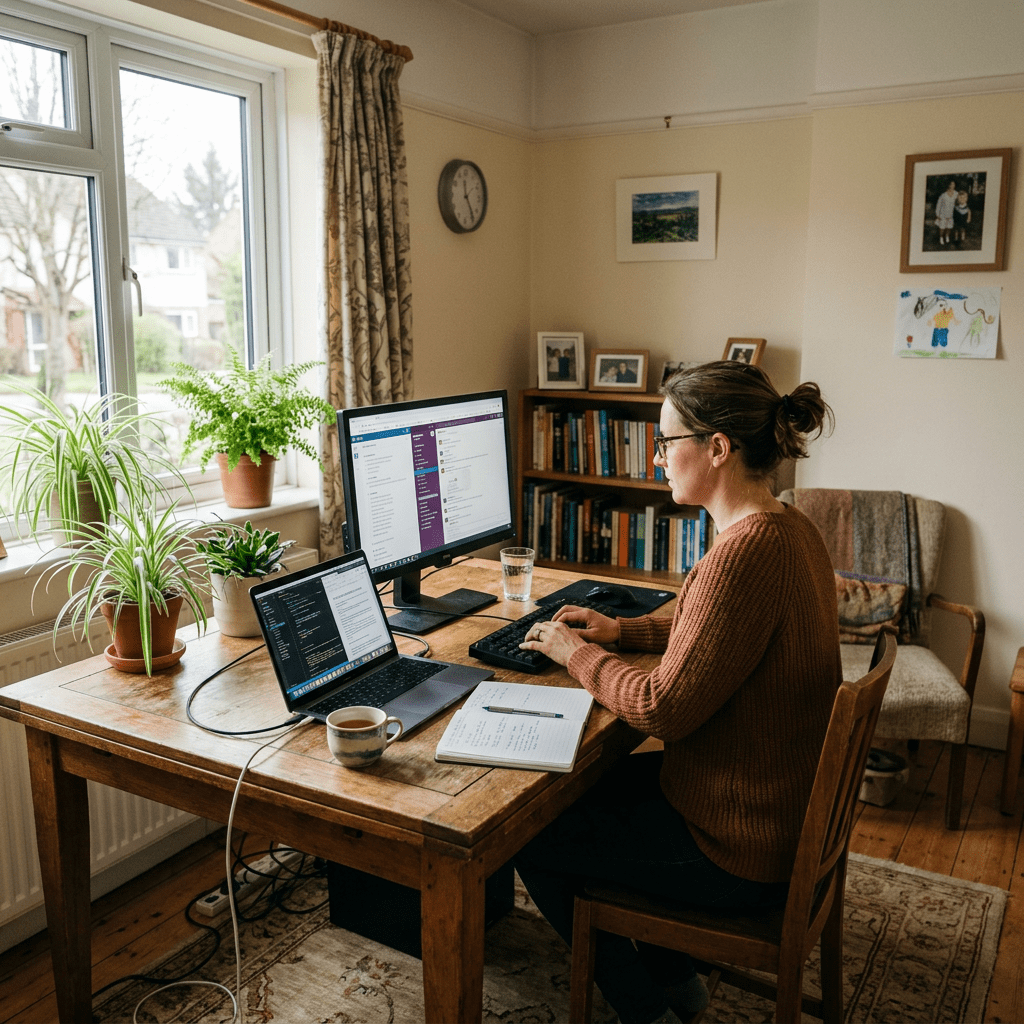
Alongside these structural changes, the boundaries between work and home are also shifting. For many households, the home is increasingly becoming a site of economic activity rather than solely a domestic space. This is particularly significant for women, who often navigate the dual responsibilities of income generation and caregiving.
Digital work has introduced new forms of flexibility that allow for a different balance between these roles. Rather than fitting life around rigid work schedules, individuals are able to organize work around existing responsibilities. While this does not eliminate challenges, it does create alternative pathways that were previously limited or unavailable.
Opportunities and Constraints
Despite its potential, the digital economy is not without its limitations. Income generated through online work can be unpredictable, particularly in the early stages. Competition is increasing as more individuals enter the space, and visibility often depends on platform algorithms that are not always transparent or consistent.
In addition, digital literacy and access to reliable internet remain uneven across the continent. These factors continue to shape who can benefit fully from emerging opportunities. As a result, while the digital economy expands access in some ways, it also introduces new forms of inequality that require attention.
Understanding this balance is essential. Framing digital work as either a guaranteed solution or a complete illusion oversimplifies a more complex reality. It is better understood as a developing space that offers real opportunities, but also demands adaptation, persistence, and ongoing learning.
Looking Ahead
The continued growth of digital work points to a broader reconfiguration of economic life across Africa. Traditional models of employment are no longer the sole framework through which individuals engage with the economy. Instead, a more flexible and varied system is emerging, shaped by technology, access, and changing expectations.
The significance of this shift lies not only in the tools being used, but in the expansion of possibilities. Individuals are increasingly able to participate in economic activity on their own terms, even within existing constraints. This does not replace the need for stable employment systems, but it does introduce additional pathways that can complement them.
As this transformation continues, the central question is not whether digital work is real, but how it will evolve. Issues of sustainability, equity, and long-term stability will become increasingly important as participation grows.



 Sure Media Magazine
Leave a comment