
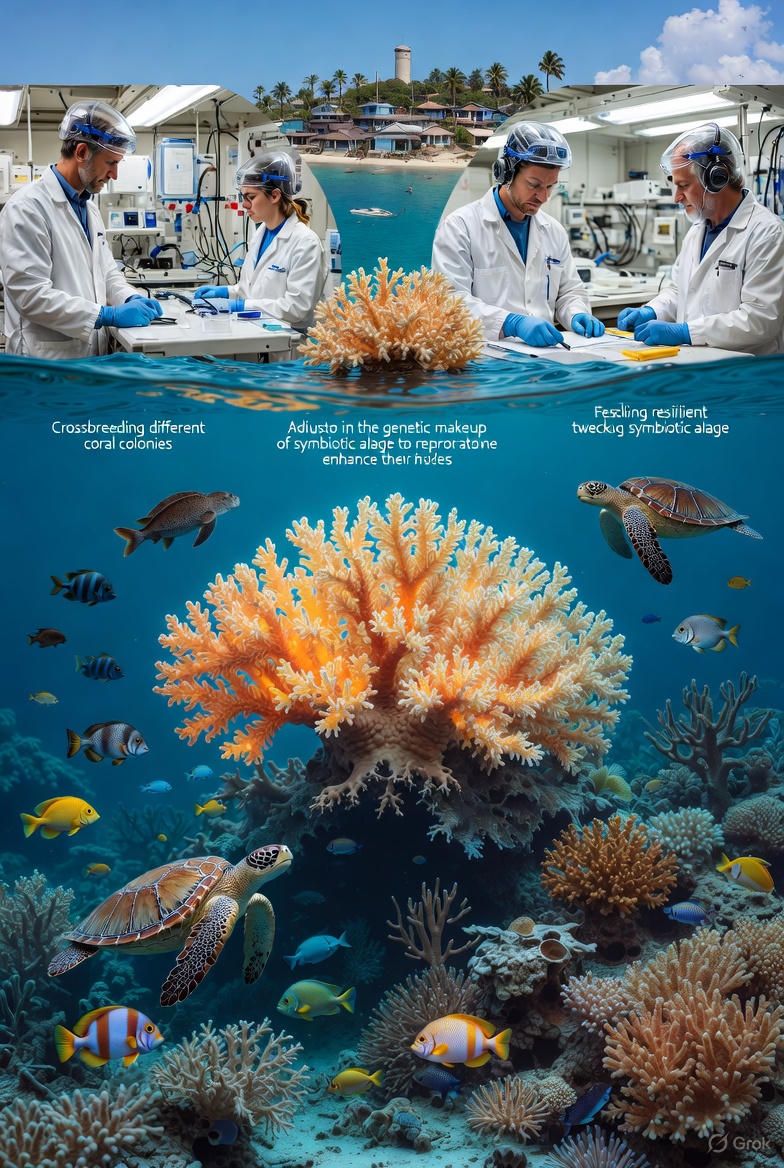
Coral reefs are among Earth’s most vibrant ecosystems, and they are vanishing fast. Rising ocean temperatures trigger mass bleaching events, turning colorful underwater worlds into ghostly deserts. But a new wave of scientists is racing to engineer heat-resistant “super corals,” using assisted evolution to accelerate nature’s adaptations and give reefs a fighting chance on a warming planet.
Around the world, researchers are crossbreeding resilient coral colonies and enhancing their symbiotic algae, the tiny partners that give corals their color and energy. These algae are often the first to fail during heat stress, so engineering tougher strains could determine whether reefs live or die. In Florida, NOAA’s Mission: Iconic Reefs program is breeding heat-tolerant hybrids like the “Flonduran” corals, created from Florida and Honduras lineages. Meanwhile, startups such as Coral Vita are growing corals up to 50 times faster in land-based nurseries using assisted evolution techniques.
The early results are promising. A 2025 study found that translocated super corals retained heat tolerance for more than a year, activating powerful DNA-repair pathways under extreme stress. Some species, such as rice coral, even pass heat resistance to their offspring through a form of biochemical inheritance. These breakthroughs suggest that engineered reefs could survive the oceans of 2050, recovering faster and bleaching less severely.
But coral is not a single organism. It is a complex biological city made of animals, algae, microbes, and minerals. Changing one part of that city can ripple unpredictably through the entire system. Releasing engineered corals into the wild raises a host of ecological questions: Could they outcompete natural corals? Reduce genetic diversity? Shift reef community balance in ways scientists can not yet predict? Researchers are calling for strong oversight to ensure innovation does not outpace caution.
The stakes could not be higher. More than 500 million people rely on reefs for food, tourism, coastal protection, and cultural identity. Without intervention, scientists warn that up to 90% of reefs could disappear by mid-century. Super corals are not just a conservation tool, they could be a critical pillar of global climate resilience.
Recent breakthroughs underscore the urgency. In 2025 alone, researchers developed heat-tolerant symbionts for elkhorn coral, deployed automated coral nurseries, and documented mass bleaching on every major reef system. Even the toughest natural corals are shrinking under extreme heat. Assisted evolution may be their only lifeline.
If successful, these efforts could one day restore reefs to their former brilliance, not as fragile relics of a cooler world, but as resilient symbols of a planet learning how to heal itself.




 Sure Media Magazine
Leave a comment