
SEO slug: africa-ai-sovereignty-infrastructure-data-centers-language-models
They Built a Power Grid. Now They’re Building a Brain.The Rift Valley has been heating Kenya’s homes for decades. It’s about to power something that might change who owns the future now.
The road into Olkaria that smells of sulphur.
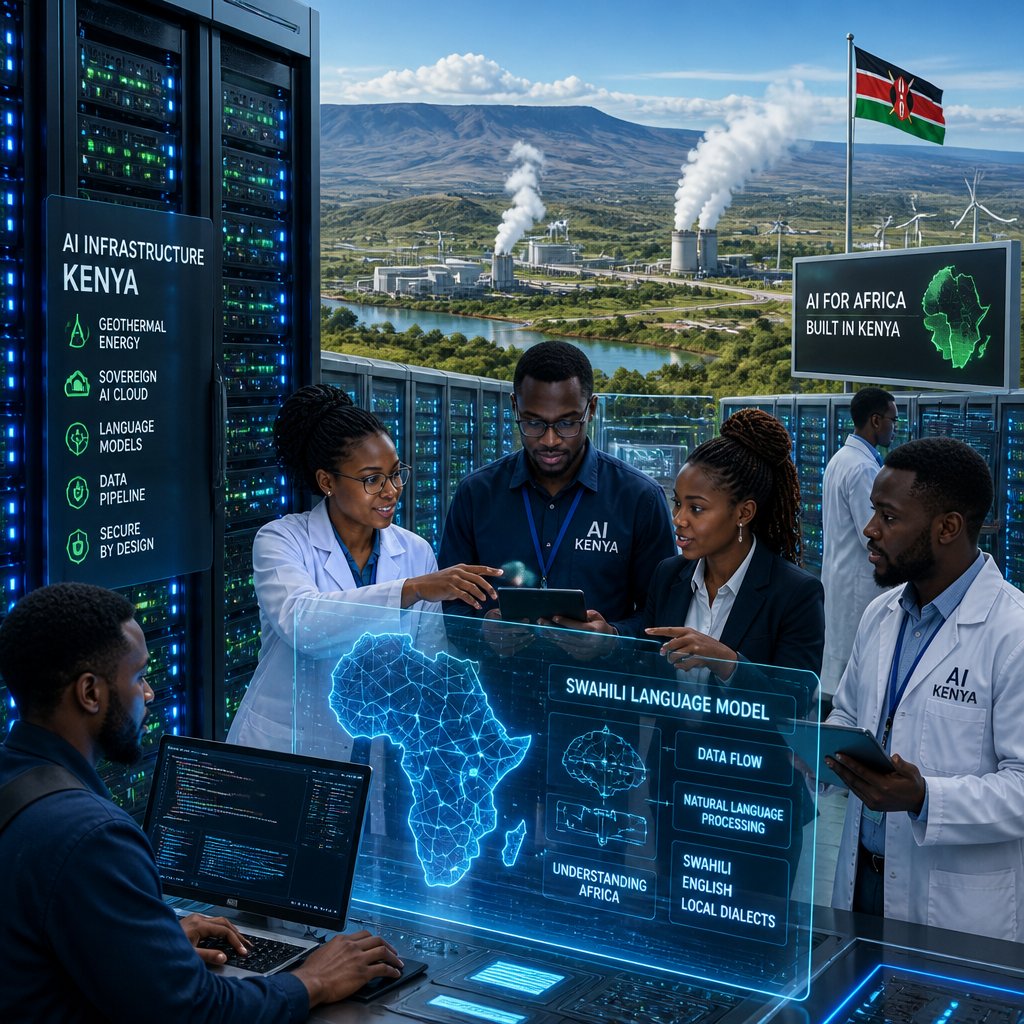
Not the faint chemical trace you notice and forget. The real thing, the kind that sits in your throat, rising from fissures in the Rift Valley floor where the earth is still deciding whether it’s finished forming. Kenya has been pulling electricity from this ground since 1985. Clean, cheap, geothermal power at the edges of the Great Rift, while the rest of the continent fought over diesel and coal. Now that same thermal heat is about to run a one-billion-dollar AI data center that Microsoft and UAE-based G42 are building specifically for artificial intelligence workloads, designed to host Kenya’s Azure East Africa Cloud Region and, alongside it, train large language models in both English and Swahili.
Read that again. Not a server farm. A facility purpose-built to develop AI, inside a country that cannot always keep its traffic lights on.
That gap is where the real story lives. And most of the world is still not looking at it.
The Numbers That Got Buried
The deficiency narrative about Africa and artificial intelligence writes itself every quarter. Poor infrastructure. Electricity gaps. The continent as perennial student. And so when the African Development Bank released its December 2025 flagship report estimating that inclusive AI deployment could add up to one trillion dollars to African GDP by 2035, roughly one-third of the continent’s current total economic output, the piece landed quietly in development finance circles and nowhere else. The report identifies agriculture, wholesale and retail, manufacturing, finance, and health and life sciences as the five sectors projected to absorb 58 percent of that gain. These are not speculative numbers from a conference slide deck. They emerge from a commissioned analysis under the G20 Digital Transformation Working Group, released by one of Africa’s most credible institutional voices.
The UN Economic Commission for Africa projects the continent’s AI contribution at 5.6 percent of GDP by 2030. UNECA Deputy Executive Secretary Mama Keita, speaking in Tangier in March 2026, framed that number as both an opportunity and a warning: the window for Africa to enter the foundational phase of global AI development is closing, and the cost of missing it is not measured only in dollars.
The private sector appears to believe her. Google launched its Johannesburg cloud region in 2025 following an investment close to $148 million. Microsoft committed approximately $300 million to expand cloud and AI infrastructure across South Africa through 2027, then added a further $285 million for Johannesburg and Cape Town, bringing its three-year South African total above $1.3 billion. Nigeria’s data center investment is projected to climb from $132 million in 2025 to nearly $770 million by 2031, per Arizton’s May 2026 market research. The Africa data center construction market as a whole is expected to hit $4.58 billion by 2031, growing at 24.26 percent annually.
These are not aid allocations. They are bets.
The Sovereignty Contradiction Nobody Names
Kigali, April 2025. Fifty-four signatories including the African Union endorsed the Africa Declaration on Artificial Intelligence at the inaugural Global AI Summit on Africa, committing to data sovereignty, distributed infrastructure, and a $60 billion Africa AI Fund to invest in talent, startups, and hardware. Cassava Technologies, the African-based global tech company, announced a $720 million partnership with Nvidia to build what it called Africa’s first AI Factory, deploying high-performance GPU clusters across Egypt, Kenya, Morocco, Nigeria, and South Africa.
On paper, that is a sovereignty story.
In practice, as Silicon Canals reported in May 2026, the largest single hardware line in a sovereignty fund is 12,000 Nvidia GPUs, designed in Santa Clara. Nigeria, Egypt, and Kenya have each released draft national AI policies explicitly naming dependence on Google, Microsoft, Nvidia, and Meta as a threat to security and national development, per Rest of World’s May 2026 reporting. Tay PeiChin, policy and program leader at the Tony Blair Institute, told Rest of World in February 2026 that the problem is not just who owns the data center but who manages it: in some North African cases, governments have built facilities only to outsource management to third parties who can, in her words, lock up the thing and throw away the keys.
African governments are not naive about this. They understand that in 2026, sovereignty is not a clean break from foreign hardware. It is a negotiating position: secure better terms now, build local datasets, retain engineers, develop the institutional capacity to refuse worse deals later. That is a more considered strategy than most external commentators have given credit for, which perhaps says more about the commentators.
Meanwhile, the data sovereignty gap runs deeper than who owns the building. African datasets represent roughly 1 percent of global data, despite the continent accounting for 17 percent of the world’s population, figures cited at the Kigali Summit. Every time African data is processed abroad, the economic value accumulates outside the continent. Researchers in Nairobi and Lagos are not unaware that this rhymes.
The Language Problem Is Also the Solution
More than 2,000 living languages exist across this continent. African languages collectively account for less than 0.1 percent of the text in standard AI pretraining datasets. English alone often constitutes more than 50 percent.
An AI that cannot understand Hausa, Yoruba, or Dholuo is not a general-purpose tool. It is a tool for someone else.
The response has been practical. Lelapa AI, the South African company founded in 2022, launched InkubaLM, described as Africa’s first multilingual large language model, trained on Swahili, Yoruba, IsiXhosa, Hausa, and isiZulu. A developer building a medical triage chatbot for a Lagos clinic does not have the luxury of waiting for a Silicon Valley team to get around to Yoruba. She trains on what exists, patches the gaps herself, and ships because the alternative is a tool nobody in her community can use. Michael Odokara-Okigbo, CEO of NKENNEAi, whose platform serves over 400,000 language learners, partnered with Nigeria’s National Information Technology Development Agency in March 2026 to build what he describes as the infrastructure layer for African language AI, covering Yoruba, Igbo, Hausa, Swahili, and Nigerian Pidgin. In February 2026, Google released the WAXAL speech dataset covering 21 Sub-Saharan African languages including Hausa, Luganda, Yoruba, and Acholi. “This provides the critical foundation for students, researchers, and entrepreneurs to build technology on their own terms, in their own languages,” said Aisha Walcott-Bryant, Head of Google Research Africa. The Nigerian government independently unveiled N-ATLAS in September 2025, an open-source language model capable of transcribing and generating text in Yoruba, Hausa, Igbo, and Nigerian-accented English.
MTN Group President and CEO Ralph Mupita put the stakes plainly at MWC Kigali: we cannot claim that no African has been left behind when our languages are not on the internet. The language work happening across Nairobi, Lagos, Cape Town, and Kampala is not cultural preservation. It is the prerequisite for AI that actually functions where people live.
What the Adoption Data Says
The Microsoft AI Economy Institute’s Global AI Diffusion Q1 2026 report provides numbers that cut against the exclusion narrative. South Africa’s generative AI adoption rate reached 23.1 percent of the working-age population in Q1 2026, up from 19.3 percent in the first half of 2025, placing it ahead of several European economies. A 2025 Fortinet survey found that 85 percent of African enterprises had invested in AI or planned to within three to five years. DeepSeek usage in Africa is estimated at two to four times higher than in other regions, according to the same Microsoft report, driven by the platform’s free access model removing cost barriers that made Western AI tools inaccessible to price-sensitive markets.
None of this is luck. Fifteen years of mobile-first computing built a behavioral architecture for technology on small screens, constrained data, and practical necessity. The same pragmatism behind M-Pesa is now shaping how AI gets absorbed into daily economic life. Africa did not skip the personal computer era because it was behind. It skipped it because mobile was already adequate. The pattern is repeating.
The Real Race
The African Development Bank warned that delays beyond 2030 could lock African systems out of the foundational wave of global AI development. The Kigali Declaration, the $1 billion Microsoft-G42 Kenya investment, the Lelapa AI language models, the Cassava Technologies GPU factories, the NKENNEAi partnership with NITDA: these are Africa’s answer.
They are not perfect answers. Some carry contradictions that will take years to work through, sovereignty declarations underwritten by foreign GPUs being the most obvious. But they are real, they are accelerating, and they are being built by people who have spent decades watching extraction operate at scale and are not interested in repeating the pattern with a different product.
Here in Olkaria, the ground still exhales heat through the fissures. The sulphur is still in your throat when you leave. And somewhere in the rock beneath the Rift Valley floor, the earth is powering machines that will help decide who writes the next century’s technology story, and in which languages they get to tell it.
Hatujawahi kuwa nyuma. We were never behind. We have always been building in a different direction, toward a destination the headlines have not yet thought to look for.





 Sure Media Magazine
Leave a comment