
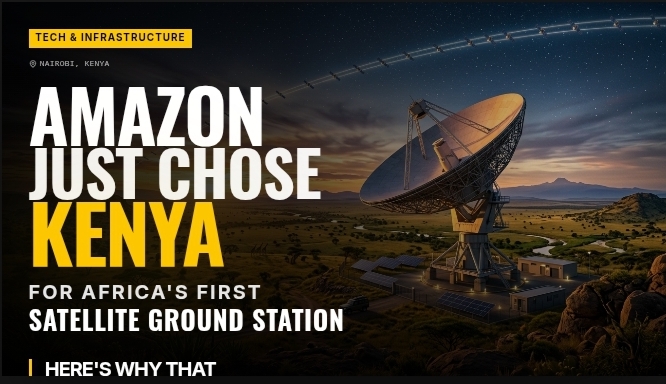
Here’s Why That Changes Everything.
SEO slug: amazon-leo-kenya-satellite-ground-station-africa
Kenya’s digital economy is about to gain an infrastructure anchor most African countries only read about in foreign tech journals. And it wasn’t built by anyone already here.
Nairobi has a particular relationship with firsts. The mobile money ecosystem that crossed the mainstream. The fintech that now processes transactions in eleven countries. The innovation district the world was calling Silicon Savannah before half of us had heard the term. Firsts accumulate here until you stop waiting for them.
Then Amazon picks Kenya for Africa’s first satellite ground station, and you feel it anyway.
The announcement came through a Kenya Gazette notice published on June 5, 2026, by the Communications Authority. Amazon’s local entity, Amazon Kuiper Kenya Limited, applied for a 15-year international gateway operator licence to build and run a satellite earth station and network control centre capable of moving internet traffic between Kenya and the rest of the planet. The project sits under Amazon Leo, the low Earth orbit internet network the company rebranded in November 2025 from Project Kuiper. This would be the first physical satellite gateway Amazon has applied to establish anywhere on the African continent.
The ground station is not just hardware. It is the missing piece between satellites running at 590 kilometres above Earth and the entrepreneur in Mombasa trying to close a contract, the student in Garissa joining a class she previously had no reliable way to attend, or the smallholder in Kisumu pulling weather data before planting. A ground station is where signals drop from orbit, convert into standard internet traffic, and push through fibre networks toward actual users. Build it in Kenya and East Africa absorbs the latency reduction directly.
Where the numbers get serious
Amazon Leo’s enterprise terminal, the Leo Ultra, is rated at download speeds up to 1,000 Mbps. The mid-range Leo Pro sits at 400 Mbps. Even a Nairobi user on the entry-level Leo Nano terminal receives up to 100 Mbps. Starlink, which launched in Kenya in July 2023 and currently holds 22,282 subscribers, the highest figure since entering the market, delivers 50 to 250 Mbps across most of its coverage zone. The ceiling Amazon is proposing for commercial users is roughly four times what Starlink reaches at its best.
The Communications Authority’s own sector data tells the current story. As of June 2025, Kenya’s total data subscriptions stood at 58.5 million, up 27.3 percent from the prior year. Of those, 4G accounts for 81.2 percent of broadband connections. Yet internet penetration remains at 40.5 percent of the population, per DataReportal’s Digital 2026 Kenya figures, which means more than 34 million Kenyans are still offline. The problem has never been appetite.
Safaricom’s fibre runs where it’s commercially worth laying. Starlink helped, but a seven-month freeze on new Nairobi activations starting November 2024, caused by congestion in a subscriber base that hasn’t broken one percent of the country’s fixed internet market, showed what happens when a single provider carries the weight alone. Kenya’s satellite internet market grew twenty-six-fold between 2022 and 2024 while total subscriptions grew just 18 percent, per the Kenya National Bureau of Statistics. The appetite is real and enormous. The infrastructure is still catching.
Amazon doesn’t arrive alone. It comes with a partnership already signed with Vodafone, Safaricom’s parent, to link Amazon Leo to existing 4G and 5G masts across the country. Approved, the ground station would operate as a regional hub, letting Amazon reach neighbouring East African markets from a single gateway. The 15-year licence duration is long enough to build something structural.
What the choice says about the continent
“Amazon’s application for a Kenya satellite gateway points to a broader effort to anchor African network operations closer to end users,” a June 2026 analysis by TechTrends Kenya noted. The framing matters. Kenya is not being selected as a concession market or a footnote at the far end of a rollout schedule. It is being selected as the anchor for an entire continent’s infrastructure layer.
That is a position with durable economic weight. The Communications Authority confirms that if the Nairobi gateway goes live, it would be Kenya’s third major satellite facility, alongside two stations already run by the Kenya Space Agency. The licence application covers the right to deploy ground infrastructure across all 47 counties using fibre backhaul and satellite-linked stations. Amazon must still apply for spectrum in specific locations, but the framework is continental in its ambition.
Kenya’s ICT sector has grown at an average of 10.8 percent annually over the past decade, per the U.S. Commercial Service’s Kenya Digital Economy country guide. The digital economy is on track to contribute 9.24 percent of GDP by 2025. Kenyan startups raised $638 million in 2024, close to 29 percent of the continent’s total venture capital, according to Tech In Africa. Those numbers describe a country that built a digital economy on mobile infrastructure. A satellite ground station rated at 400 to 1,000 Mbps for commercial users is the layer above that economy, the one that makes it globally competitive rather than just regionally prominent.
One tension remains unresolved in the public record. Telecommunications specialists cited by TechTrends Kenya in June 2026 raised concerns that higher-power satellite transmissions could disrupt existing wireless services if spectrum coordination is mishandled. Only around 100 dedicated LEO ground stations were operational worldwide at the end of 2025, per Deloitte. Kenya is applying to host one of them. How the Communications Authority handles the spectrum question will determine whether this country becomes the continent’s model or an expensive lesson in what not to do.
Staring at Nairobi’s skyline from Ngong Hills on a clear evening, you can see exactly why satellite infrastructure makes sense here. The city runs outward in every direction, its edges dissolving into suburbs, then into roads that thin into tracks, then into the vast interior where the fibre hasn’t come yet and a mobile mast stands alone against the horizon. Speed comes from orbit now, for millions of people in those spaces. Amazon noticed.
The application was filed April 17, 2026. The Gazette notice ran June 5. The world has a few weeks to catch up.




 Sure Media Magazine
Leave a comment