
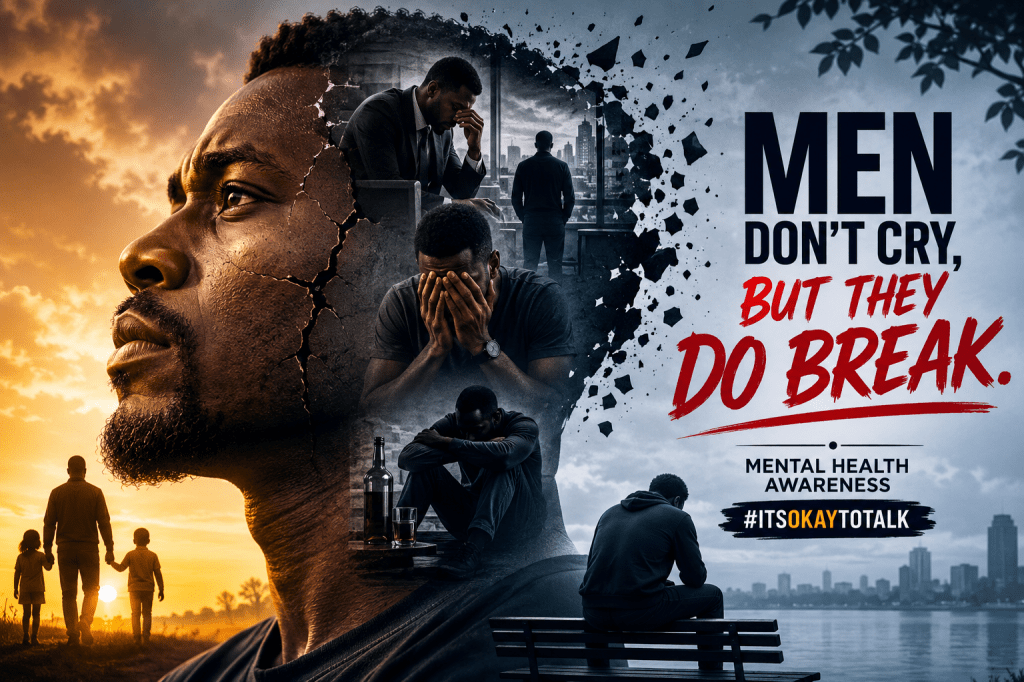
When strength is silence, and silence becomes a hidden mental health crisis
It is June again. In the mental health calendar, June marks Men’s Mental Health Awareness Month, a time meant to encourage men to speak, seek help, and challenge the silence surrounding emotional struggles.
But here is the uncomfortable question: how many men even know this month exists? And even if they do, how many believe it is a conversation meant for them?
For many African men, mental health feels like a conversation that happens at a distance, something discussed in seminars, social media posts, or among professionals, but rarely in homes, friendships, or everyday life.
Many men are struggling, but often in ways we do not immediately recognize.
They stop laughing. Work longer hours. Become quieter. More irritable. Start drinking more. Become angrier and slowly withdraw into themselves.
The family calls it stress. Friends call it “life.” Society calls it strength.
But this is often what emotional distress looks like in men.
Across many African communities, boys are raised with one message repeated in different ways: be strong. Do not cry. Do not complain. Handle your problems. Be a man!
Historically, maybe this made sense. Men were expected to physically protect families and communities from danger. Strength meant survival.
But today, the world has changed. Most men are no longer fighting wild animals or defending villages from attack. The battles now are quieter, heavier, and deeply personal: unemployment, financial pressure, heartbreak, burnout, loneliness, fatherhood stress, relationship breakdowns, and the exhausting pressure to always appear okay.
Yet somehow, the definition of masculinity has remained the same.
Men are still expected to provide, protect, endure, and lead; often while carrying burdens they were never taught how to talk about.
And so, many suffer silently.
Or rather, they suffer in a language we often fail to recognize.
A man who suddenly becomes harsh, unavailable, or detached may not always be “difficult.” Sometimes, he is emotionally exhausted and has no healthy vocabulary for pain.
This is not to excuse harmful behaviour. Pain should never become permission to hurt others.
But if we are serious about men’s mental health, we must become honest about how many men were taught survival before emotional awareness.
We raised many boys to be strong, but not emotionally safe.
So we should not be surprised when adulthood arrives, and many men struggle with emotional intimacy, accountability, or vulnerability.

Perhaps part of the challenge begins with how we raise boys.
How do you become emotionally available when vulnerability was treated like weakness?
How do you ask for help when silence was praised as maturity?
How do you become emotionally available in marriage if vulnerability always feels unsafe?
Maybe this is the moment we ask harder questions.
Is it time to redefine strength? Can strength mean asking for help instead of quietly drowning?
Can providing be redefined beyond money to include emotional presence, kindness, and consistency?
Can “protecting” mean creating homes where wives and children feel emotionally safe, instead of homes filled with anger, silence, fear, or emotional absence?
In 2024, Kenyan media personality Oga Obinna organised a men’s mental health walk, a reminder that men may be willing to talk when they feel safe enough.
The truth is, many men are not refusing help because they do not care.
Sometimes, they were simply taught that suffering quietly is what strength looks like.
But there is also some responsibility men themselves must carry in this conversation, be willing to unlearn silence, to acknowledge emotional strain early, and to seek help before breaking point.
Today, support is more accessible than ever, including psychiatric departments in all county referral hospitals and private facilities coming up.There are also virtual therapy options where men can speak to professionals without the pressure of physical presence or fear of being seen. Some men are already embracing these spaces, slowly redefining what help-seeking looks like.
At the same time, everyday conversations between men need to evolve beyond the usual focus on sports, business, work, women, and politics to also include emotional honesty. This is not a dismissal of these friendships but a recognition that men also need spaces where they can speak openly and figure things out for themselves.
Imagine what begins to shift when men are intentional about how they speak to one another.
When they can share their mental/emotional struggles.
When “I’m not okay” is met not with humour, discomfort, or silence, but with support.
Because healing does not happen only in therapy rooms. It is also shaped in the quieter, everyday spaces of brotherhood. where men can talk, reflect, and begin to find their own solutions together.
But maybe strength is not supposed to mean silence.
Maybe real strength sounds like: “I am not okay.”
And maybe the strongest thing we can do for the next generation of African boys is teach them that vulnerability is not weakness; it is part of being human.
Change begins with something simple: fathers asking sons harder questions, friends checking in beyond jokes and football, partners creating spaces where vulnerability feels safe, and men learning that asking for help is not failure.
Because strength should not cost men their peace, their relationships, or their lives.



 Sure Media Magazine
Leave a comment