

In eastern Uganda, Jewish life does not look like the version most people imagine when they think of the Jewish diaspora. It is not centred in Brooklyn, London, Paris, Buenos Aires or Tel Aviv. It lives in villages near Mbale, in schools where children learn Hebrew alongside the Ugandan curriculum, in synagogues where prayers move between Luganda, English and Hebrew, and in families who observe Shabbat in a region where Christianity and Islam dominate the religious landscape.
These Jews are known as the Abayudaya — “People of Judah” in Luganda. For more than a century, they have practised Judaism in East Africa. Their story begins with Semei Kakungulu, a Ugandan military and political figure who, after studying the Hebrew Bible, rejected Christian doctrine and embraced Jewish practice. In 1919, he declared that his community was Jewish. What followed was not a symbolic identification with ancient Israel, but a lived religious tradition: circumcision, Sabbath observance, dietary laws, prayer, Hebrew learning and, eventually, formal conversion under Conservative/Masorti Jewish authority.
Yet the question that still shadows the Abayudaya is brutally simple: if a community lives as Jews, studies as Jews, prays as Jews and converts through recognised Jewish movements, who gets to decide whether they are Jewish enough?
That question is no longer theoretical. It has passed through Israeli bureaucracy, the Jewish Agency, rabbinical movements, the High Court of Justice and the life of one Ugandan Jew, Yosef Kibita, whose long battle for Israeli citizenship became a test case for African Jewish belonging.
Kibita’s story exposed one of the most sensitive fault lines in the Jewish world: the gap between religious recognition, communal acceptance and state power. The Jewish Agency recognised the Abayudaya as a Jewish community in 2016, a move widely understood to make members eligible for immigration to Israel under the Law of Return. But Israel’s Interior Ministry later rejected Kibita’s aliyah application, arguing that his conversion had not taken place within a recognised Jewish community at the relevant time.
The circular logic was painful. The Abayudaya could not be recognised because their conversions had occurred before full recognition. But their conversions were part of the very process by which they entered global Jewish life. For a community built through study, faith and formal religious commitment, the message sounded like a moving target: you may be Jewish to your rabbis, to your community and to much of the diaspora, but not necessarily to the state that claims to speak for Jewish return.
Kibita eventually won. In 2024, after years of legal struggle and multiple conversion processes, he became the first Abayudaya member recognised for aliyah. But his victory did not settle the larger question. If anything, it sharpened it. Was Kibita an exception, or the beginning of recognition for a wider African Jewish community? And why did one observant Jew from Uganda have to fight so much harder than many immigrants with distant Jewish ancestry?
The Abayudaya are not the only Jews in East Africa. In Kenya, the Nairobi Hebrew Congregation has stood for more than a century and describes itself as the only operating synagogue in East Africa. Its community reflects a different Jewish history: European settlers, Sephardic and Ashkenazi families, Israeli diplomats and businesspeople, Jews from Yemen, Iraq, India, Morocco, South Africa and native-born Kenyan Jews. In recent decades, it has also become a meeting point for the changing reality of Jewish life in Africa: older diaspora families, Israeli expatriates, visitors, converts and Africans drawn to Judaism through study and conviction.
This makes East Africa one of the most revealing places to ask who belongs in the Jewish world. In Nairobi, Jewish identity is tied to migration, colonial history, Israeli diplomacy and a small but enduring synagogue community. In Uganda, it is tied to African religious self-definition, conversion, village life and a century of practice. In both places, Jewish life exists far from the traditional centres of Jewish power.
That distance matters. Jewish recognition has never been only theological. It is also racial, historical, political and bureaucratic. A Jew from New York, Paris or Moscow may enter the global Jewish conversation with assumptions of familiarity. An African Jew often enters with suspicion attached: Are they really Jewish? Did they convert properly? Are they seeking faith, aid, visas or migration? These questions may sometimes be framed as administrative caution, but they land as a deeper wound — the implication that African Jewish identity must be proven more rigorously than others.
The Abayudaya make that suspicion difficult to sustain. Their community has rabbis, synagogues, schools, Jewish education, holiday observance and international relationships. Their spiritual leader, Rabbi Gershom Sizomu, was ordained in the United States through the Conservative movement and became a prominent religious and political figure in Uganda. The community has survived persecution, including during Idi Amin’s rule, when open Jewish practice was suppressed. It has been rebuilt through local commitment and global Jewish support.
Still, recognition has remained uneven. That is partly because the Abayudaya do not fit into the dominant Jewish origin story. They do not claim descent from ancient Israel in the way Ethiopian Jews historically have. Their Judaism is rooted in choice, study and conversion. But Judaism has always included converts. The Book of Ruth is central to Jewish tradition precisely because it honours chosen belonging. The problem, then, is not conversion itself. The problem is which converts are treated as natural additions to the Jewish people and which are treated as demographic threats.
This is where the African dimension becomes unavoidable. Black Jews around the world have often had to defend the legitimacy of their Jewishness against assumptions that Jewish identity is white, European or Middle Eastern. African Jews disturb that visual grammar. They force the Jewish world to separate Jewish authenticity from race, geography and inherited expectation.
The question also reaches beyond Uganda. Across Africa, small Jewish communities and Jewish-identifying groups are growing, studying, converting and seeking connection with global Judaism. Some are deeply rooted in religious practice; others are newer and more fragile. Not every claim of Jewish identity will be accepted by every movement or by Israel. But the Abayudaya case shows why the process must be transparent, consistent and respectful. When recognition feels arbitrary, it damages not only the community seeking acceptance but the moral credibility of the institutions doing the judging.
For Israel, the stakes are particularly high. The Law of Return is one of the state’s foundational promises: that Jews anywhere in the world have a home in Israel. But the law depends on a prior question — who counts as a Jew? When that answer is shaped by inconsistent bureaucracy, denominational conflict or anxiety about converts from poorer countries, the promise becomes conditional in ways that are hard to defend.
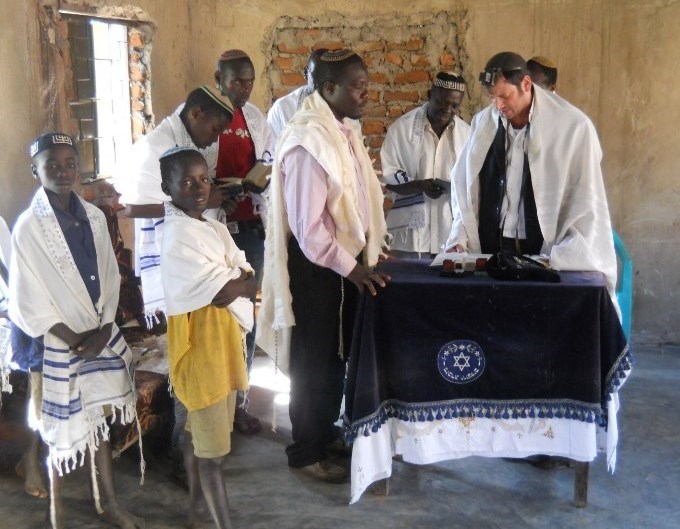
ِLocal and foreign Rabbis pray in the synagogue of Puti next to Mbale
For the Abayudaya, the question is both spiritual and practical. Recognition affects the ability to study in Israel, immigrate, marry, participate in global Jewish institutions and be treated as part of the Jewish people without endless explanation. But even without Israel’s approval, their Jewish life continues. Children still study Hebrew. Families still prepare for Shabbat. Synagogues still gather. Holidays still mark the calendar. Jewish identity, in this sense, is not granted from Jerusalem; it is lived in community.
That is what makes the story powerful. The Abayudaya are not asking the Jewish world to invent a new category for them. They are asking whether the categories the Jewish world already claims to honour — study, observance, conversion, peoplehood, covenant — apply equally when the Jews in question are African.
The answer will shape more than one Ugandan community. It will reveal whether global Jewish belonging is expansive enough to include Jews whose history does not begin in Europe, whose Hebrew carries an African accent, whose synagogues stand beside banana trees and coffee farms, and whose claim to Judaism comes not through bloodline but through a century of chosen faith.
In the end, the Abayudaya challenge the Jewish world with a question older than the modern State of Israel and larger than any ministry file: is Jewish peoplehood a closed inheritance, or a living covenant?



 Sure Media Magazine
Leave a comment