
SEO slug: gikomba-market-traders-digital-transformation-kenya
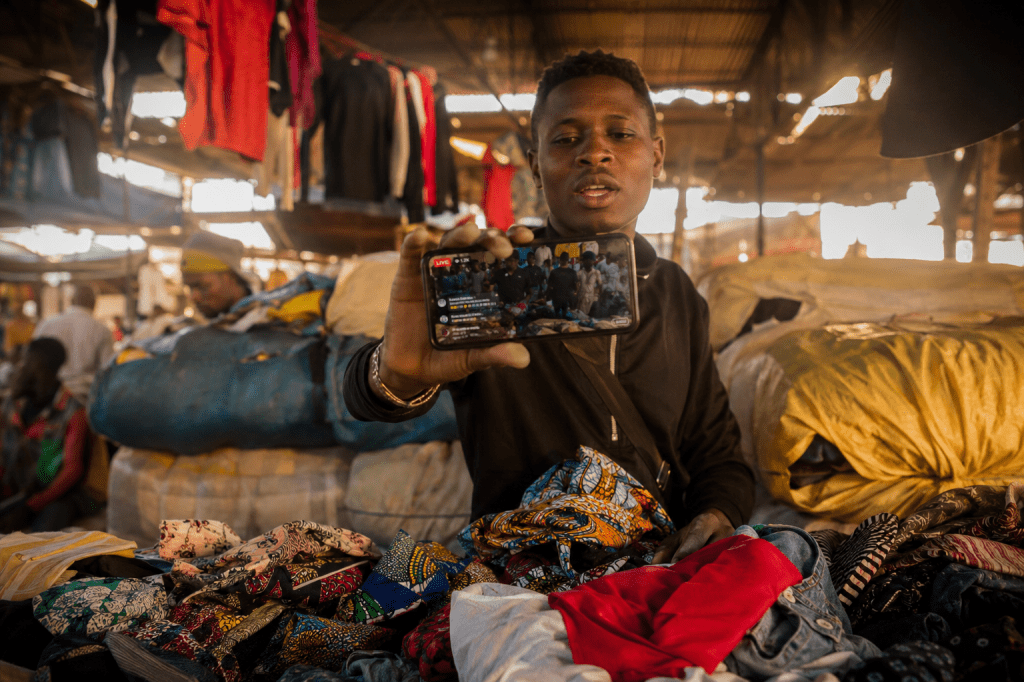
The livestream starts at 6:15 a.m. A hand cuts through the plastic binding of a bale just arrived from a Manchester warehouse. Coats, blazers, denim jackets spill onto a tarpaulin spread across a concrete floor somewhere inside Nairobi’s Gikomba Market. Within forty seconds of that blade hitting plastic, two thousand people are watching. A North Face jacket surfaces. The comments detonate.
That is not a technology story. That is a survival story. And inside East Africa’s largest open-air market, it is playing out on every aisle, every morning, before Nairobi has finished its first cup of chai.
Gikomba has never been easy to love. The market, tracing its roots to the 1950s along the banks of the Nairobi River, has survived bulldozers, bombings, and fires that would have finished smaller institutions. By 2024, the government counted 100,000 people working within its borders. It draws more than 200,000 visitors daily, generating an estimated Sh80 million monthly in county revenue, according to reporting by the Daily Nation in 2026. It supplies mitumba, the Swahili term for second-hand clothing imported in bulk from Europe, North America, and Asia, to retailers across all 47 counties and into Uganda and Tanzania. Gikomba is not a market. It is infrastructure.
But infrastructure burns. In 2021, a single fire destroyed more than 900 stalls. In 2025, Nairobi County unveiled a new seven-storey complex, Gikomba Quarry Road Market Block D, built to house 1,700 traders after decades of catastrophic loss. A well-intentioned answer to a physical problem. The traders, however, had already found a different solution.
They had moved online.
The screen is the new stall
The simplest way to understand what is happening at Gikomba is this: traders have stopped waiting for customers to walk past them. They are broadcasting to customers everywhere at once.
Kenya had 10.6 million TikTok users as of 2025, per DHL Kenya’s industry report on secondhand fashion, and Gikomba’s traders have made that platform their primary storefront. The mechanism is not complicated. A trader opens a bale live. Viewers watch in real time. Whoever comments first and pays via M-Pesa wins the item. A premium-grade leather bag that might sit on a physical stall for three days sells in under a minute. The scarcity is real and visible. The urgency manufactures itself.
Alex Kimani, known professionally as Jamal, runs Jamaldeen Collection out of Kilimani, sourcing designer handbags from Gikomba each morning before most traders have unlocked their stalls. He built the operation entirely on TikTok. “TikTok is what built me as a brand,” Kimani told Business Daily in April 2025. “It’s what built this shop.” A single piece from his curated haul routinely fetches between Ksh 50,000 and Ksh 100,000. The bale he pulled it from may have cost Ksh 800.
Instagram runs a parallel operation. While TikTok handles volume and urgency, traders use Instagram to build aesthetic identity. Washed, ironed, and properly photographed vintage pieces are priced at rates that rival retail boutiques. The item has not changed. The presentation has. Presentation, it turns out, is worth serious money.
The money moves before the goods do
None of this works without payment infrastructure, and Kenya has the most sophisticated mobile money ecosystem on the continent. M-Pesa processes more than $50 billion in transactions annually, according to Market Data Forecast’s 2024 Africa Mobile Money report, and serves 31 million active users in Kenya alone. Mobile money penetration exceeds 82% of Kenya’s adult population, the highest figure anywhere in Africa.
By 2024, mobile money-only payments for daily and monthly expenses had jumped from 5.3% of Kenyan consumers in 2021 to 30.7%, according to Financial Sector Deepening Kenya’s 2025 analysis of Global Findex data. Cash-only reliance dropped from 48% to 27.1% across the same period. In Kenya, 55.8% of adults now make digital payments to businesses, against 11.7% in Uganda and 3.9% in Tanzania. These are not marginal differences.
For Gikomba traders, the practical effect is immediate and clean. A customer in Kisumu watches a livestream from Nairobi. She claims a jacket. She pays M-Pesa. The confirmation arrives within seconds. The item is tagged, packed, and handed to a boda-boda courier for same-day dispatch, or loaded onto an overnight matatu to reach her by morning. A transaction that once required physical presence, cash in hand, and aggressive haggling across a crowded stall now completes from two different cities on two different screens.
Beyond payments, the digital footprint is doing something the physical stall never could. Traders running their sales through digital accounts generate transaction histories that algorithmic lenders can read. Where a bank once demanded title deeds and payslips from informal traders who had neither, digital lenders now read consistent M-Pesa flows as proof of capacity. Credit follows data. Data follows digitization.
The road from bale to doorstep
Kenya imported 230,535.3 tonnes of second-hand clothing in 2024, according to the Kenya National Bureau of Statistics 2025 Economic Survey. That is an enormous supply chain moving through Gikomba every week, and it now connects to a logistics network that would have been unrecognizable five years ago.
The boda-boda courier network has been absorbed into last-mile fulfillment almost entirely through informal but reliable channels. Trusted riders develop steady relationships with specific traders. A trader who sells fifty items in a single livestream does not scramble for delivery; she calls her rider. He is probably already on his way. For destinations across Kenya, matatus and overnight bus services handle the movement. Monica Akinyi, founder of Trendy Thrifts Kenya, described the pressure this creates in a February 2025 DHL report: “When a customer sees something they like on TikTok, they want it immediately.”
Some traders have moved further still, coordinating directly with suppliers in the United Kingdom and China, cutting out local middlemen, managing cross-border sourcing from a smartphone. The physical stall in Gikomba, once the center of the operation, is becoming a fulfillment warehouse. The center has shifted to wherever the phone is.
What the county is building, the traders already built
Nairobi County’s Ksh 259.7 million investment in a new Gikomba complex is a meaningful commitment. The 2021 fire made clear that the market’s physical vulnerability was not acceptable. But here is what is worth pausing on: while county planners were drawing seven-storey blueprints, the traders were constructing an entirely different kind of structure out of pixels, phone credit, and trusted delivery riders.
The informal sector accounts for 83.6% of total employment in Kenya, per the KNBS 2025 Economic Survey. These are people whom formal infrastructure has historically reached last and served least. What Gikomba’s digital pivot shows is what happens when those same people gain direct access to tools that are genuinely useful at a price point they can afford. A smartphone. A data bundle. A TikTok account. The barrier is low. The reach is national.
Brian Nyambura, the 22-year-old known on TikTok as Nash, started by posting navigation videos about Gikomba, guides to its corridors and price zones, before pivoting to direct selling. His path maps the logic of the shift precisely: the same platform that taught outsiders how to navigate the market is now used by insiders to bypass it entirely.
Kwa ground, everything is different
I have walked through Gikomba at 5 a.m., when the bales arrive and the prices are lowest and the light is still dark enough to hide the mud. The market smells of rain-soaked fabric and kerosene, and the sound is a specific kind of noise that does not exist anywhere else in Nairobi, a percussion of haggling and handcarts and roosters from the adjacent residential blocks. It is chaotic in the way that works. It runs on relationships built across years, between traders who know exactly whose bale contains what and riders who know which road to take when Jogoo Road is blocked.
What the digital tools have done is not replace that world. They have extended it. The trader livestreaming her bale opening at 6 a.m. is still in Gikomba, standing on the same ground, drawing on the same knowledge of what grade-A stock looks like and what buyers in Mombasa want right now. The camera is the longest corridor in the market. The one that reaches everywhere.
Kenyans imported nearly a quarter of a million tonnes of second-hand clothing last year, more than any previous year on record. That number will not fall. The trade is not going anywhere. But where it lives, how it operates, who it serves, and who it profits, those things are changing fast and permanently, on the streets of a market that has already burned and rebuilt itself more times than anyone should have to count.
The seven-storey building is being constructed for a Gikomba that partly still exists. The one that definitely exists has already moved to your phone.




 Sure Media Magazine
Leave a comment