
As antisemitism and anti-Palestinian racism collide on American campuses, the people asked to keep the peace are being forced to decide whose fear counts, what speech is protected, and when politics becomes harassment.
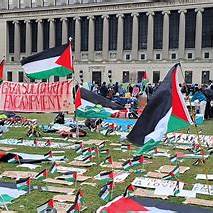
Palestinian flags at the Gaza Solidarity Encampment at Columbia University, April 2024. The campus protests became a flashpoint in debates over antisemitism, anti-Palestinian racism, free speech and student safety.
On an American campus after October 7, the hardest job is not always held by the university president whose congressional testimony goes viral, or the student protester whose slogan becomes a national controversy. Often, it belongs to the people whose names rarely make headlines: the student-union chair trying to keep a divestment vote from collapsing into accusation; the chaplain comforting Jewish and Palestinian students on the same afternoon; the security officer deciding whether a protest chant is disruptive or threatening; the dean of students trying to explain why one poster was removed and another allowed to stay.
They are the campus moderators of a conflict that is no longer only about Israel and Gaza. It has become a test of how diaspora communities live together when the language of identity, grief, nationalism, racism and free speech breaks down.
Across the United States, universities have spent more than two years trying to manage an impossible triangle: protecting Jewish students from antisemitism, protecting Palestinian, Arab and Muslim students from anti-Palestinian racism and Islamophobia, and protecting political speech even when that speech is offensive, painful or morally charged. The result is a campus atmosphere in which almost every institutional decision is read as a declaration of allegiance.
For many Jewish students, the fear is not theoretical. The Anti-Defamation League’s 2025 audit recorded more than 6,000 antisemitic incidents across the United States, making the year one of the worst since the organisation began tracking such incidents in 1979. Incidents on campuses fell from the previous year’s extraordinary high, but they remained far above prewar levels. For students who wear a Star of David, attend Hillel, identify as Israeli, or are simply known as Jewish in class, the question is often basic: Can I be visibly Jewish here without becoming a target?
For Palestinian, Arab and Muslim students, the fear is different but no less real. Many say universities have responded to concerns about antisemitism by treating Palestine-related speech as inherently suspect. A keffiyeh becomes a warning sign. A vigil becomes a security concern. A slogan becomes evidence in a disciplinary file. A student who uses the word “genocide” may find themselves asked to explain whether they meant to threaten Jewish classmates. Civil-rights groups have documented complaints of chilled speech, doxxing, surveillance, discipline and fear among students advocating for Palestinian rights.
The hardest part is that these fears do not cancel each other out. They coexist, often in the same hallway.
A Jewish student may hear “Zionists off campus” not as criticism of a state but as a message that they do not belong. A Palestinian student may hear mandatory antisemitism training not as protection for Jewish peers but as an institutional warning that their own grief is dangerous. A university may say it is enforcing neutral rules, while students on both sides see selective punishment. A protest may be described by one group as a moral witness and by another as intimidation.
This is the crisis beneath the visible crisis. The public sees tents, arrests, slogans, donors and congressional hearings. Campus moderators see the daily consequences: students skipping class, chaplains overwhelmed, friendships destroyed, faculty afraid to teach, administrators rewriting policy under pressure from Washington, alumni, trustees and lawyers.
The argument is often described as a free-speech debate, but that phrase is too clean for what is happening. Universities are not only deciding whether students may speak. They are deciding what speech means when it lands on communities already in pain.
The phrase “from the river to the sea,” for example, can be heard by some Palestinian students as a demand for liberation and equal rights, while many Jewish students hear it as a call for Israel’s elimination. “Globalise the intifada” can be defended as a slogan of resistance and condemned as a threat. “Zionism is racism” can be framed as a political critique or experienced as a rejection of Jewish self-determination. Even the word “genocide” has become a campus fault line: for pro-Palestinian students, it may describe the scale of Palestinian suffering in Gaza; for many Jewish and Israeli students, it may feel like an accusation that collapses their identity into criminality.
The moderator’s task is to ask the question that activists often reject: not only what did the speaker intend, but how did the words function in that space, at that time, toward those people?
That is a narrow path. If universities punish too broadly, they risk suppressing political advocacy, especially Palestinian advocacy. If they intervene too little, they risk allowing harassment and intimidation to be normalised. If they define antisemitism in a way that treats most anti-Zionist speech as anti-Jewish hate, Palestinian students may be silenced. If they define antisemitism too narrowly, Jewish students may be left to navigate hostility that is obvious to them but invisible to administrators.
In practice, this has produced a culture of mutual suspicion. Jewish students ask why their institutions reacted slowly to harassment, vandalism or exclusion. Palestinian students ask why their institutions respond quickly to pro-Palestinian activism but slowly to anti-Palestinian slurs, doxxing or physical threats. Administrators insist they are applying rules. Students insist the rules bend according to politics.
The federal government has intensified this pressure. The U.S. Department of Education has opened and publicised investigations into universities over alleged failures to protect Jewish students from antisemitic harassment and discrimination. That scrutiny has made campus leaders more alert to antisemitism, but it has also created fear that universities may overcorrect by treating Palestine activism itself as a compliance risk.
The danger is not only censorship. It is institutional incoherence.

Pro-Israel counterprotesters attend a pro-Palestinian protest at the University of Texas at Austin, April 2024. The same campus spaces have become sites of fear, grief and competing claims to safety.
A student government may approve a resolution calling for divestment, only to have administrators condemn the process. A professor may be investigated for speech that would once have been considered protected political expression. A student group may be suspended for protest activity while another group sees its complaints dismissed as merely political disagreement. Security may be increased around Jewish spaces, while Palestinian students interpret the same security presence as surveillance of them.
For chaplains, the work is especially delicate. Jewish chaplains may be supporting students who feel abandoned by progressive peers and frightened by the casualness with which Jewish pain is dismissed. Muslim chaplains may be supporting students grieving mass death in Gaza while feeling that their mourning has been treated as extremism. Interfaith staff may find that dialogue itself has become suspect: too soft for activists, too political for administrators, too painful for students who want recognition before reconciliation.
This is where the campus becomes a mirror of the wider diaspora. American Jews are divided over Israel, Zionism, safety, protest and the meaning of solidarity. Palestinian, Arab and Muslim communities are demanding that their suffering be recognised not as a footnote to antisemitism debates but as a civil-rights issue in its own right. Universities are caught between these demands, often lacking the language, trust or courage to address both honestly.
The easy institutional answer is symmetry: condemn antisemitism, condemn Islamophobia, praise dialogue, promise safety. But the reality is not symmetrical in experience. Jewish students and Palestinian students are not interchangeable victims in a public-relations script. Their histories, fears and vulnerabilities are different. Yet a university that recognises only one vulnerability will deepen the other.
That is why the people in the middle matter. The student-union leader who insists that both Jewish and Palestinian students be allowed to speak may be accused of cowardice by both sides. The administrator who allows a protest may be accused of enabling hate; the administrator who restricts it may be accused of repression. The chaplain who comforts a Zionist student and a Palestinian student in the same week may understand better than any president that this conflict has entered the intimate life of the campus.
The question for universities is no longer whether they can make everyone feel comfortable. They cannot. The question is whether they can create rules that are principled enough to survive pressure, precise enough to distinguish speech from harassment, and humane enough to recognise that students are not merely debating foreign policy. They are carrying identity, family history, fear and grief into classrooms, dormitories and dining halls.
That requires more than crisis management. It requires universities to say clearly that antisemitism is real and must not be minimised when it appears in anti-Israel spaces. It also requires them to say clearly that Palestinian identity, Palestinian mourning and advocacy for Palestinian rights are not inherently antisemitic. It requires administrators to protect Jewish students without making support for Palestine presumptively suspect, and to protect Palestinian students without dismissing Jewish fears as bad faith.
It also requires honesty about language. Zionism is not one thing to all Jews. Anti-Zionism is not one thing to all Palestinians. A slogan can be protected speech and still be morally reckless. A protest can be disruptive without being discriminatory. A complaint can be sincere even when the remedy demanded is dangerous. A university can defend free speech and still condemn bigotry.
The campus moderator’s job is impossible if institutions pretend these distinctions are easy.
The people trying to keep the peace are not neutral because they feel nothing. They are neutral, at their best, because they understand that a campus cannot survive if safety is granted only to the side with the better lawyer, louder donor, stronger political patron or more viral video.
Their work is procedural, emotional and deeply moral. They must decide who gets the microphone, who gets protection, who gets disciplined, who gets believed, and who gets to belong.
That is why the story of this campus moment should not begin with the loudest chant. It should begin with the person holding the room together after the chant ends.



 Sure Media Magazine
Leave a comment