
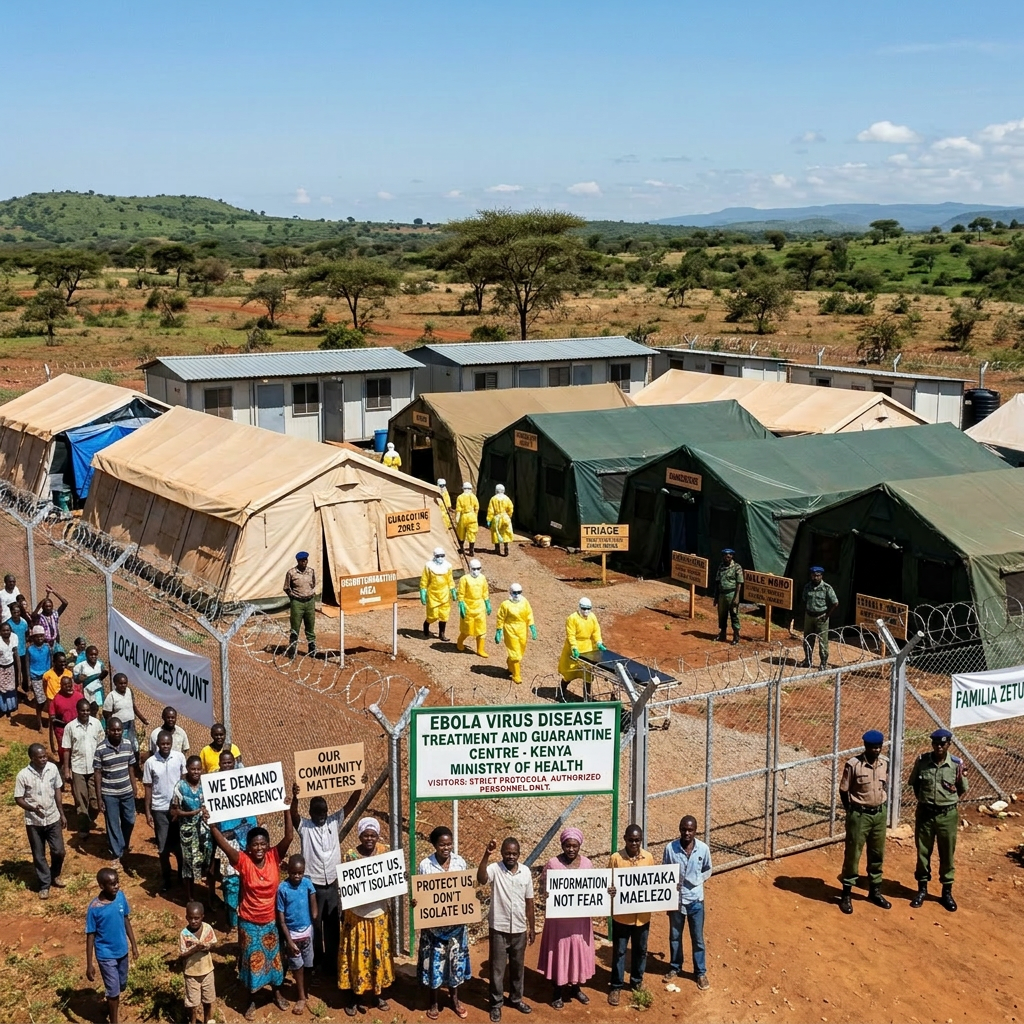
President William S. Ruto approved an agreement with the United States to establish an Ebola quarantine and treatment facility in Kenya which included a 13.5 million USD funding package from the US. This has brought about harsh criticism by the Kenyan citizens, with many raising legitimate concerns over the dangerous virus. This has led to widespread protests and public backlash in the country, with many seeking to understand why the government would sign an agreement that would endanger the lives of almost 58 million people.
Understanding what Ebola is
Ebola is a severe and fatal infectious disease in humans and primates caused by a group of viruses called orthoebolaviruses. Average symptoms of the disease appear 8-10 days after exposure and include fever, aches, pains and fatigue, diarrhea, vomiting and bleeding. Ebola has a higher risk of infection to healthy people through contact with the body fluids of an infected sick or dead person. I bet you have heard the misconception that Ebola is transmitted by simply being close to someone and this is absolutely NOT true! Ebola does not spread through the air. Treatment and prevention of the disease involves medications, supportive care and vaccines. Medications include Inmazeb and Ebanga, which is used to treat the Zaire Strain of the Virus. Early medical treatment includes intravenous fluids, balancing electrolytes and managing oxygen levels increases chances of survival.
It is important to note that Ebola is a very deadly virus and without treatment, up to 90% of the cases are fatal.
Ebola cases in recent times
The largest Ebola outbreak was between 2014 to 2016 in West Africa, where more than 28,000 cases were reported. According to the National Centre for Emerging and Zoonotic Infectious Diseases (NCEZID), most of the recent cases have been reported in the Democratic Republic of the Congo (DRC) and Uganda. In 2020, DRC reported 130 cases of orthoebolavirus Zairense, with 42.3% fatal cases. In 2021, DRC reported 12 cases of the orthoebolavirus Zairense between February and May, with 50% fatal cases. Between October and December, it reported 11 cases of the same virus, with a fatality percentage of 82%. Guinea reported 23 cases of orthoebolavirus Zairense, with 52.2% fatality. In 2022, Uganda reported 164 cases of Orthoebolavirus Sudanese, with 34% of fatal cases. DRC reported 6 cases of orthoebolavirus Zairense the same year, with 100% fatality. In 2025, DRC reported 45 cases of orthoebolavirus Zairense, with 70% fatality, while Uganda reported 12 confirmed cases of Orthoebolavirus Sudanese, with 30% fatality.
The most recent outbreak reported was in May 2026, in both Uganda and Democratic Republic of the Congo. The outbreak was caused by Bundibugyo virus ( orthoebolavirus bundibugyoense). According to the World Health Organization (WHO), as of 17th June 2026, DRC had reported 896 confirmed cases, including 232 deaths. Uganda had reported 19 confirmed cases, with 2 confirmed deaths as of 18th June 2026.
The Kenya-United States Ebola Deal
Recently, Kenya approved a U.S request to establish a facility at Laikipia airbase in Central Kenya for Americans who may have been exposed to Ebola. The Kenyan President defended the planned quarantine facility, despite protests from local leaders and residents.
The United States announced that it would commit about USD 13.5 million to help Kenya in its preparations. The U.S also promised to finance infection prevention and control, emergency response systems, Ebola laboratory capacity, training of health workers and border screening. Kenya on the other hand agreed to allow construction and operation of a 50-bed quarantine facility and permit the facility to receive U.S. citizens exposed to Ebola. The facility would be staffed primarily by members of the U.S. Public Health Service and Kenya would cooperate on broader regional preparedness.
Kenya’s High Court issued orders temporarily stopping the construction and operation of the facility while petitions are heard.
Why many Kenyans are against the deal
The deal has sparked a lot of backlash from the public, civil society groups, medical professionals and political leaders. There are several major grievances that have been raised. The first concern is that Kenya lacks the capacity to safely manage a highly infectious and deadly disease like Ebola. Many believe that were there to be a failure in containment, it could lead to very high transmission rates in the country, that would in turn overwhelm the current health care system. Civil societies such as Katiba Kenya also believe that the deal was approved without adequate public participation or parliamentary oversight. Furthermore, questions have been raised on reasons why the United States does not want to manage its own citizens domestically and instead insists on transporting American patients to an Ebola free nation. To many this spells double standards by the U.S.
What should be done going forward
Setting the facility in Kenya will not be an easy task but the Government could try some of the following things to convince its citizens. The first thing would be to ensure full transparency. The full text of the agreement should be made public, with clear explanations of each country’s obligations. The other thing it could do is give way for parliamentary debate and approval where necessary. There should be compliance with environmental and health regulations. The most important thing is that the public expect safety assurances such as internationally recognised biosafety standards, independent inspection of the quarantine facility, clear protocols and emergency response plans in case of accidents. Questions on whether the facility only the U.S. citizens should be addressed. The agreement would be received well if the benefits would be extended to the Kenyan people. These can come in the form of for example training Kenyan health workers, investments in hospitals and laboratories, strengthening of disease surveillance and research collaboration.



 Sure Media Magazine
Leave a comment