
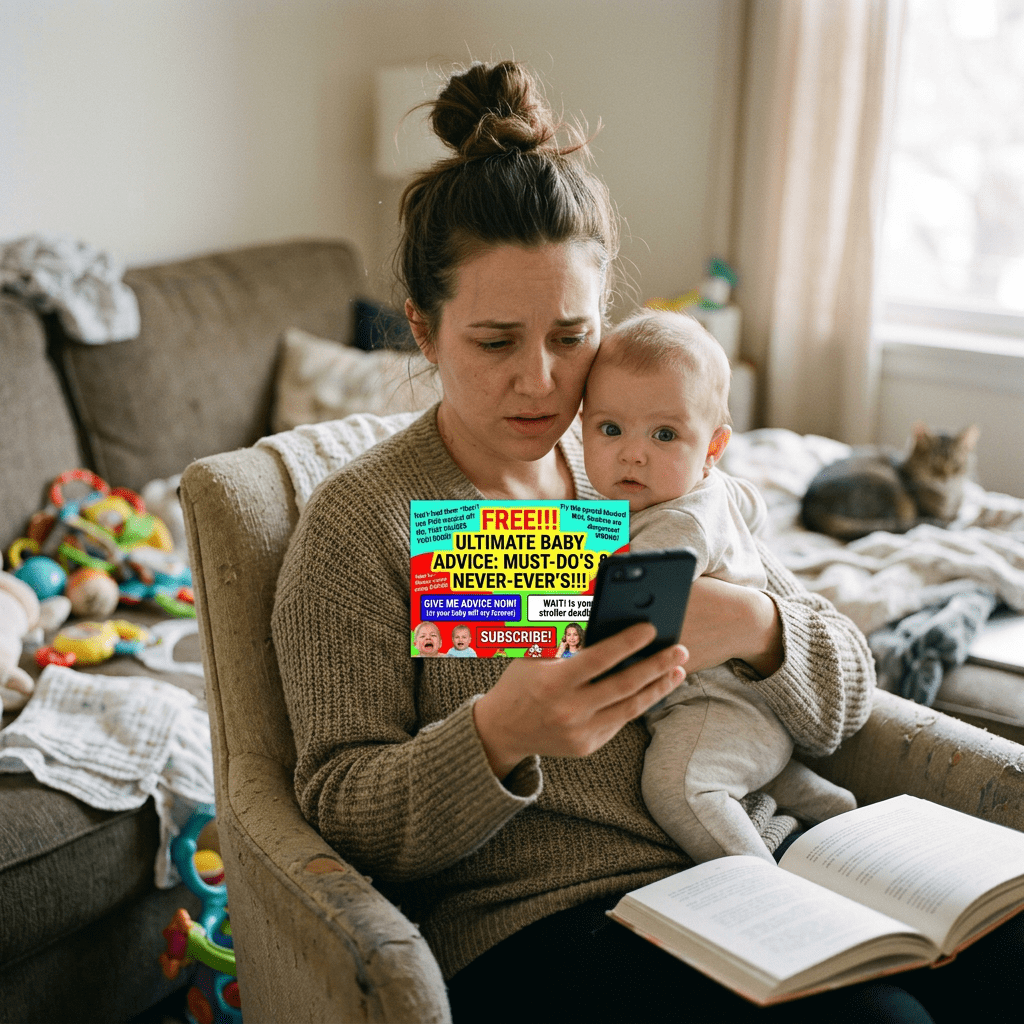
While your newborn is nursing, you open social media for a few minutes. One video insists your baby’s fussiness is trapped gas. Another blames tension. A third points to reflux. By the time your baby finishes feeding, you’ve been handed three different diagnoses, three solutions, and one lingering fear: What if I’m already getting this wrong?
The problem isn’t that the advice contradicts itself. It’s that every piece of advice sounds like the absolute truth.
Today’s parents have unprecedented access to expert guidance, but information without context can quickly become a daily source of anxiety. Psychologists have long observed that more information doesn’t always produce better decisions. In fact, studies on information overload suggest that when people are faced with too many competing inputs, especially on emotionally significant decisions, they often become less confident in their choices, not more.
For generations, humans parented within a physical village. A grandmother showed you how to bathe a slippery newborn. A mother or aunt answered your anxious questions. An experienced neighbour reassured you that a crying spell was completely normal. Their advice wasn’t valuable simply because they had raised children. It was valuable because they knew you. They knew your baby, your family, and the circumstances in which you were raising your child.
Today, the algorithm has become part of the modern village. It is available at 2 a.m., answers questions instantly, and contains more parenting knowledge than any one person could ever accumulate. In many ways, it is an extraordinary resource. Yet, it lacks something every real village has: context. It cannot see your baby’s temperament, understand your family’s rhythms, or appreciate the cultural and practical realities shaping your decisions.
I’ve been overwhelmed by the algorithm more than once. Before my daughter was even born, my feed was filled with professionals warning against co-sleeping. The message felt absolute, and when my husband suggested we might sleep with the baby during the first few months, I dismissed the idea entirely. But once she arrived, I discovered that having her beside me made nighttime feeds calmer and more manageable for our family. As I read more widely, I also realized the conversation was more nuanced than the algorithm had led me to believe. Recommendations about infant sleep are often shaped by cultural norms, living arrangements, parental leave policies, and the support systems available to families. Practices considered essential for fostering independence in one society are often viewed as counterproductive, or even neglectful, in another.
I encountered a similar lesson with tummy time. Every recommendation urged parents to practice it several times a day, but my baby clearly disliked it. Instead of forcing a routine because the internet said I should, I learned to pay attention to her cues, making tummy time playful when she was receptive and stopping when frustration outweighed the benefit. The same was true for feeding. Much of the advice I encountered promoted feeding every three hours, yet my daughter had her own rhythm. Sometimes she nursed for five minutes, sometimes for thirty. Sometimes she wanted to feed again after an hour, sometimes after only ten minutes. Feeding responsively, rather than by the clock, worked better for both of us and helped establish a healthy milk supply. This responsive approach is well-validated by developmental psychologists as foundational for secure attachment and robust infant development, yet that nuance is easily drowned out by the fast-moving certainty of algorithm-driven content.
None of these experiences taught me that expert advice was unhelpful. Rather, they taught me something more valuable: evidence offers broad principles, but parenting still requires judgment. The digital village is highly effective at expanding our vocabulary; it was through an online community that I discovered the arms-up swaddle, a minor adjustment that transformed my daughter’s brief, 20-minute catnaps into restful, restorative sleep.
The advice offered by the algorithm isn’t inherently bad. In fact, much of it is grounded in research and shared by qualified professionals. The challenge is that even the best advice arrives stripped of the context that gives it meaning. Every recommendation still has to pass through the realities of a particular family, a particular culture, and, most importantly, a particular baby.
Perhaps the skill modern motherhood demands isn’t learning more advice, but discerning what fits the child in front of you. To recognise when a recommendation fits the child in front of you, and when it doesn’t. To know when information is expanding your confidence, and when it’s quietly replacing it with anxiety.
The algorithm can introduce brilliant ideas, challenge assumptions, and open doors to knowledge our mothers never had. But it cannot watch your baby’s subtle cues or understand the delicate ecosystem of your home.
The algorithm offers possibilities. Your child provides the context.




 Sure Media Magazine
Leave a comment