
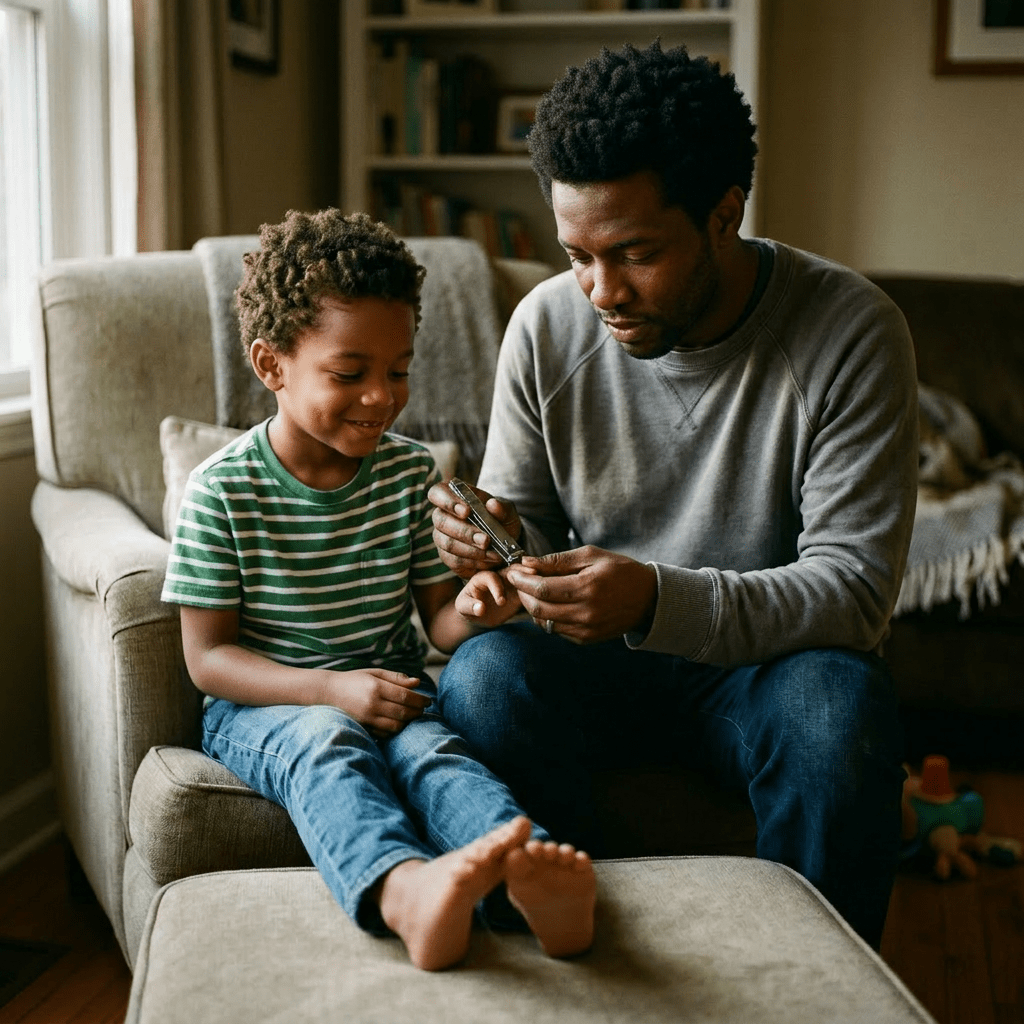
I am sitting on the edge of my bathroom sink, nail clippers in hand, when I notice it: I have angled the blade the exact same way he always did. Not approximately. Exactly. The slight tilt to the left before the press, the pause at the corner to avoid a snag. A procedure so practiced it has become invisible — which is how I know it is not mine. It is my father’s.
He was not a man who spoke easily about love.My father was warm in the way that weather is warm — you felt it on your skin before you could name it, and when it was gone you mostly noticed the cold. He showed up to things. He stayed. But words that went inward, toward feeling, seemed to cost him more than he could afford. He did not say I’m proud of you the way other fathers did, easily, like change from a pocket. He held onto it.
What he did instead, when I was small, was cut my nails.
Every week or so — I cannot remember what prompted it, whether I asked or he simply noticed — he would sit me down, take my hand in both of his, and work through each finger with a focus that I now understand was rare for him. The television went quiet in my memory. The room contracted to just his hands and mine. He was methodical about it: never rushed, never careless, examining each nail before the cut with the seriousness of a man doing something that mattered. He would press my fingertip gently to flatten the nail bed before clipping, and then run his thumb along the edge afterward to check his own work. He did the same thing every time.
I did not know what to do with that attention. I was 7 years and I understood love primarily through its loudest forms — the birthday surprises, the I love yous said before school. The nail-cutting registered as something smaller. Maintenance. Fatherly duty, the way driving me places was fatherly duty.
It was not until I started cutting my own nails — somewhere in my twenties, alone in apartments, far from Bungoma — that I began to understand what had actually been happening. The thing about physical ritual is that the body remembers it differently than the mind does. The mind catalogues moments by their drama. The body catalogues them by repetition, by touch, by what it was taught to do without thinking. I had been taught this. Someone had held my hands and shown me, without ever saying so, exactly how much care a person deserves.
My father and I talk on the phone every week. The calls follow a reliable pattern: we discuss Formula one, the weather in Bungoma, logistical updates about the family. We are good at this. We have twenty-odd years of practice at covering the surface of things and agreeing that the surface is enough. There are things I have wanted to say that I never have, and I suspect the same is true for him. This is the inheritance I spent years trying to refuse: the silence that sits between two people who love each other and cannot quite cross to the other side of it.
What I did not realize, for a long time, is that there was another inheritance running alongside it.
The body learns what the mind will not say. He pressed my fingertip flat before the clip so that the cut would be clean and would not hurt. He checked his work with his thumb. He was so deliberate, so unhurried, in that small moment, that I now think it was the place where everything he couldn’t say collected and became action instead. The nail-cutting was not incidental to his love. It was the form his love took when words ran out.
I have since read that researchers who study attachment call this nonverbal attunement — the way caregivers communicate safety and care through physical attention to the body: the exact pressure of a hug, the specific way someone adjusts a blanket, the practiced care of a hand holding yours. The science confirms what I think I knew in some animal part of myself: my father was fluent in something. It just wasn’t language.
I do my own nails now the way he did mine. The tilt, the pause, the thumb-check at the end. I did not decide to do it this way. It is simply what my hands know. And there is something in that involuntary repetition — the inheritance I did not choose and cannot quite put down — that has started to feel less like a limitation and more like a translation.
He could not always cross to me in words. But he crossed in other ways, for years, without my knowing it. And now I carry the crossing with me, etched into the muscles of my hands.
The last time I visited Bungoma, I watched my father trim his own nails at the kitchen table. Same tilt. Same pause. I almost said something — almost named it, held it up between us. Instead I watched, and said nothing, and sat with the knowledge that this was exactly what he would have done.
Some things are passed down without permission. Some love arrives not in the saying but in the teaching of a gesture so small you don’t notice it for years, until one day you’re alone in a bathroom, doing it exactly right, and you realize you were never really taught at all — you were simply held, and watched, and shown.





 Sure Media Magazine
Leave a comment