
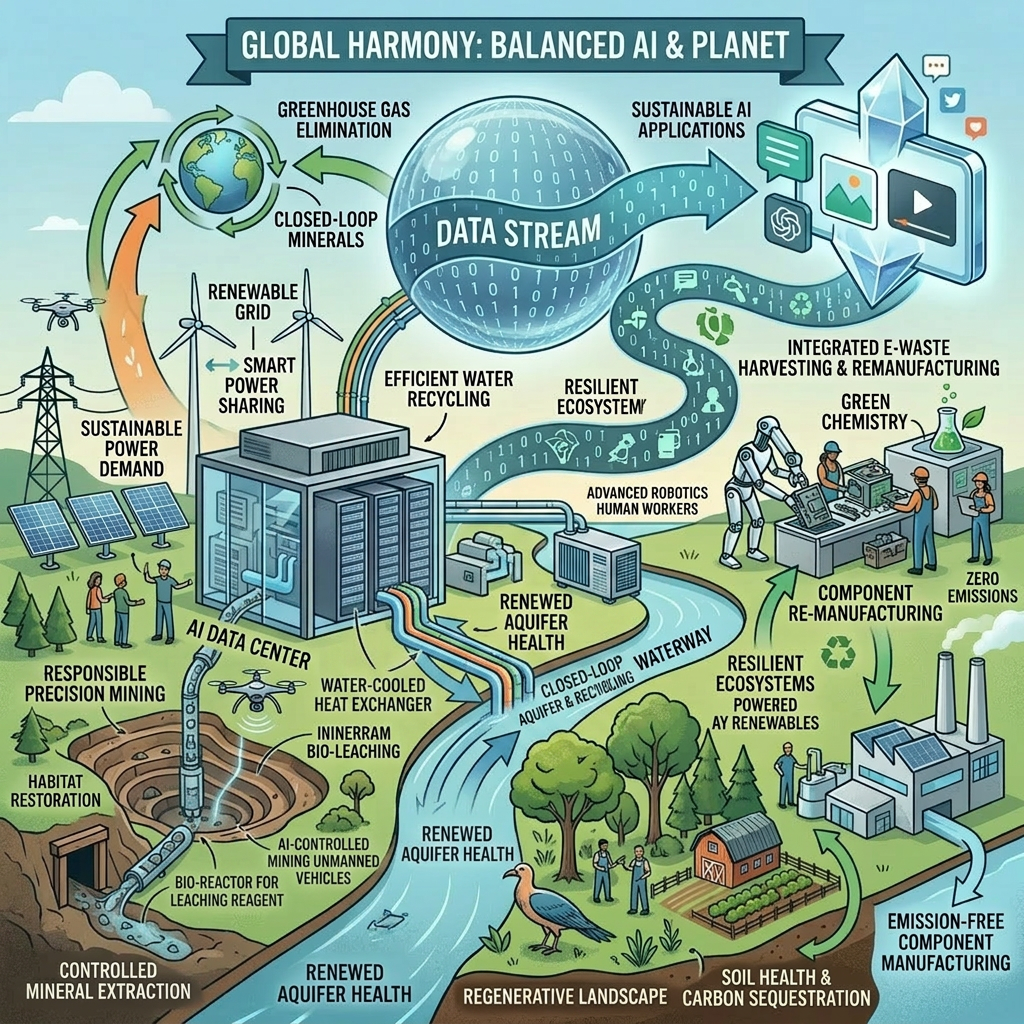
Artificial Intelligence is no doubt revolutionizing our world by automating complex tasks, generating new content and processing huge amounts of data at very high speeds, but at what cost? To many, AI feels clean because it does exist in the digital world, but this is not the case. It requires physical infrastructure and massive data centres that consume a large amount of resources daily. So, what are the main costs of Artificial intelligence that most users are unaware of?
Energy-Hungry Data Centers
According to a new report by International Energy Agency (IEA), electricity demands from data centres rose by 17% in 2025, with that of AI-focussed data centres climbing even faster. Data centre power demand is expected to surge 160% by 2030, requiring 68 gigawatts capacity, compared to 10 gigawatts in 2025.
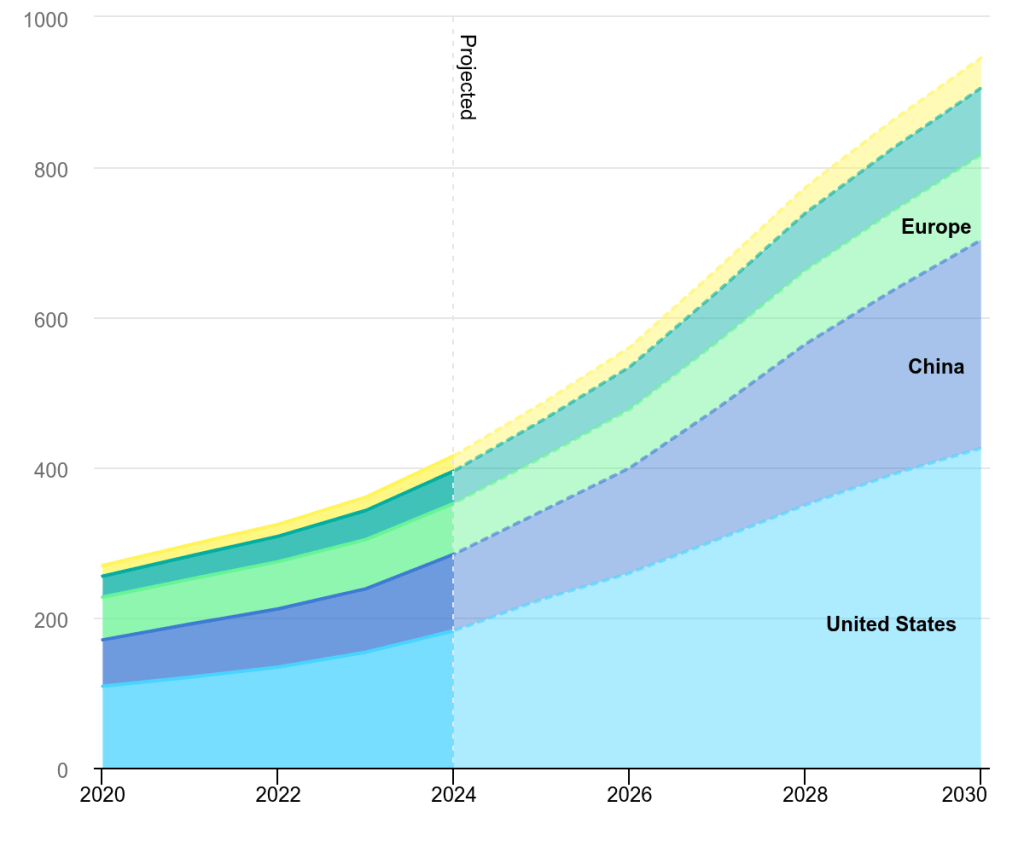
Data centre electricity consumption by region, Base Case, 2020-2030, IEA.
Last updated 10 Apr 2025.
Power consumption by AI data centres is driven by several components. The first is computing hardware and accelerators. These include GPUs, dual CPUs, networking cards and storage. Information from Hanwa Data Centres indicate that averagely, modern GPUs consume 700-1200 watts per chip compared to traditional CPUs that use 150-200 watts, reflecting very high energy consumption. A typical AI server rack contains 8 GPUs, hence the total power requirement comes to around 10-12 kilowatts per server. When multiplied by hundreds or thousands of racks, the total amount of energy consumption is huge. Advanced cooling technologies for the data centres also accounts for high energy needs. Power backup systems must always match the full IT load, and hence more cost in a bid to meet energy requirements.
High water consumption
Facilities mainly rely on circulating water to cool their equipment. The Environmental Protection Agency estimates that a data centre can use up to 5 million gallons of water everyday for cooling. This is equivalent to almost 16,000 U.S households.
A perfect example is water consumption by data centers in Phoenix, United States. According to data collected by The Consumer Reports Organization, the data centres over there consume 385 million gallons of water per year just for cooling purposes, without even accounting for water used for electricity generation. Water consumption by data centers in Phoenix is projected to be 3.7 billion gallons per year, enough to supply 34,000 homes. That’s an insane amount of water!
Furthermore, Bloomberg News reports that two thirds of data centers built since 2022 are in areas already experiencing water shortages. A 56-page UNU-INWEH report reveals that data centres processing chatbot queries, AI-generated images, and machine learning tools require billions of litres of water to operate. The United Nations (UN) warns that AI-related water consumption could equal the basic annual domestic needs of 1.3 billion people by 2030 and is calling for urgent response and transparency by everyone involved.
Growing demand for rare minerals
AI data centers consume high amounts of energy, and therefore drives up the demand for critical minerals used for energy generation. The systems require minerals such as copper for power transmission and wiring, aluminum for server racks and cooling plates, gallium to be used as power converters and rare earth elements (magnets)used in data center motors, robotics, and advanced cooling systems . Elements such as gallium, germanium, indium, palladium and tantalum are important in enabling the high-performance of chips at the heart of every GPU and data center. Training AI models requires huge amounts of high performing GPUs containing gallium arsenide semiconductors. Germanium-based fiber optics are also an important part of these data centres.
The need for these minerals demands for reliable supply chains.With China controlling vast majority of the minerals, i.e., almost 98% of global primary gallium production and 60 percent of germanium refining, other countries, including the United States are now pouring billions diversifying sources and expanding domestic mining capabilities. A good example is when The US and Abu Dhabi governments, with Orion Resource Partners, formed a $1.8 billion consortium to invest in strategic metals in October 2025, aiming to counter China’s dominance and secure supplies for national security. Canada’s government established a $2 billion fund to provide equity and loan guarantees for new domestic mines and processing facilities, aiming to bolster its role as a secure supplier.
Strategies like these by companies and governments that aim to de-risk and secure supply chains cost a lot of money and other resources.
Training of AI models
One may ask, what is AI model training? It refers to the process of feeding algorithm data, examining the results and optimizing the model output to increase the desired accuracy and effectiveness. An AI model is a set of selected algorithms and data (used to train the algorithms) so that they can make very accurate predictions. The success of AI model training depends on the quality and depth of data, plus identification and compensation of deficiencies by trainers, mainly data scientists.
According to Local AI master, training a GPT-4 level AI model for example, costs between $50m to $200m in 2025, with about $150m for a single training run. When broken down, it includes $80m-120m for GPU compute, $10-30m for preparation and storage of data, $20m-50m for engineering personnel and $5m-15m for infrastructure and software. Companies and governments have to spend a lot of money on computer infrastructure, engineering & research and data& storage.
What’s now clear
It is clear that AI depends on vast networks of servers, energy systems, water resources, and raw materials. As Artificial Intelligence becomes more embedded in our lives, it is important to ensure that the pursuit of intelligence does not come at the expense of the planet it sustains. Humanity should appreciate AI in the same way it appreciates other innovations such as medicine.


 Sure Media Magazine
Leave a comment