
As hundreds of Kenyan police officers return from an under-resourced international deployment, casualties, disputed payments and one family’s unresolved search are testing what Kenya owes the people it sends into foreign conflicts.
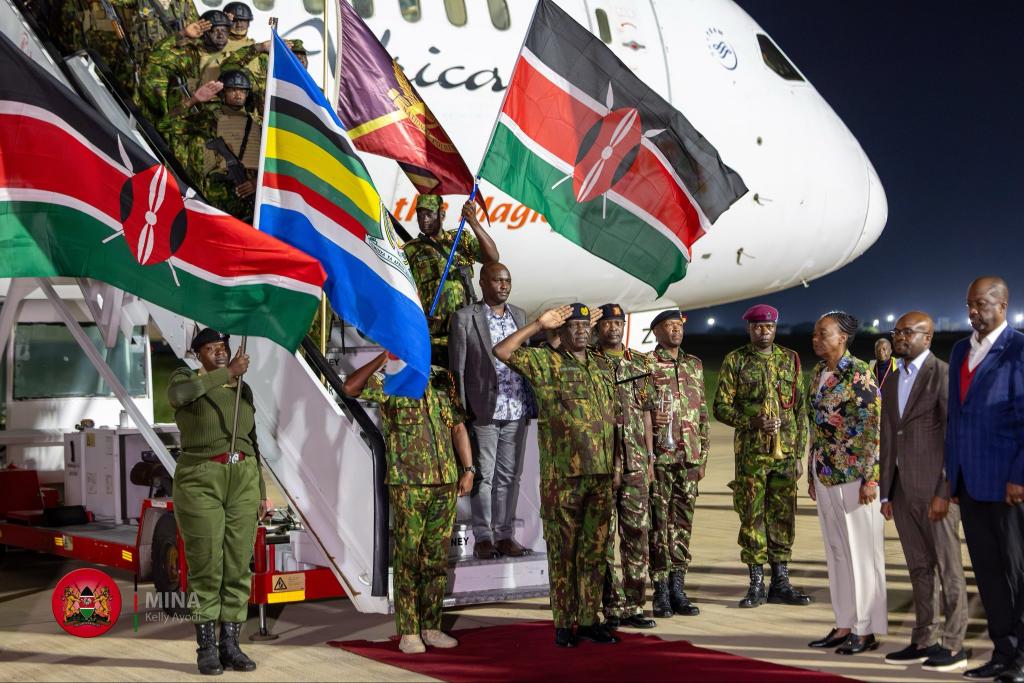
When contingents of Kenyan police officers returned from Haiti, the official homecoming was presented as a moment of national accomplishment.
Senior security officials praised the officers’ discipline and courage. Flags were raised beside the aircraft. The government credited the Kenyan-led mission with protecting critical infrastructure, reopening important roads and supporting the Haitian National Police against heavily armed gangs.
But the airport ceremonies told only one part of the story.
Behind the language of service and international leadership were officers who had entered a mission repeatedly troubled by shortages of personnel, funding and equipment. Some had reported uncertainty over allowances. Others had been wounded. Several had died or disappeared. Families were left to navigate official systems that did not always provide timely or conclusive answers.
Even after most of the returning officers had landed in Kenya, the Senate was asking the government to explain what psychological support existed for them, what had happened to unresolved personnel cases and why the family of one missing officer still lacked his remains and a verified account of his fate.
The mission may have ended for many of the officers, but its human consequences did not end when their plane touched down.
A force designed on paper
The United Nations Security Council authorised the Multinational Security Support Mission in October 2023 after Haiti requested international assistance against gangs that had overwhelmed large parts of the country.
Unlike a conventional United Nations peacekeeping operation, the mission was led by Kenya and depended heavily on voluntary international contributions. Its purpose was to support Haitian police, secure critical infrastructure and create conditions in which political institutions could function again.
The planned force was supposed to grow to approximately 2,500 personnel drawn from several countries. Kenya committed the largest contingent and sent its first officers in June 2024.
The mission entered an environment that resembled an urban war zone more than an ordinary policing operation. Armed groups controlled neighbourhoods, roads and economic routes. Police stations had been attacked. Residents had been displaced, while killings, kidnappings and sexual violence spread through communities with limited state protection.
Kenyan officers were therefore expected to perform several roles at once. They had to conduct patrols, reinforce Haitian police, protect public infrastructure, respond to gang attacks and help restore confidence in institutions that had been weakened by years of political crisis.
The ambition was substantial. The resources available to fulfil it were not.
In September 2024, Reuters reported that the mission was more than $150 million short of its estimated first-year financial requirements. The force had also deployed far fewer personnel than planned. Officers interviewed by the news agency described shortages of radios, armoured firing platforms and manpower.
Those deficiencies were not minor procurement inconveniences. They influenced what officers could do and how safely they could do it.
In one operation, Kenyan and Haitian forces reportedly drove gangs from the town of Ganthier but lacked sufficient personnel to remain there. The gangs returned after the security forces withdrew.
This illustrated one of the mission’s central problems: clearing an area was not the same as controlling it. Without enough officers, vehicles, intelligence and logistical support, tactical gains could disappear as soon as the force moved elsewhere.
The gap between the mission approved internationally and the force delivered on the ground placed the greatest burden on the personnel who had already deployed.
Fighting before the equipment arrived
Officers who spoke anonymously to Reuters questioned why they had been sent into Haiti before essential equipment was ready.
Some described taking fire from gunmen positioned in elevated buildings while operating from vehicles without suitable platforms from which to respond. Others said radios were not consistently available in their vehicles.
The United States, the mission’s principal international supporter, later delivered additional vehicles and communications equipment. Kenyan and American officials also maintained that the mission was making progress.
The shortages, however, revealed a deeper accountability question.
When a government deploys personnel to a high-risk foreign operation, responsibility does not end with training them and placing them on an aircraft. The state must be able to demonstrate that the mission has adequate intelligence, communications systems, medical evacuation arrangements, protective vehicles and personnel strength.
International partners also carry obligations. A multinational operation cannot depend on political promises that remain unfulfilled once officers are already facing armed groups.
The Haiti mission showed what can happen when the people deployed arrive faster than the resources promised to support them.
Kenyan officers became the visible face of an international response whose financing and logistics remained uncertain. When the mission struggled, the officers absorbed both the operational danger and the public criticism.
The price of unclear promises
Equipment was not the only source of frustration.
Officers told Reuters in 2024 that they had been informed before deployment that they would receive monthly mission bonuses of approximately $1,500. Some said they had not signed contracts clearly explaining the payment structure or schedule. When payments began arriving, officers reported receiving different amounts without adequate explanations of how the figures had been calculated.[2]
The disagreement was significant not only because of the money involved but also because it exposed how little independently verifiable information was available about officers’ employment conditions.
Were the mission payments salaries, allowances or operational bonuses? Which institution was responsible for releasing them? What happened when international contributions arrived late? Were families informed about insurance and compensation arrangements before deployment?
Without publicly accessible policies or individual contracts, competing claims were difficult to resolve.
That opacity placed officers in a vulnerable position. Speaking publicly could expose them to disciplinary consequences. Remaining silent meant that disputes involving their welfare could be dismissed as rumours.
A credible post-mission review should therefore include a complete reconciliation of payments. Each returning officer should receive a written statement showing the amounts promised, the amounts paid, the source of the funds and any outstanding balance.
Recognition ceremonies cannot substitute for financial clarity.
Casualties behind the diplomatic language
The risks of the mission became impossible to treat as abstract when Kenyan officers began dying.
The uncertainty became its own form of harm
Kuria’s relatives went to court seeking information. They wanted the government to state what it knew, explain the search and clarify whether he was alive, dead or recoverable. Public recognition of him as a fallen officer did not resolve the family’s most basic questions: Where were his remains? What evidence had been used to reach a conclusion? Why had the family not received a full account?
In September 2025, another Kenyan officer was killed and eight others were injured when two armoured vehicles were involved in an accident near Port-au-Prince. Three of the injured officers were reportedly in serious condition and evacuated to the Dominican Republic for treatment.[4]
Each incident created obligations that extended beyond an official announcement.
A casualty system must notify families before information spreads through news reports or social media. It must provide regular updates, repatriate remains where possible, process compensation and support dependants. Wounded officers require continuing medical treatment after evacuation, not simply emergency care in the country of deployment.
Where a body cannot be recovered, the government owes the family an honest account of what is known, what remains uncertain and what efforts are continuing.
Secrecy may sometimes be operationally necessary during a mission. It should not become a permanent shield against accountability once the operation has ended.
Returning home is not the same as recovering
The government’s public account of the returning contingents emphasised courage, professional achievement and Kenya’s expanding international-security role.
Those achievements deserve recognition. Kenyan officers entered an exceptionally dangerous environment. The Ministry of Interior credited them with helping secure Haiti’s airport, seaport and important road networks, as well as enabling humanitarian access and supporting local policing.
But an officer can complete a mission successfully and still return injured.
Some injuries are visible: gunshot wounds, impaired mobility, hearing damage or pain caused by vehicle accidents. Others emerge gradually through disturbed sleep, emotional withdrawal, irritability, fear, substance dependence or an inability to readjust to family life.
One officer interviewed during the deployment described being tormented by scenes he had witnessed in Haiti. His account suggested exposure to events that could remain psychologically distressing long after leaving the country.
Yet the official announcement marking the return of 653 officers did not publicly explain whether they had undergone psychological screening, how long monitoring would continue or what specialised care was available to them.
That absence was noticed in Parliament.
Her intervention shifted the issue from private suffering to public responsibility.
Post-deployment mental-health care should not depend on whether an individual officer is willing to declare that something is wrong. Police culture often rewards emotional control, endurance and silence. Personnel may fear that requesting psychological support will damage their reputations or careers.
A serious system would therefore make confidential assessment routine for everyone returning from a high-risk mission. It would include follow-up evaluations months later, because trauma does not always appear immediately. Families should also be given information on warning signs and avenues for seeking support.
The purpose would not be to portray all returning officers as psychologically damaged. It would be to recognise that exposure to sustained violence creates predictable occupational risks.
Who is responsible when a multinational mission falls short?
The Haiti operation complicates accountability because responsibility was distributed across several institutions.
Kenya recruited and deployed most of the officers. Haitian authorities worked alongside them. The United Nations Security Council provided international authorisation. Donor countries supplied funds, vehicles and logistical support. Mission commanders controlled operations on the ground.
This structure allows responsibility to become fragmented.
If allowances were delayed, one institution could blame the funding mechanism. If vehicles were inadequate, another could point to the supplier. If the force lacked sufficient personnel, governments that had pledged support could blame domestic constraints. If a family demanded answers, officials could cite an active investigation or operational confidentiality.
The result is a system in which many institutions participate but no single institution appears fully responsible for failure.
For deployed officers, however, institutional complexity does not reduce the consequences. An inadequate vehicle remains inadequate regardless of who procured it. A delayed allowance remains unpaid regardless of which account is awaiting funds. A missing relative remains missing regardless of which authority holds the relevant information.
Kenya’s responsibility should therefore be measured not only by whether it fulfilled an international commitment, but also by whether it protected the rights and welfare of its personnel throughout that commitment.
What accountability should look like
The transition from the Kenyan-led mission to the larger Gang Suppression Force creates an opportunity for a public assessment of what happened in Haiti.
Such an assessment should not be reduced to a declaration that the mission either succeeded or failed. It should examine what officers were asked to do, what resources they received and what consequences followed.
The government should publish an after-action report detailing the number of officers deployed, casualties recorded, serious injuries treated, payments completed and unresolved cases. Operational information that could endanger individuals can be withheld, but broad welfare and expenditure data should not remain secret.
Parliament should receive an explanation of the mission’s compensation, insurance and medical-care arrangements. Returned officers should have access to independent channels through which they can report unpaid benefits, inadequate treatment or psychological distress without fear of retaliation.
Most importantly, affected families should receive individual answers rather than ceremonial language.
The lessons from Haiti also matter beyond this single mission. Kenya is likely to remain involved in international peace and security operations. Its officers may again be asked to enter conflicts where institutions have collapsed and armed groups possess military-grade weapons.
Future deployments should begin only after clear agreements establish who supplies equipment, who pays allowances, who evacuates the injured and who communicates with families after a casualty.
The people accepting the risk should not discover those arrangements after the shooting begins.
The mission after the mission
At the airport, the returning officers were welcomed as representatives of Kenya’s international ambition.
But the true measure of that ambition will be found elsewhere: in hospital appointments kept after the cameras leave, in allowances reconciled, in confidential counselling sessions, in compensation delivered without families having to fight for it and in honest answers given to those still waiting for someone who did not return.
Kenya’s officers went to Haiti carrying the expectations of a multinational mission that was never fully equipped to meet its original ambitions.
They should not be expected to carry its unresolved costs alone.
The mission abroad may have concluded. The mission at home—accounting for the wounded, supporting the returned and providing truth to the bereaved—has only begun.





 Sure Media Magazine
Leave a comment