
With vet costs high and budgets tight, more Americans are grabbing pet food off the supermarket shelf. Here’s what a veterinary nutritionist wants you to know before you do.
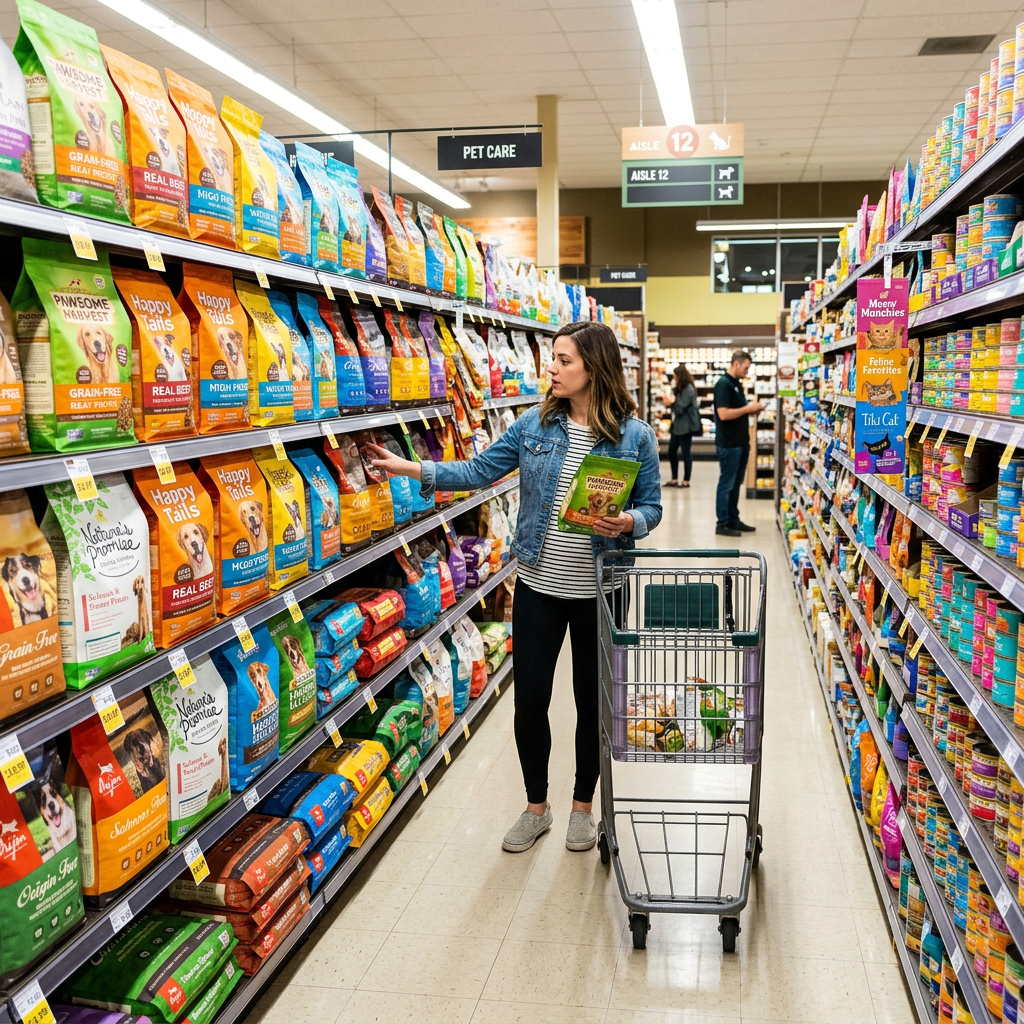
You’re standing in the pet food aisle at your local grocery store, staring at a wall of bags that all say roughly the same things in different fonts. “Real chicken.” “Wholesome grains.” “Complete and balanced.” One bag has a golden retriever running through a field. Another has what appears to be an actual farm. A third has a chef’s hat on it.
None of that imagery, it turns out, tells you much about what’s actually inside.
As inflation has pushed pet owners away from specialty pet stores and boutique brands, grocery store pet food has quietly become one of the most common choices for millions of American households. U.S. pet industry spending reached $157 billion in 2025, but the number of owners reporting financial strain is rising sharply; more than half say inflation has changed how they shop for their animals. Many of them are ending up in the supermarket aisle.
The question is: what does buying pet food there actually mean for your animal? The answer is more complicated, and more reassuring in parts, than you might expect.
What the Label Is Actually Telling You
Start with the one piece of the label that carries real weight: the nutritional adequacy statement.
It’s usually in small print near the bottom of the back panel. It says something like: “formulated to meet the nutritional levels established by the AAFCO Dog Food Nutrient Profiles for adult maintenance.” AAFCO is the Association of American Feed Control Officials, the organization whose guidelines most states use to regulate pet food. If that statement is on the label, the food has been formulated to meet minimum nutritional standards for whatever life stage it names.
“That statement is your baseline,” says Dr. Maryanne Murphy, a veterinary nutritionist and clinical associate professor at the University of Tennessee whose research focuses on dog and cat nutrition. “If a food doesn’t have it, walk away. If it does have it, you’ve cleared the first hurdle.”
The life stage matters. “Adult maintenance” means the food is formulated for adult animals, not puppies, kittens, or pregnant animals, which have different nutritional needs. “All life stages” means it meets requirements for every stage, but be aware that foods formulated for growth stages tend to be higher in calories, which can be too rich for sedentary adult dogs.
What the label will not tell you is nearly as important as what it will.
The ingredient list, for example, looks informative but functions largely as marketing. Ingredients are listed by weight before processing, which is why “chicken” can appear first even when the actual chicken content after moisture is removed is relatively small. An ingredient called “chicken by-product meal,” by contrast, is already dried and concentrated, meaning it actually delivers more protein per ounce than fresh chicken listed above it. The name sounds worse. The nutrition is often better.
Research from Tufts University found that pet food labels are widely considered confusing and misleading by both pet owners and veterinary professionals. Surveys of pet owners consistently show that people make purchasing decisions based primarily on ingredient lists, despite those lists being among the least useful tools for evaluating a food’s actual quality.
Images on packaging are even less reliable. One well-documented example: a major cat food brand has displayed images of grilled chicken breast and salmon fillets on its label for years. The actual ingredients include chicken by-product meal and fish meal, nutritionally sound, but nothing resembling what’s pictured. The FDA requires that labels not be misleading, but enforcement of that standard in pet food has historically been inconsistent.
What Makes a Food Actually Good
The question that matters most, and the one the label won’t answer, is whether the company has a qualified nutritionist involved in formulating the food.
The Pet Nutrition Alliance, a coalition of veterinary nutrition professionals, publishes a free annual report comparing major pet food manufacturers on criteria that don’t appear on bags: whether they employ a full-time credentialed nutritionist (specifically a Diplomate of the American College of Veterinary Internal Medicine Nutrition specialty, or a PhD in animal nutrition), whether that nutritionist formulates the diets, what quality control measures they use, and whether they conduct feeding trials rather than simply calculating nutrient profiles from ingredient lists.
Most pet owners have never heard of this report. It is one of the most useful free tools available for evaluating what you’re buying.
The brands that consistently score well on these criteria, and that happen to be widely available at grocery stores, include Purina Pro Plan, Hills Science Diet (in some grocery chains), and Royal Canin. All three employ substantial research and nutrition teams, conduct feeding trials, and have long track records of nutritional consistency.
“These are not glamorous brands,” says Dr. Murphy. “They don’t have beautiful packaging or trendy ingredient lists. But they have the research. That’s what I look for.”
The brands that veterinary nutritionists most often flag for concern are not necessarily the cheapest ones. They’re often the newest boutique brands with compelling stories, “small batch,” “human grade,” “ancestral diet”, that spend heavily on marketing and lightly on nutritional science. The fresh pet food market has exploded in recent years, and a 2026 peer-reviewed meta-analysis in the journal Nutrients found that many of the marketing claims attached to fresh or “premium” pet foods, that additives and preservatives are harmful, that human-grade ingredients are superior, that whole ingredients outperform processed ones, are not supported by the scientific evidence.
That doesn’t mean those foods are bad. It means the price premium often isn’t buying what owners think it’s buying.
The Grain-Free Warning
If you’re considering a grain-free pet food, even a premium one, this is worth knowing.
Since around 2018, the FDA has been investigating a potential link between grain-free diets and dilated cardiomyopathy (DCM), a serious heart condition in dogs. The investigation has not resulted in a recall or a formal ban, and the science remains actively debated. But the veterinary consensus, for now, is cautious: most veterinary nutritionists recommend grain-inclusive diets for most dogs unless a specific medical reason exists for avoiding grains.
Cats, who are obligate carnivores, have different needs; they require high protein and limited carbohydrates regardless of whether the carbohydrates come from grains or grain alternatives. A grain-free food for cats isn’t necessarily concerning in the same way, but the premium price tag rarely reflects a meaningful nutritional difference from a well-formulated grain-inclusive food.
“Grains are not the enemy,” says Dr. Murphy. “They provide fiber, carbohydrates, and essential nutrients. The idea that grain-free is automatically healthier is one of the biggest misconceptions I encounter from pet owners.”
A Practical Guide to the Grocery Aisle
So what should you actually do when you’re standing in that aisle?
Start with the nutritional adequacy statement. It should name the life stage your pet is in. “Adult maintenance” for adult pets. “All life stages” or “growth” for puppies and kittens.
Look at who makes the food. If the manufacturer is listed, search the Pet Nutrition Alliance database (petnutritionalliance.org) before you buy. It takes two minutes and tells you more than the label ever will.
Ignore the images. The golden retriever on the package tells you nothing about the food inside. The farm backdrop tells you nothing either. These are marketing choices, not nutritional signals.
Treat ingredient order with nuance. “Chicken” appearing first does not mean this is a high-protein food. “By-product meal” appearing third does not mean this is a low-quality food. What you want is a food where a named protein source, chicken, salmon, beef, or turkey, is among the first few ingredients, not corn syrup or a vague “animal digest.”
Look for brands with a feeding trial history. The label will sometimes say a food was tested using AAFCO feeding procedures rather than simply formulated. Feeding trials are more rigorous. This is worth seeking out.
Be skeptical of claims you can’t verify. “Human-grade,” “ancestral,” “biologically appropriate”, these are marketing terms with no standardized regulatory definition in the United States. They tell you about the target consumer, not the product.
Ask your vet. It’s a simple step that many pet owners skip. Veterinarians, particularly those with nutrition training, can recommend foods matched to your specific pet’s age, breed, weight, and health history. This is free advice that often gets ignored in favor of packaging.
The Bottom Line
Here is what the research actually supports: a well-formulated grocery store brand, particularly from manufacturers like Purina or Hill’s that have invested decades in nutritional research, can be as good for your pet as most specialty or boutique alternatives at twice the price.
And here is the harder truth: a beautiful bag of boutique food from a company with no qualified nutritionist on staff, no feeding trials, and no verifiable quality control may be worse for your pet than the store-brand kibble sitting next to it on a lower shelf.
The pet food industry is genuinely difficult to navigate because it is largely built on aesthetics rather than transparency. Labels are designed to appeal to pet owners’ values and emotions, not to provide the information that veterinary nutrition experts say actually matters.
The good news is that the tools to cut through the noise exist and are free. The AAFCO nutritional adequacy statement, the Pet Nutrition Alliance database, and your veterinarian are all more reliable guides than any bag’s front panel.
Your pet cannot read the packaging. You can. Use that advantage.
What to Look for at a Glance
On the label:
- AAFCO nutritional adequacy statement with the correct life stage
- Named protein source in first three ingredients (chicken, beef, salmon, not “meat” or “animal”)
- No corn syrup, artificial preservatives, or unspecified “animal digest” prominently listed
Questions to ask the manufacturer (or search online):
- Do they employ a board-certified veterinary nutritionist or a PhD in animal nutrition?
- Do their products undergo AAFCO feeding trials?
- Can they tell you where their ingredients are sourced?
Trusted brands widely available in grocery stores:
- Purina Pro Plan
- Hill’s Science Diet (select retailers)
- Royal Canin (select retailers)
- Iams (standard formulas, not boutique lines)
Red flags regardless of price:
- “Grain-free” with no veterinary reason for it
- Claims like “human-grade” or “ancestral recipe” with no research to back them
- No AAFCO statement
- No manufacturer contact information
Your vet is always the best first call. But when you’re standing in the aisle, bag in hand, these are the questions that actually matter.
For more information on evaluating pet food manufacturers, visit petnutritionalliance.org. The Petfoodology blog, maintained by the Cummings School of Veterinary Medicine at Tufts University, offers free, research-backed guidance at vetnutrition.tufts.edu/petfoodology.




 Sure Media Magazine
Leave a comment