
The Breach: Imani’s Journal
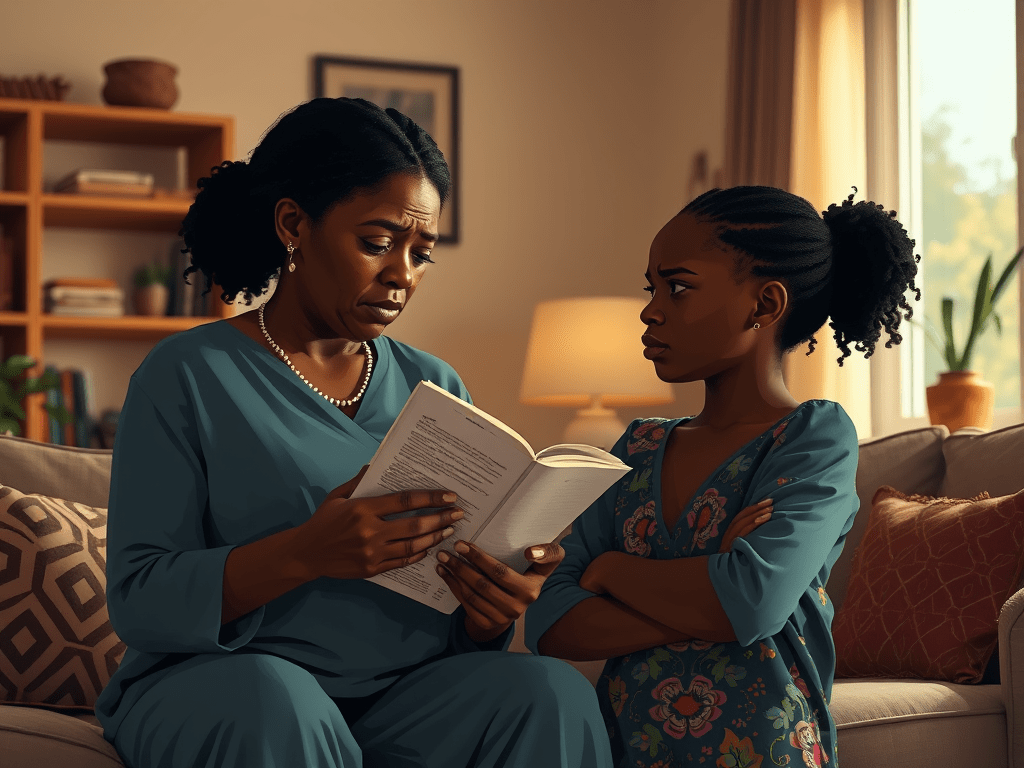
Imani rushes in, heart racing, frustration mounting. She wanted privacy for her thoughts, but her mother now holds her journal pages, never meant to be read.
“You’re ungrateful,” her mother says, her voice sharp but tired, carrying the weight of years spent enduring, surviving, and sacrificing.
Imani swallows hard, fighting to steady her voice. “I’m not ungrateful… I’m afraid.”
She gestures to the scattered pages: thoughts on painful marriages, mothers who stayed to avoid hunger, burdens of too many children, and the hidden cost of quiet survival.
Her mother’s chest tightens. She had fought her battles quietly, believing that endurance itself was a form of strength. Now, seeing her daughter’s words feels like exposure, like judgment.
“You think I failed?” her mother whispers, almost to herself. “I did what I had to do. You wouldn’t understand.”
Imani feels the sting of misunderstanding, but also the undeniable weight of reality: survival comes at a cost, and sometimes that cost is silence.
The room swells with unspoken truths: one generation demanding gratitude, the other demanding acknowledgment. Both are right. Both are hurting. Both are trying to survive in the only ways they know.
The New Language of Healing
Across countless African households, younger generations are learning to speak in a new language , a language of boundaries, trauma, and self-preservation. Words like “gaslighting,” “emotional neglect,” and “inner child” are entering homes where silence once reigned supreme.
To some parents, this language feels like a form of rebellion. To some children, it feels like liberation. And therein lies the tension.
Survival vs. Healing
Our parents lived through things we may never fully understand: money problems, pressure from society, few choices, and beliefs that saw putting up with hardship as a sign of respect. Asking questions about these beliefs is not disrespectful; it is trying to heal from hurts they could not fix.
Yet the clash is real. Expressing the need for healing often reads as an accusation. Setting boundaries feels like defiance. And the very act of speaking openly about one’s emotions can feel like betrayal.
This is the uncomfortable truth: surviving and healing are not always aligned. And in African households, the language of therapy is not neutral; it carries weight, history, and emotion.
Bridging the Divide
Navigating this generational divide requires patience, empathy, and courage. It asks of both generations: the older to listen without defensiveness, and the younger to honor without silencing themselves.
But right now, in many homes, that understanding is still a work in progress. And for some, that conversation begins with discomfort.
Why does healing sound like rebellion in African households?






 Sure Media Magazine
Leave a comment