
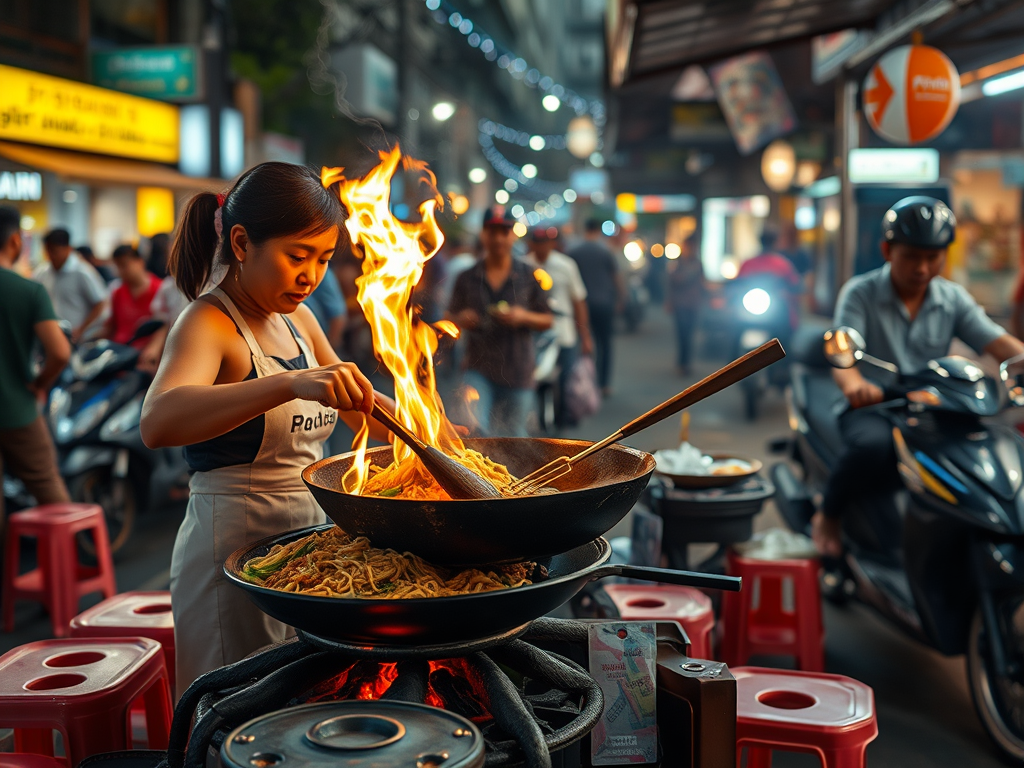
The first time I understood that food could be a destination on its own, I was standing on a crowded sidewalk in Bangkok at 11:40 p.m., sweat running down my back, motorbikes weaving past plastic stools, and smoke rising from a charcoal grill like a signal fire. No white tablecloth. No reservations. Just a woman with a wok, moving faster than seemed humanly possible.
I had not come for temples or rooftop bars. I had come for a plate of Pad Thai cooked three feet from traffic.
That night changed how I think about travel.
We often build trips around landmarks — towers, museums, beaches. But if you really want to understand a place, follow the smell of garlic hitting hot oil. Follow the line of locals who don’t need menus. Follow the sound of laughter around a cart with three plastic chairs. Street food is not just convenient eating. It is compressed culture.
Here are the street foods that are not just worth tasting — they are worth booking a flight for.
Pad Thai in Bangkok
You can eat Pad Thai anywhere in the world. But eating it in Bangkok is different.
On a side street off Sukhumvit Road, I watched the vendor crack eggs directly into the wok, toss rice noodles with tamarind sauce, palm sugar, fish sauce, and chili flakes in a choreography refined over years. Flames shot up as she flipped everything in a single motion. The dish landed on a plate lined with banana leaf, topped with crushed peanuts and a wedge of lime.
The first bite was layered — sweet, salty, sour, smoky. Balanced. Alive.
Street-side Pad Thai tells you something important about Thailand: flavor is harmony. No single ingredient dominates. That philosophy extends beyond the plate — it mirrors Thai social culture, where balance and subtlety matter.
You can dine in luxury restaurants in Bangkok, but the soul of the city sizzles on the street.
Tacos al Pastor in Mexico City
In Mexico City, tacos are not casual food. They are ritual.
Late one evening in Roma Norte, I joined a crowd gathered around a vertical spit of marinated pork turning slowly under heat. The trompo glowed red. The taquero shaved thin slices of meat directly onto small corn tortillas and, without looking, flicked a slice of pineapple from the top of the spit so it landed perfectly on the taco.
No wasted movement. No hesitation.
The taco was small — two bites. But it carried history. Tacos al pastor trace back to Lebanese immigrants who adapted shawarma techniques to Mexican ingredients. What you’re eating is culinary migration.
Street tacos reveal Mexico’s layered identity: indigenous roots, colonial influence, Middle Eastern adaptation — all wrapped in a tortilla.
You don’t just eat it. You participate in it.
Nyama Choma in Kenya
In Kenya, street food is social glue.
Nyama choma — roasted meat, usually goat or beef — is rarely eaten alone. It’s shared. It’s debated over. It’s argued about (especially which region prepares it best).
At a roadside joint outside Nairobi, I watched as slabs of meat roasted slowly over open charcoal. No heavy marinades. No complicated sauces. Just salt, fire, and patience. When ready, it was chopped roughly and served with kachumbari — a simple tomato and onion salad — and ugali.
The taste was direct. Honest.
Nyama choma tells you something about Kenyan culture: community matters. The meal is not rushed. Conversations stretch longer than the plate lasts. Deals are made. Friendships deepen. Politics gets discussed loudly.
It is food as gathering point.
Jerk Chicken in Jamaica
If you ever find yourself in Jamaica and you don’t follow the scent of pimento wood smoke, you’re missing the point.
At a roadside stand near Montego Bay, jerk chicken cooks inside metal drum grills. The spice mixture — scotch bonnet peppers, allspice, thyme, garlic — is rubbed deep into the meat before it hits the fire.
The heat builds slowly. The smoke penetrates everything.
Jerk cooking originated with the Maroons — enslaved Africans who escaped into the mountains and developed slow-smoking techniques to preserve and conceal their food. What tastes like spice and fire today carries resistance and survival in its history.
Street food here is not just flavor. It is story.
Banh Mi in Ho Chi Minh City
In Vietnam, the banh mi sandwich might be the clearest symbol of cultural fusion.
French colonialism introduced baguettes. Vietnamese cooks transformed them.
On a busy morning in Ho Chi Minh City, I bought a banh mi from a cart wedged between two motorbike repair shops. The vendor sliced the baguette open and layered pâté, grilled pork, pickled carrots, daikon, cilantro, chili, and soy-based sauce inside.
Crunchy. Savory. Fresh. Spicy.
Every bite carried two histories colliding — and evolving into something uniquely Vietnamese.
The beauty of street food is that it adapts. It absorbs influence. It reinvents.
Samosas in India
In Delhi’s Chandni Chowk market, samosas are stacked high behind glass cases, golden and triangular.
I watched a vendor break one open with his fingers before serving it, releasing steam scented with cumin and coriander. Inside: spiced potatoes, peas, sometimes minced meat. Outside: crisp pastry.
Simple ingredients, powerful flavor.
Samosas are portable, affordable, and democratic. Everyone eats them — students, office workers, tourists, laborers. Street food in India thrives because it feeds millions efficiently and deliciously.
But it also reflects India’s love for bold spices and layered flavors. Complexity is embraced, not avoided.





 Sure Media Magazine
Leave a reply to WisdomFuel Cancel reply