
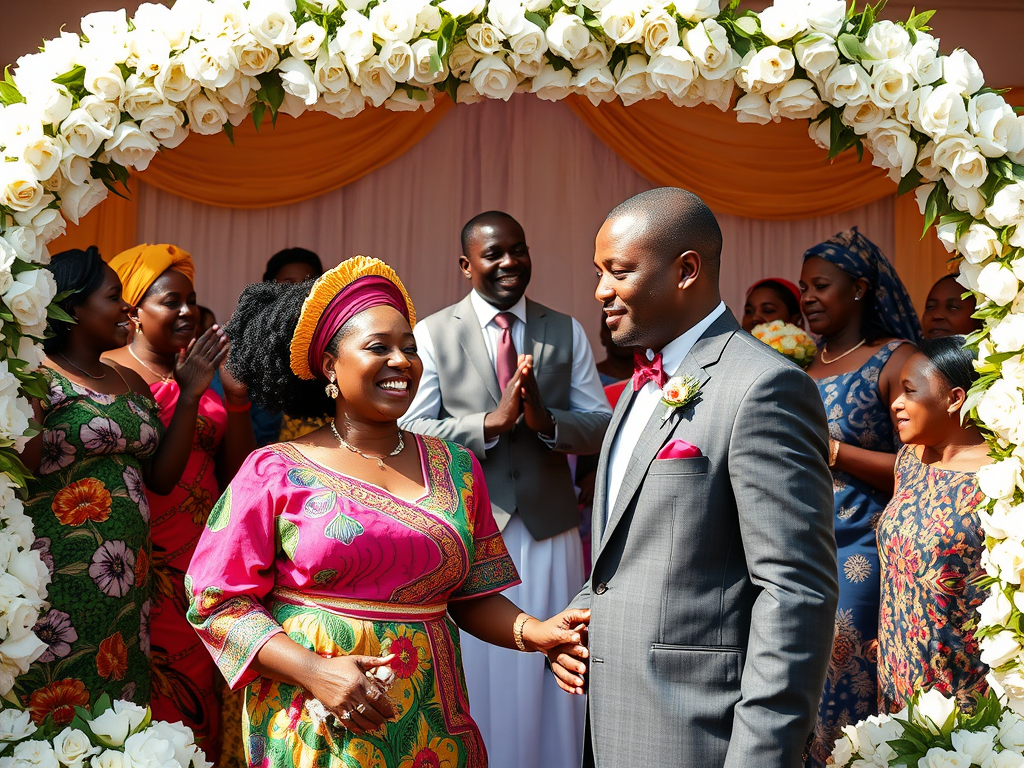
On a very humid Saturday afternoon in Nairobi, Maria found herself standing in two separate worlds.
To Maria’s rear, countless aunties sporting colorful dresses were jovially ululating. Though it was a celebratory moment, there was a deeper theme that connected them all, perhaps, continuity. And there was Daniel, slightly overwhelmed, and standing steady under an arch with white flowers that looked as if it had been borrowed from an entirely different tradition. The ceremony would switch from ancestral blessings to church vows, and everything else in between, in two different languages, and two different families that were still grappling with what all of this was.
Maria had once promised her grandmother that she would marry “home.” To her grandmother, marrying “home” meant someone who understood the rituals completely. Someone who would know who the first elder to speak would be, what gifts had to be exchanged, who to greet first, and in what order.Most of this had been learned by Daniel from late night internet searches and numerous coaching sessions.But he knew Maria that, in most parts of urban Africa it was enough for the couple.
When Marriage Becomes a Personal Affair
For numerous decades, and in most parts of the African continent, marriage has been seen as a collective societal event. It meant forming new partnerships, keeping a language in use, and organizing social order. Continuity was always on the agenda when it came to weddings.
In growing urban areas and business hubs, new buildings capture new interconnections and new types of social engagements facilitated by educational institutions, workplaces, and online platforms. The old social mobility limitations, controlling under what circumstances people fell in love and with whom, have also loosened.
These new developments have also contributed to new forms of social relationships in many of the urban centers ,intermarriage. Walking into a wedding with multiple cultures, traditions, and food is common.
People intermarrying across culture and ethnicity is a positive social development, however, the tendency is still there to have some family and social tensions with such unions.
The Diplomacy of the Marriage Process
Maria’s family thought it would be best to have her parents and grandparents present as they conducted what they envisioned to be a very serious negotiation with Daniel’s family.
In this unusual family negotiation, ‘s family crossed the so-called civilization boundary and Daniel’s family remained on the so-called civilized side.
“This negotiation is not about the rural side and the livestock. It is about recognition.” When such negotiations involve intermarriage, there are bound to be several translations which include traditions, loyalty and fears.
Families worry about erosion,about grandchildren who might not speak the language fluently, about ceremonies performed incorrectly, about lineage threads thinning over time.Yet what many families discover is not disappearance but adaptation.The traditions stay. They’re just modified.
Children With More Than One Story
Years later, Maria’s daughter, Malaika, would face the same question: “What are you?”It’s a question posed to countless children from mixed families, suggesting that a singular identity is the only ‘real’ identity.
Malaika’s last name identified her with one side. The stories from her grandmother’s place, with another. Holidays meant a mix of traditions. Funerals a mix of everything. She felt like she belonged everywhere, and sometimes, like she belonged nowhere.
Research on bi-cultural identity formation indicates children from culturally mixed families often develop high levels of adaptive skills. They understand early on that identity is not a fixed construct, but a broad spectrum. They speak the language of complexity with ease.This resilience, however, does not develop spontaneously. It takes very active, intentional parenting. It takes equal validation, equal narratives, equal affection.
Maria and Daniel set some ground rules early on all family histories are to be recounted at bed time, both languages are to be used at home, and no culture is to be treated as inferior.They had decided that belonging would be purposefully made.
Love in the Shadows of History
In politically divided societies, intermarriage can be of particular significance. It is not just a question of compatibility, but of loyalty.
Maria’s friends talk about how there is suspicion every election season because people act differently as they become more politically charged. One of them says, “It’s as if our marriage becomes a political statement. Even when we just want it to be ordinary.”
When two people from different backgrounds marry, it doesn’t get rid of prejudice, racism, hate, or any of the other injustices that exist. It doesn’t mean that everything will be fine between two different communities that have historically fought with each other, but it does bring them closer together.They end up co-sharing bills,emotions,proximity et al.
The Role of Women
In many situations, women face the most challenges during intercultural marriages. This is because people expect them to mimic the ways and customs of their husband’s culture. In doing so, they without a doubt, leave their culture behind.
When marriages cross borders, the power plays that exist become even more pronounced. This is because a person’s migration, economic, or citizenship status, dictates whose culture is held more important.
Maria expressed to Daniel that their marriage would be a “we are not choosing one side” culture. This was before they were even formally engaged.This statement was disturbing to both families.The act of creating something together, suggests that customs are not something that sits in a museum, but is something alive that can grow and change.
The Kitchen as Cultural Laboratory
Every Sunday, Daniel makes a childhood favorite. He learned it from his mother. Maria, during holiday seasons, makes a favorite festive dish. “Festive,” she says, with lots of spices. Now, she says, their daughter has started asking for both her mother’s and her father’s dish on the same plate.
Newlyweds’ descendants with combined surnames.
Critics say blending weakens the essence of the cultures involved. The thing is, pure cultures has never really existed. History is a testament of the opposite. History is built on the crossed lines of trade, migration, conquest, and coexistence.Intermarriage makes that crossing personal.
A Measure of Integration
Sociologists have used intermarriage as a measure of social integration. The fact that people are willing to have children that cross social boundaries indicates that social boundaries have become informal.While intermarriage is a sign that social changes have taken place, it also does not mean that inequalities have been addressed. Occupational and economic inequalities may be maintained. Prejudice may exist in the institution and household, but intermarriage is a sign that it is soft and this means, of course, that identities are becoming more flexible.
The Wedding, Revisited
As Maria and Daniel exchanged wedding vows, something subtle shifted.Her grandmother granted her a blessing; a first for her. She took her time to speak, so others could understand her. We’ll focus on preservation. She almost let it slip that it was about something else entirely.“May your home honor every river that brought you here.”
It was not worded as a surrender, and it certainly was not defeat. It was an acceptance that plenty more still exists, and that something like this could, and would, live on.
The ululations and the church choir went on. A space was created somewhere between modern vows, and ancient invocation. Not a single culture would take over, but something new was created.It is not only about the two people who fall in love. It is about two families, and entire social structures, newly defining and re-negotiating a sense of identity and community. It is about traditions re-discovering their elasticity, and children not being restricted to a single belonging, but rather inheriting a multiplicity.It challenges each social order, Is belonging rigidly defined and contained? Or is it something that can stretch?
It was a hot afternoon in Nairobi. It was layered with different languages and different prayers. The response to that challenge was reservedly optimistic.
It seemed as though it was the case. Belonging could stretch.





 Sure Media Magazine
Leave a reply to Lynn Kimani Cancel reply