
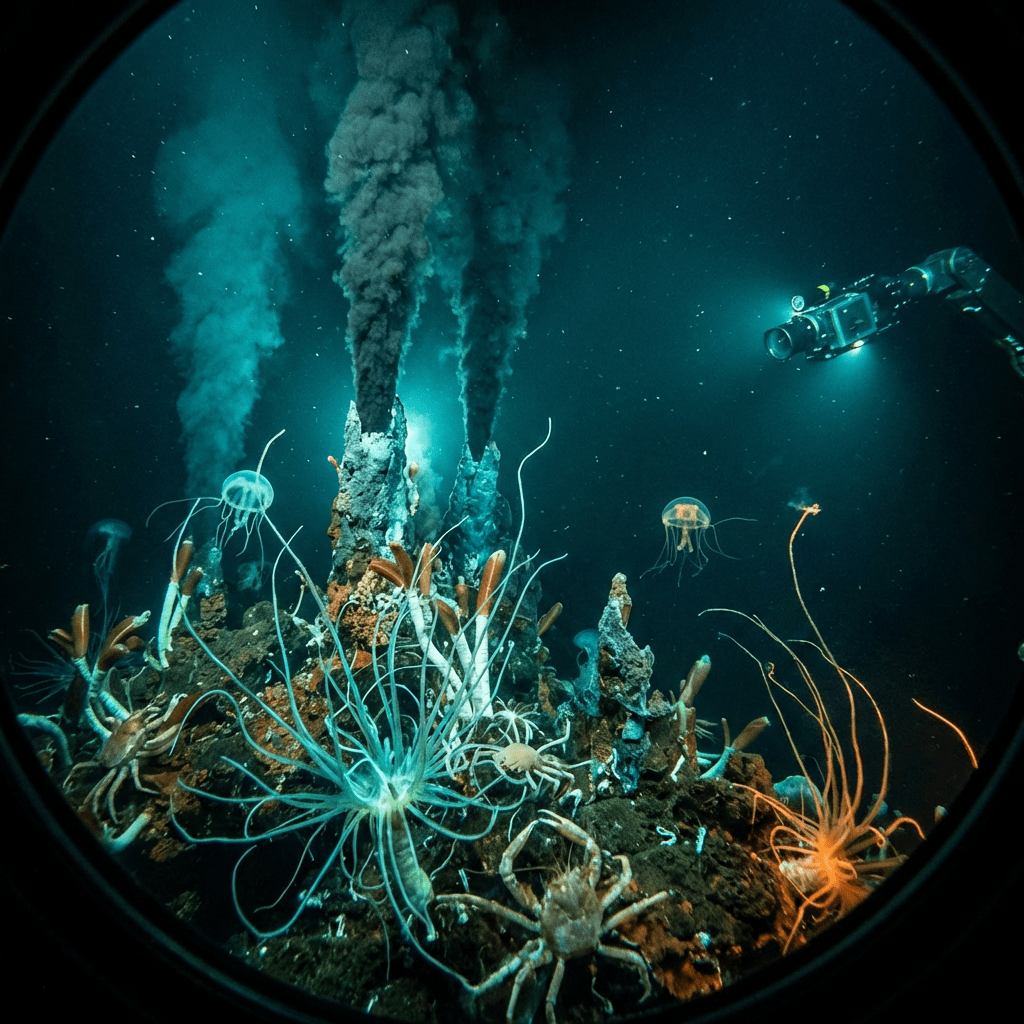
Scientists have found something that shouldn’t exist in the dark, crushing depths of the ocean, far below where sunlight can reach: oxygen being made without photosynthesis.
For a long time, biology books have taught that life on Earth gets its oxygen from sunshine. Plants, algae, and some bacteria use light to break down water molecules, which gives off oxygen as a waste product. But recent research suggests a different option. Researchers call it “dark oxygen” because it may form in deep-sea habitats where there is no sunlight.
If true, the discovery could change how scientists think about life on Earth and where they look for it outside of our planet.
Oxygen without the sun?
Researchers found the new information by looking at deep-ocean places like hydrothermal vents and seafloors that are rich in minerals. We already know that these ecosystems are home to species that can live without sunshine and instead get their energy from chemicals in a process called chemosynthesis. But people didn’t think that oxygen would be a component of that.
Researchers have found strange oxygen signatures in these very harsh conditions. These levels are difficult to explain using just known biological or physical mechanisms. This has led to an intriguing idea: certain chemical reactions that happen on the seafloor with minerals, water, and electrical currents could be splitting water molecules and letting oxygen out without any light.
One suggested the reaction could happen through natural electrical gradients between different mineral-rich areas of the ocean crust. These gradients can cause reactions that are akin to electrolysis, which is how people use electricity to break water into hydrogen and oxygen. This means that some portions of the ocean floor might be working like a huge, natural battery.
Assertion for debate
Not every scientist is sure. Finding oxygen in the deep sea is challenging, and other scientists say that the signals might be caused by things that are more recognizable, including small pockets of photosynthetic oxygen that have been moved from other places or measurement errors.
Researchers have said in response to early discoveries, “There’s still a lot we don’t know.” To confirm “dark oxygen,” we need to take more accurate measurements and do the experiment again on our own.
But the thought of it is enough to get people excited. If oxygen may arise through solely chemical or geological processes in the absence of light, it contradicts a long-standing belief that oxygen is a reliable indicator of photosynthetic life.
Revisiting biosignatures
That idea is a big part of the quest for life on other planets.
Astronomers seek one of the most important “biosignatures“—oxygen in the atmosphere—when they examine distant planets. Oxygen is closely linked to life on Earth; therefore, finding it on another planet is a positive sign that it might be home to life. But if oxygen can be made without biology or sunshine, that makes things more complicated.
A planet with a lot of oxygen might not have life on it. On the other hand, life might exist in places that produce oxygen in entirely different ways or not at all. Scientists who research planetary atmospheres have said in the past several years that “this discovery makes us rethink what counts as a sign of life.”
What this means for icy worlds
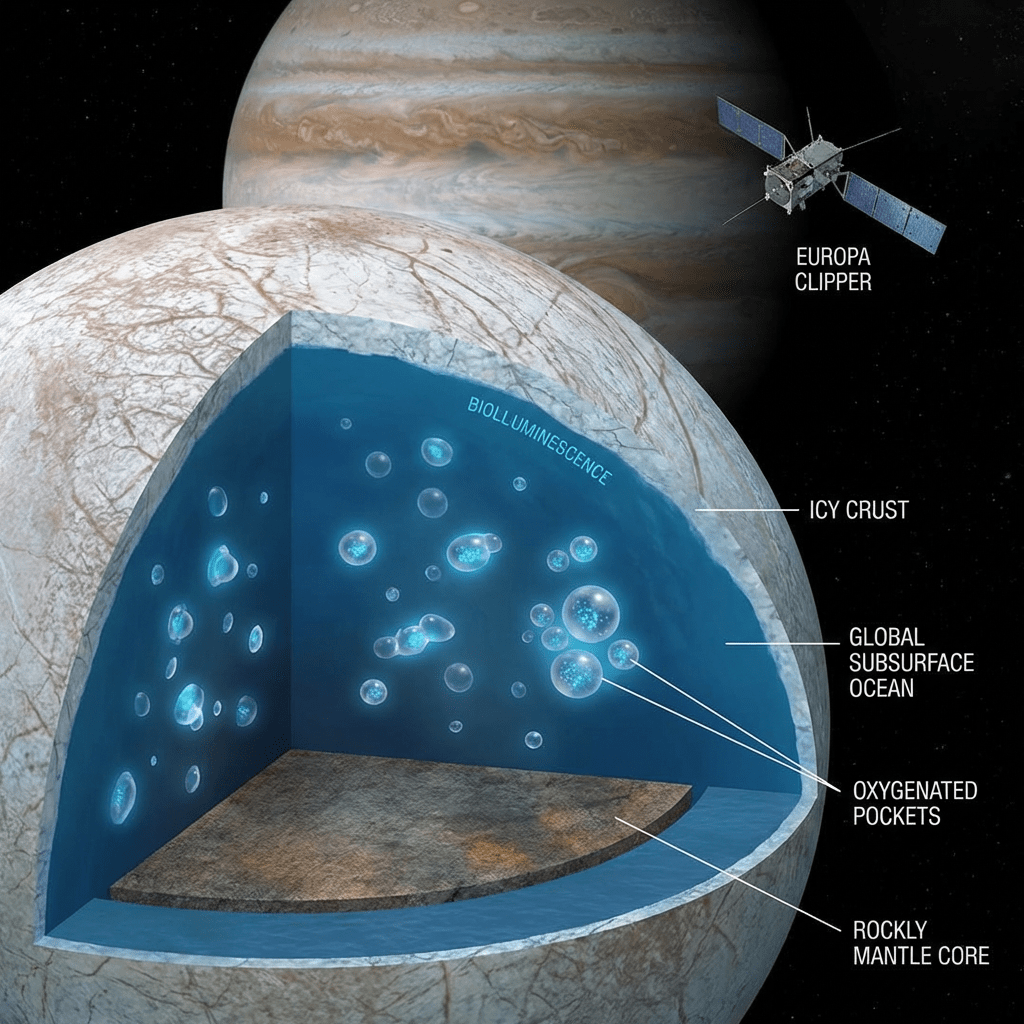
It’s especially intriguing to think about how oxygen could grow in the dark when it comes to frozen moons in our solar system.
People think that moons like Europa (which orbits Jupiter) and Enceladus (which orbits Saturn) have giant oceans below their thick ice shells. These oceans don’t get any sunlight, but they might have the chemicals that life needs to survive.
If “dark oxygen” activities happen there, they could be an unanticipated supply of oxygen and maybe even energy for microbial ecosystems. For example, spacecraft have previously seen plumes of water vapor and organic compounds erupting from below the surface of Enceladus. There is a lot of evidence that Europa has a salty ocean that interacts with a rocky seafloor.
Both of these realms are excellent places to look for life. And in theory, both may have the same kinds of chemical processes that scientists are now studying on the ocean floor of Earth.
General concept of habitability
The “dark oxygen” concept ultimately signifies a significant transformation in science, transcending Earth-centric paradigms regarding the mechanisms of life.
For a long time, people thought that sunshine was the main thing that made the Earth livable. But deep-sea ecosystems have previously proved that life can exist without it, using only chemistry.
Scientists are now looking into whether even oxygen, a molecule that is essential for life as we know it, could have come from somewhere else.
If that’s true, it opens up more places where life could exist and the ways scientists look for it.
The next steps
The theory of “dark oxygen” is still new and up for dispute for now. Scientists are trying to repeat their results, improve their tools, and learn more about the chemistry of deep-sea ecosystems.
Future missions may also assist in testing these ideas in space. NASA‘s next mission, the Europa Clipper, will look closely at the moon’s chemistry to find out more about its ocean’s makeup and whether it may support life.
The deep ocean is still one of the least studied areas on Earth, yet it’s also one of the most startling. Without light, it can still be full of reactions that we are just starting to grasp. And in that darkness, oxygen may be silently testing what we thought we knew about life.





 Sure Media Magazine
Leave a comment