
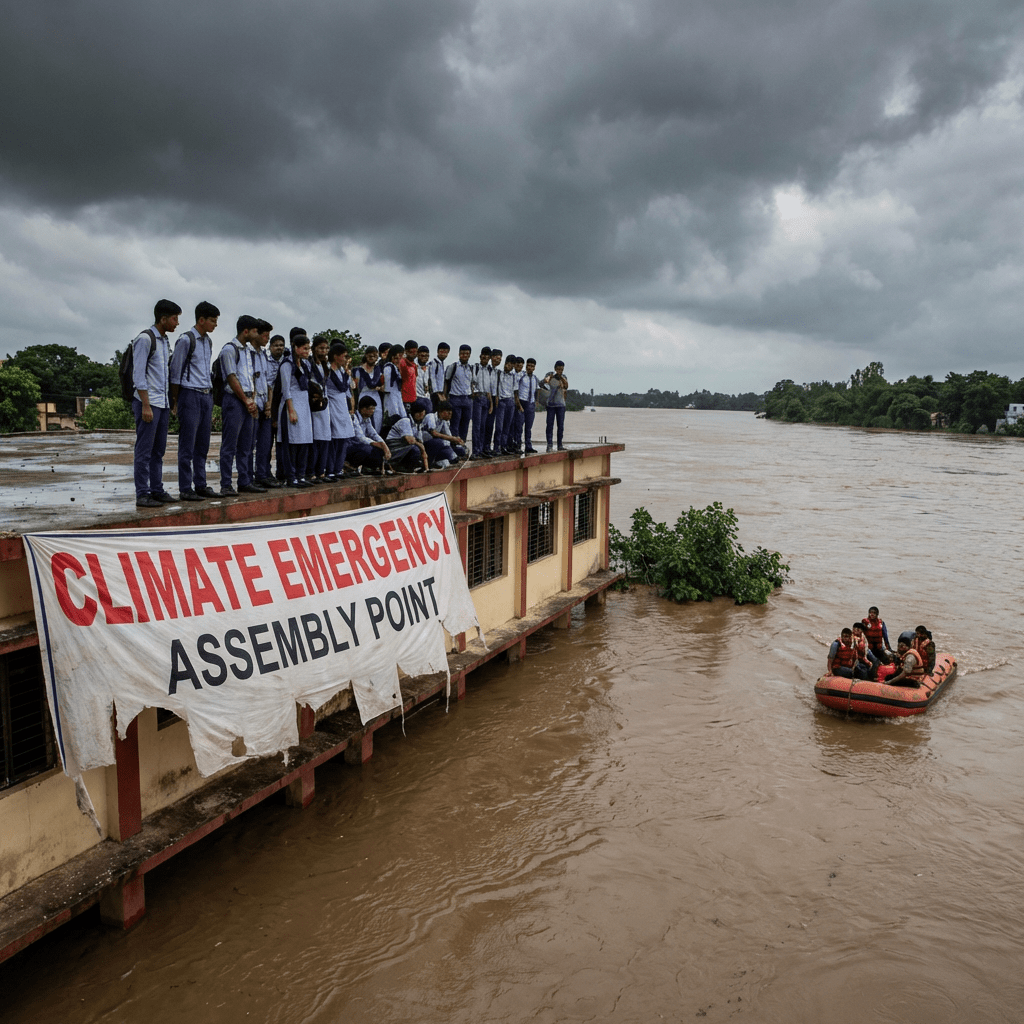
The first smoke day came in late September, on a Tuesday that was supposed to feel ordinary.
At 7:15 a.m., parents in the district outside Spokane, Washington, checked their phones and saw the same message from the school system: classes would open two hours late because of poor air quality. By lunch, the delay became a closure. By evening, the district had added a warning about outdoor sports, field trips, and recess. The smoke from nearby wildfires had settled so thickly over the city that the mountains disappeared from view.
For 15-year-old Maya Torres, a sophomore at Franklin High, the shutdown was not just an inconvenience. It was the third weather-related school disruption in six weeks. A heat wave had already forced a shortened schedule in August. Then a flood in a nearby county knocked out a bus route for two days. Now the smoke had arrived, seeping into gyms, classrooms, and lungs.
“I feel like school is always reacting now,” Maya said. “We are never really starting the year. We are just handling the next thing.”
That sentence captures a growing reality for students across climate-hit regions. Schools used to close for snow days, power outages, or the rare emergency. Now they are being pushed into a cycle of closures, delays, relocations, and emergency learning plans that have more to do with fire maps and temperature alerts than with the academic calendar.
The educational damage is often hidden. It does not always look dramatic. No single disaster may shut a school down for a year. Instead, the losses arrive in fragments: missed lessons, canceled labs, exhausted teachers, students who stop logging in when learning moves online, and classrooms that spend more time discussing safety than algebra, history, or reading.
At Franklin High, the school year has become a patchwork of adaptations. Portable HEPA filters hum in the library. Teachers keep backup slides on USB drives in case the internet goes down. The football team now practices before sunrise during heat alerts. Students are reminded to bring water bottles, but many already know the drill. They have learned to glance at the air quality index the way previous generations checked the weather forecast.
Principal David Nguyen said the school now treats climate disruption as part of operations. “We plan for smoke, heat, flooding, and power issues the way we used to plan for fire drills,” he said. “The problem is, those disruptions keep multiplying. You can prepare for one or two. You cannot keep improvising forever.”
That constant improvisation has consequences. Teachers say they lose instructional time every time the district shifts into emergency mode. A chemistry teacher can postpone a lab once or twice. She cannot do that every week. A history class can move online for a day, but not all students have stable internet, quiet homes, or caregivers available to help. When schools close repeatedly, the gap between students with resources and those without grows wider.
“We tell kids to keep up, but the conditions are not equal,” said school counselor Renee Salazar. “Some students can switch to remote learning and barely miss a beat. Others disappear for a few days and come back lost.”
That unevenness has become one of the defining inequities of climate education. Students in wealthier households are more likely to have laptops, private study space, and adults who can take time off work when school is disrupted. Students in lower-income families often shoulder more care responsibilities and live in housing that is itself less safe during disasters. When learning shifts online, those same students are also more likely to lose access to the support systems that keep them engaged.
And yet these are often the students most directly exposed to climate risk.
In Franklin High’s mostly working-class neighborhood, many families rent older apartments with poor insulation. Heat lingers inside long after sunset. Some students commute long distances because they were pushed out of cheaper housing by rising rents and development pressure. Others live with grandparents or shared households where a closure means children are suddenly responsible for younger siblings while adults work.
Maya knows that pattern well. Her mother cleans hotel rooms. Her father drives deliveries. When school closes, nobody in the family gets a day off.
“If school is closed, it means my mom has to figure out what to do with me and my brother,” she said. “It does not just mean no class. It means the whole day changes.”
That is one reason educators and researchers increasingly say climate change is not only a science issue. It is a schooling issue, a labor issue, a housing issue, and a public health issue. It affects attendance, performance, nutrition, transportation, and mental health. It also changes what students believe school is for.
For some, the lesson is that institutions are fragile. For others, it is that adults are slow to respond. A few students begin to connect the dots between the smoke outside and the policies inside the school walls. Why do they know so much about safety procedures, but so little about the fires themselves? Why are they drilled on lockdowns and evacuations, but not given space to study why their community keeps burning?
Teachers struggle with that question too.
“Students are living through climate change, whether we name it or not,” said science teacher Carla Mendes. “If we never connect their experience to the larger story, we are teaching them to accept disruption as normal. That feels dishonest.”
Mendes tries to bring climate into class through local examples. She shows air quality data, wildfire maps, and temperature records from the region. She asks students to compare past and present patterns. She does not make the lessons political, she says, but she does make them real.
That distinction matters, especially in places where environmental education is under pressure. Some districts avoid climate topics because parents complain. Some administrators worry about controversy. Some teachers self-censor because they do not want to be accused of pushing an agenda. The result is a strange kind of silence: students breathe smoke, miss school, and watch their routines fracture, while the curriculum treats these events as isolated bad luck.
That silence is costly.
When disasters are framed as random, students miss the chance to understand the systems behind them. They are less likely to see links between fossil fuel use, land management, urban planning, and public policy. They are also less likely to see themselves as participants in change. That is a serious loss in any classroom, but especially in one where the crisis is already part of daily life.
Still, there are glimpses of adaptation that feel more than defensive. At Franklin High, one English teacher has begun assigning short reflections after each climate disruption. Not formal essays, just honest writing about what students noticed and how it felt. A social studies class recently examined how different neighborhoods in the same city fared during the heat wave, looking at tree cover, pavement, access to cooling centers, and income. The point was not to scare students. It was to help them see the shape of the problem.
“When young people can name what is happening, they stop feeling like they are just being hit by bad weather,” Salazar said. “They start recognizing patterns. That changes what they ask for.”
What they ask for, increasingly, is not only better air filters or emergency schedules, but safer buildings, more outdoor shade, cleaner transportation, stronger community planning, and honest teaching about climate risks. In other words, they want schools that do more than survive the next disaster. They want schools that prepare them to understand the one after that.
That may be the deepest shift underway. Climate change is not simply interrupting education. It is rewriting its terms.
A generation of students is learning that the school year can be broken by smoke, flood, heat, and fire. They are learning that some children will lose more than others. They are learning that adaptation is now part of childhood.
The question is whether schools will keep treating these disruptions as temporary, or whether they will finally admit that the climate crisis is already in the classroom.




 Sure Media Magazine
Leave a comment