
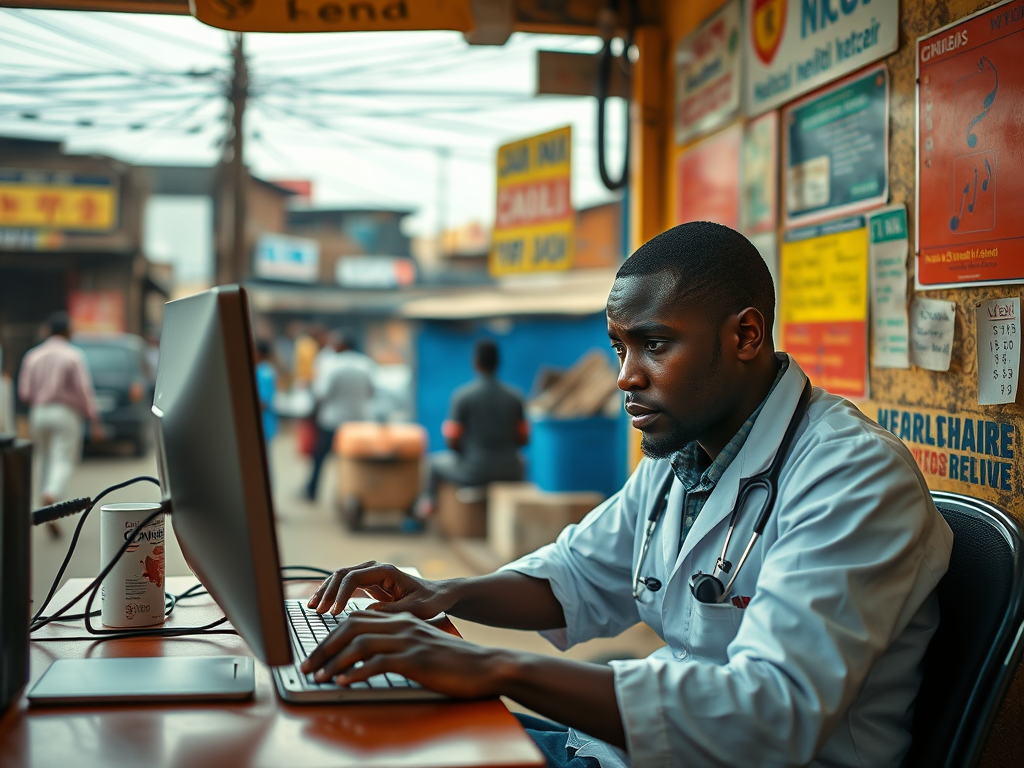
As Kenya rolls out its ambitious Universal Health Coverage (UHC) 2.0 plan, a new crisis is quietly brewing on the country’s healthcare frontlines: the rise of “ghost interns.” These are thousands of interns who work as medical officers, nurses, and clinical officers. A broken system traps them, as county budgets and weak digital payroll systems fail to collaborate.
At the same time, shocks from around the world are making things worse. Donald Trump’s reelection makes it even harder for Kenya to secure funding for its already stretched healthcare system. Counties are speeding up digital health solutions in response. But for many interns, these systems promise to make things easier but end up causing confusion, exclusion, and delays.
Urban areas connected to the internet are experiencing a clear divide from rural areas that lack connectivity. For example, there are cyber cafés in Kibera and dispensaries in Turkana and Teso that often lose power. Young health care workers find themselves in a professional limbo at the heart of this issue.
From the promise of devolution to payroll hell
Kenya’s 2010 Constitution gave health services to 47 counties, promising care that was more local and responsive. In practice, the change has had different effects on different people, especially those who are just starting out in their careers.
Interns in the medical field have some of the hardest jobs. Many people have trouble getting into county systems after completing required rotations set by the Kenya Medical Practitioners and Dentists Council. There are more than 36 medical schools that graduate students every year, but job openings haven’t kept up. Because of budget limits, less than half of them find jobs.
Nurses and clinical officers have a slightly easier time making the switch. Getting a license from the Nursing Council of Kenya often means that you can start working faster. Clinical officers, on the other hand, benefit from structured placements that the Ministry of Health Kenya sets up.
But in 2026, a new layer of complexity has come up: digitalization. As part of UHC 2.0, county governments are rolling out e-payroll systems that require interns to log, verify, and keep track of their employment status online. This should make things less bureaucratic, in theory. System problems, delays, and access gaps have left many people stuck in reality.
Juma Otieno, a 26-year-old medical officer, says the experience feels like a dream. He still hasn’t found a job six months after finishing his internship. He checks county portals every day from a small cyber café in Kibera, hoping to find a job that never comes. He takes on online medical writing jobs to supplement his income. Work that keeps him going but keeps him away from clinical practice. He says, “I’m a ghost in the system.”
Wizards in the City, Ghosts in the Country

The digital divide is changing the way internships work all over the country. Amina Hassan, a nurse intern at Nairobi’s Kenyatta National Hospital, works in a digital environment that is both chaotic and functional. She goes to Zoom debriefings, learns more through TikTok tutorials, and is able to meet licensing requirements even when the system goes down from time to time. She says, “It’s a mess, but at least we’re connected.”
Clinical officers in peri-urban areas are coming up with new ways to adapt. In Kitui, some people have started using WhatsApp to talk to doctors when there aren’t enough of them. This lets them get help from doctors who aren’t in their area. Even though these ideas are not formal, they show how connectivity can make up for gaps in the workforce.
But the story is entirely unique in rural counties. Mary Epong, a clinical officer intern in Turkana, has trouble with unreliable electricity and poor network coverage. Her solar-powered phone often freezes up when she tries to upload her stipend. Logbooks, which are now partially digital, are either missing or broken, which is delaying her professional registration. She says, “No signal, no pay, no posting.”
Medical officers in these areas have to confront even more problems. Training facilities often lack sufficient resources and specialists to oversee them. Many interns leave as soon as they can, which is leading to a brain drain toward private urban hospitals, Gulf countries, or telemedicine platforms. Recent data shows that almost 70% of intern absorptions happen in just a few counties with more money, which makes geographic inequality worse.
Personal Stories: The Cost of Limbo for People
There are deeply personal stories behind the policy failures. Juma, who used to be at the top of his class, wanted to do a residency in orthopedics. Instead, he spends his days trying to navigate his way through unreliable portals and avoiding scams that promise guaranteed jobs. His skills, which used to be sharp from hands-on training, are at risk of becoming dull. He says matter-of-factly, “Counties like hiring nurses because they are cheaper.”
Mary’s life is characterized by solitude. At her rural post in Teso, she struggles to obtain even basic medical supplies. Patients are waiting because the administrative systems are slow. She feels connected to other clinical officers through informal WhatsApp groups, but they can’t take the place of institutional support.
Amina works in Nairobi and lives in both worlds. She uses short videos to show other midwives in remote areas how to do things. But she still feels the pressure of a system that is changing increasingly because of AI and automation.
Across the board, people are still frustrated by things like late paychecks, poor training, and a lack of structured support. Informal digital communities, especially WhatsApp groups, are places where people can plan, share information, and ask for change.
Policy Change: Interns Want “E-Equity”
More than 5,000 interns signed a petition in February 2026 asking for major changes under what they call the “Hybrid Internship Bill.” Some of their ideas are the following:
- Digital logbook systems that work offline
- Satellite training centers in areas that don’t get enough help
- National absorption quotas to make counties more equal
Dr. Selina Mutua and other advocates say that the current model gives too much power to cities. She says, “Devolution plus digitization is making cities better and rural areas worse.” People are already discussing some potential solutions.
There have been talks about pilot programs that would bring satellite internet to remote counties and use blockchain for payroll. But things are still moving slowly because of political tensions between the national and county governments. Interns are starting to realize how much power they have as a group as the 2027 elections get closer. Juma says, “We are the future of this system.” “If we are ignored, UHC will fail.”
A Call Beyond the Gap
The “ghost interns” in Kenya show how devolution can be both beneficial and bad. A system meant to give people power that could make things worse if there isn’t coordination and fairness.
As global funding needs grow and digital health systems grow, the need for “e-equity” becomes more urgent. Investing in rural connectivity, standardized national frameworks, and inclusive digital design is no longer a choice; it is a necessity.
To bridge this gap, we would need to do more than just repair systems. It would mean opening up pathways again so that Juma could practice, Mary could serve well, and Amina could make a bigger difference.
These interns show both how fragile and how hopeful Kenya’s healthcare future is, from the dust of Turkana to the hum of Kibera’s cyber cafés. If they don’t solve their problems soon, the term “ghost intern” may become more common than not.






 Sure Media Magazine
Leave a comment