
When Curating Your Life Becomes Exhausting
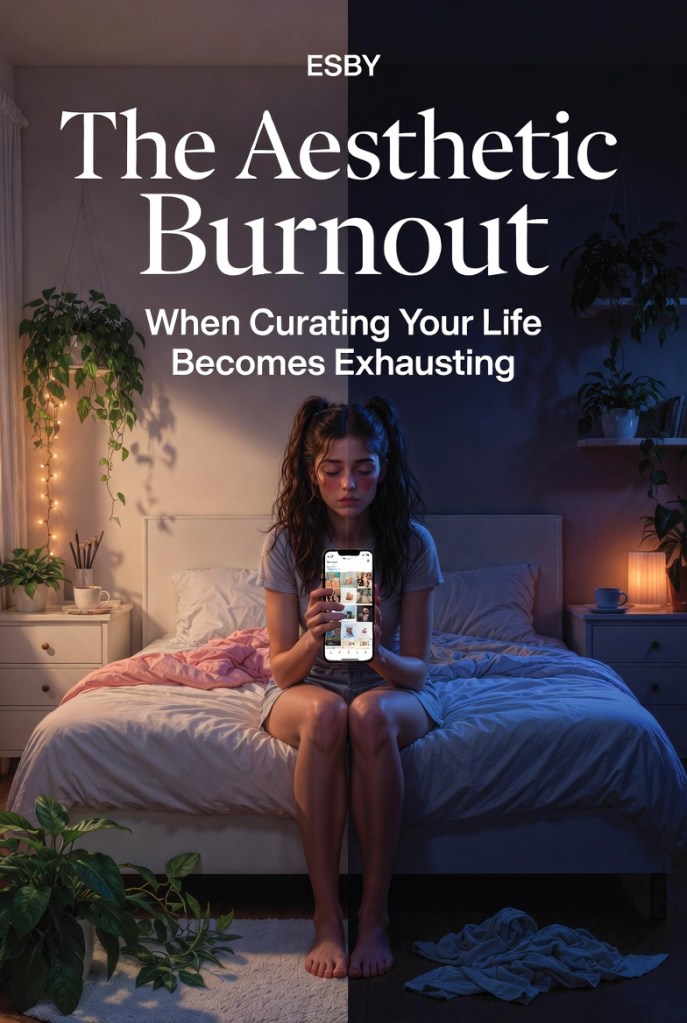
There is a particular kind of tiredness that has no name in any medical textbook. It doesn’t come from overwork, sleep deprivation, or emotional trauma — though it often travels alongside all three. It comes from something quieter and stranger: the relentless pressure to make your life look like something worth watching.
Call it aesthetic burnout. It is the fatigue of never being fully off-camera.
The Algorithm Wants a Coherent You
Somewhere between the rise of Instagram’s visual grid and TikTok’s For You Page, a subtle but seismic shift occurred in how we relate to our own lives. Everyday existence — your morning routine, your bedroom, your lunch, your face — became raw material. Not just something to be lived, but something to be curated, optimised, and packaged into a visual identity coherent enough for an algorithm to reward.
The aesthetics have names now. “Clean girl.” “That girl.” “Dark academia.” “Coastal grandmother.” Each one is a complete lifestyle package: specific colour palettes, particular products, an implied set of values and daily rituals. To participate is not merely to adopt a style — it is to perform a self. Consistently. Convincingly. At scale.
This is not a fringe phenomenon. A 2025 study published in Frontiers in Psychology found measurable links between passive TikTok consumption and body-related envy, suggesting that scrolling — even without actively posting — reshapes how users experience and evaluate their own bodies and lives. The women most affected were not those who felt they were comparing themselves to others. They were simply watching, absorbing, and slowly finding their unfiltered reality inadequate by comparison.
Tired Girl Makeup and the Monetisation of Exhaustion
Perhaps nothing captures the paradox of aesthetic culture more precisely than the “tired girl makeup” trend. On its surface, it appears to be a small act of rebellion — an embrace of imperfection, dark circles included. In practice, it is the opposite. Rather than opting out of the performance of wellness, tired girl makeup absorbs burnout into the aesthetic. Exhaustion becomes a look. A look requires products. Products require purchase. The cycle continues.
This is the sophistication of contemporary aesthetic culture: it does not demand that you be well. It only demands that your unwellness be visually coherent.
The clean girl look sells green juices and linen sets. Tired girl makeup sells under-eye patches and tinted lip balm. Dark academia sells leather-bound notebooks and tweed coats. The emotional state is almost irrelevant — what matters is that it is legible, reproducible, and ideally shoppable. Burnout, repackaged, becomes content.
Identity by Algorithm
What makes aesthetic culture genuinely disorienting — beyond the obvious commercial mechanics — is the way it colonises identity formation itself.
Human beings have always constructed identity through appearance, affiliation, and self-presentation. This is not new. What is new is the feedback loop: the immediate, quantified response that social platforms provide. A post performs well or it doesn’t. An aesthetic resonates or it doesn’t. The algorithm tells you, in near real-time, which version of yourself is worth amplifying.
Over time, this creates a peculiar kind of self-surveillance. You begin to see your own life through the lens of its potential content — not because you are vain or shallow, but because the platform has trained you to. You notice the light in your kitchen and think: that would photograph well. You choose a coffee shop based partly on its aesthetic. You curate a bookshelf not only for the books but for the backdrop they create. None of these individual acts is particularly alarming. Accumulated, they amount to a significant reorientation of how you inhabit your own life.
The philosopher Erving Goffman wrote, decades before social media existed, about the “performance of self” in everyday life — the idea that we are always, to some degree, managing impressions. What he could not have anticipated was a world in which the audience is always present, the stage never dark, and the performance metrics publicly visible. Social media did not invent self-presentation. It industrialised it.
The Quiet Cost
The burnout that results is not dramatic. It rarely announces itself. It arrives, instead, as a low-grade dissatisfaction — a feeling that your actual life keeps falling short of the one you are curating online. It shows up as the exhaustion of maintaining visual consistency across platforms, of keeping up with the micro-trend cycle, of never quite allowing yourself to exist in a moment without also imagining how it might be framed.
It shows up, too, as a strange estrangement from your own preferences. After months or years of filtering your choices through the question of how they will appear, it becomes genuinely difficult to know what you actually want — as opposed to what fits the aesthetic you have built. Your home, your wardrobe, your hobbies, your relationships: all slowly adjusted toward legibility, toward coherence, toward content.
This is what aesthetic culture, at its most corrosive, does to selfhood. It does not erase who you are. It layers so many curated versions over the original that finding it again requires real effort.
Opting Out Is Not Simple
It would be convenient to end here with an injunction to simply log off — to reclaim your messy, unfiltered, algorithm-immune life. But that advice, while not wrong, understates the structural pressure involved.
For many women, aesthetic participation is not purely recreational. It is economic. It is social. It is the way communities are built, opportunities are found, and visibility is earned in industries that now operate partly or entirely through social platforms. To opt out entirely is a privilege not universally available.
What is available, however, is a more conscious relationship with the performance — one that acknowledges the pressure without fully surrendering to it. That might look like deliberately maintaining spaces in your life that exist outside the frame: conversations that are never posted, rooms that are never photographed, mornings that belong entirely to you.
It might also look like noticing, without judgment, the moments when you reach for your phone not out of genuine desire to share but out of a trained compulsion to document. That pause — that small gap between impulse and action — is where agency lives.
The Unfiltered Self
There is a version of you that predates every aesthetic you have ever adopted. She is less consistent, harder to categorise, and entirely unoptimised for algorithmic reward. She is also, in all likelihood, more interesting — and considerably less tired.
Aesthetic culture will not stop evolving. The trends will keep turning over; the packaging will keep getting more sophisticated. But the fatigue it generates is a signal worth listening to. Not as content. Not as a look. Simply as information: something in the performance is costing more than it returns.
The most radical thing you can do, in a world that wants your life to be a mood board, is to occasionally allow it to be nothing more than a life.





 Sure Media Magazine
Leave a comment