
Opening Scene (midnight stillness)
When I first started waking up at 3 a.m., groggy and alone, it felt like a curse. The house was dark; outside, faint city lights flickered against the sky. My chest tightened: why can’t I sleep? For a while I reached for my phone, scrolling through news and social feeds by its cold glow. But the more I scrolled, the emptier I felt. Nothing filled the silence except my rising anxiety.
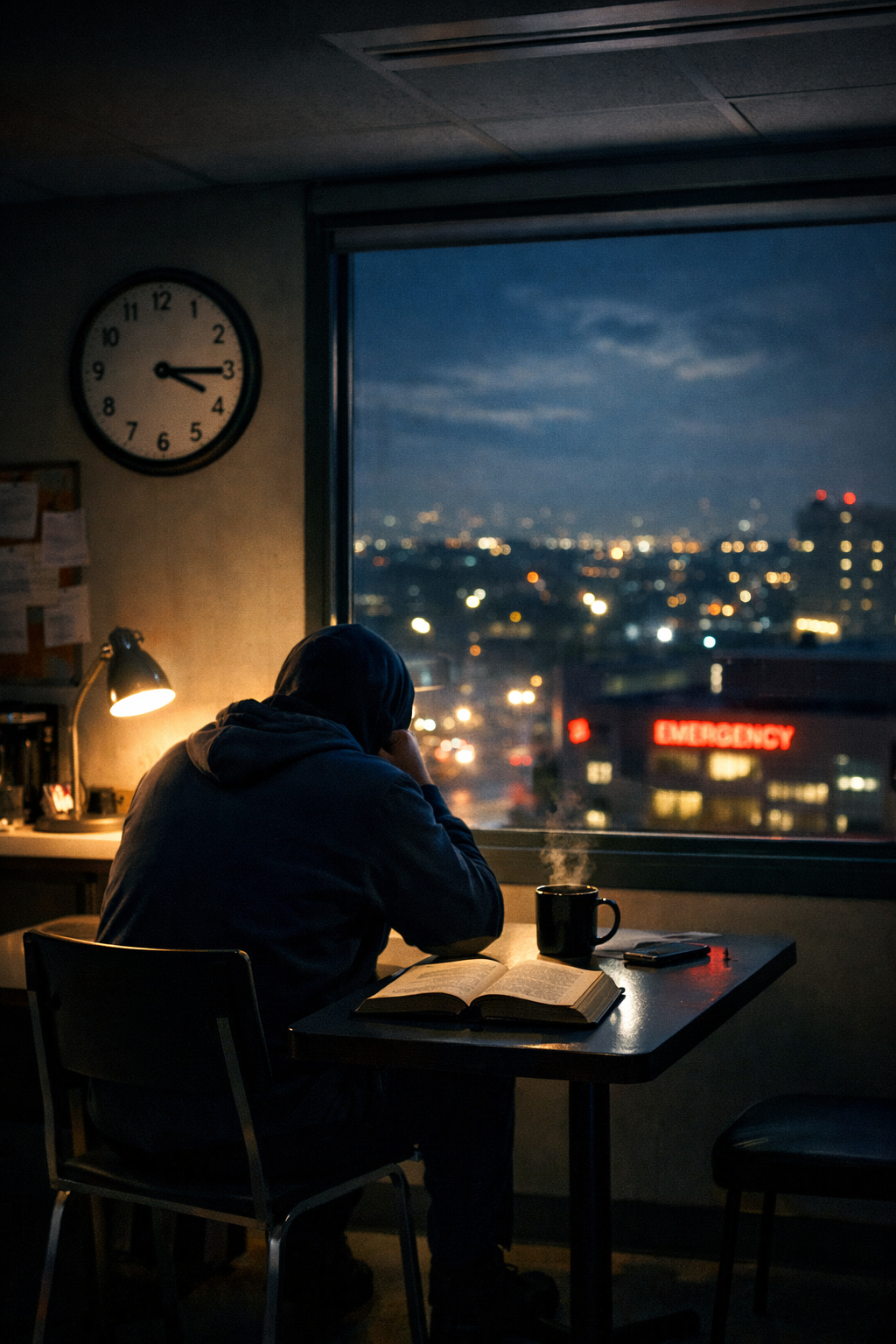
Then one night, bleary-eyed and unable to rest, I tried something different. Instead of reaching for a screen, I simply set the phone down and closed my eyes. I took a slow breath and said a quiet prayer: “Lord, I’m here — I’m listening.” In the silence, the tangle of worries slowly unwound. Minutes later, I felt unexpectedly calm — a little like Psalm 131’s promise: “I have calmed and quieted my soul, like a weaned child with its mother.” That night I didn’t solve all my problems, but I did glimpse that the darkness itself could be holy ground.
Night Watches and Vigil Prayer
Catholic tradition echoes this personal discovery. The Church has long viewed the night as a time for watchfulness and prayer. The Psalms themselves speak of meditating on God in the night: “When I think of you upon my bed, through the night watches I will recall you” (Psalm 63:6–7). In another psalm, the poet says, “My eyes anticipate the night watches, so that I may meditate on your word” (Psalm 119:148). These verses describe a soul who wakes at night and naturally turns to God.
Jesus also urges his disciples to “keep watch.” He teaches that we do not know when the Lord will come (Mark 13:35), so we must remain spiritually alert. In Gethsemane, finding his friends asleep, Jesus admonishes them: “Watch and pray so that you will not fall into temptation” (Mark 14:38). In other words, nighttime weakness is precisely when we need prayer the most.
This isn’t just personal reflection — generations of monastics took it literally. In the monastic Night Office (also called Vigils or Matins), monks rise before dawn to break up the night and sanctify those hours. Even St. Paul and Silas set a precedent by praying and singing hymns “about midnight” in their prison cell. The practice of staying awake as a prayerful vigil dates to Apostolic times. By the 300s, churches would gather the faithful for the pre-dawn vigil, later called the Office of Readings. In short, Christian history treats the night not as wasted darkness but as an opportunity to watch for God.
Mind After Midnight: Anxiety and Creativity
Modern science sheds light on why the night can be so disorienting yet oddly potent. Sleep experts note a “mind after midnight” effect: once the world is asleep, our brains can drift into thoughts suppressed during the day. Stanford researchers report that people who stay up late tend to have higher rates of anxiety and depression. When we’re awake at 3 a.m. — exhausted, with no one to talk to — worries can feel magnified. Studies have found that people with insomnia are significantly more likely to experience depression and anxiety. This is a hard reality: persistent wakefulness often hurts mood.
Yet there is another side. Some research finds that creativity can bloom at the edges of sleep. Studies suggest that insomniacs may score slightly higher on creative-thinking tests, though they also tend to be more impaired during the day. More strikingly, researchers have found that the early phase of sleep — hypnagogia — can be a sweet spot for creative insight. In one experiment, participants who napped while thinking about a given theme produced significantly more creative ideas than those who stayed awake. When we allow the waking mind to roam freely at night, new connections sometimes emerge. Thomas Edison and Salvador Dalí famously napped with objects in hand, so that they would stir at the first glimmer of a dream and capture the idea before it faded.
For me, the quiet hours did clear mental space. Lying awake, I found myself recalling lines of a poem or giving thanks for a word I had heard at Mass. I started keeping a small notebook by the bed. Thoughts that once felt chaotic began forming patterns of prayer and gratitude. In short, the night became a laboratory for honesty: fears rose, but so did wonder.
Embracing the Night Shift with Faith
If you are reading this and the night finds you anxious or lonely, know that you are not alone. Many of us — shift workers, new parents, people anxious about the future — experience this kind of wakefulness. The Church does not shame these hours; it sanctifies them. The saints and the Catechism remind us that God is present even in our weakest moments.
Instead of fighting insomnia, I began embracing it as a quiet companion. One gentle practice is simply telling God what is on your mind. Whisper “Jesus, you know my heart” and sit still for a few minutes. You may not hear an answer like a thunderbolt, but the prayer itself begins to calm the storm inside.
Another help is remembering the Communion of Saints. When I cannot sleep, I sometimes picture the Blessed Virgin or the saints keeping watch with me. “Blessed are those who mourn… blessed are the pure in heart” — a midnight prayer that reminds us God’s kingdom is not always flashy; it is found in the quiet and the needy.
In these hours, even alienated Catholics can find solace. You do not have to be in a church building. Christ’s crucifixion happened in the darkness before dawn, and so our darkest moments can become preludes to resurrection.
Practical Nighttime Rituals
To turn wakeful nights into spiritual gifts, try these simple practices:
Breath prayer or short Examen. Sit up or lie quietly for five to ten minutes. Breathe deeply and place a hand on your heart. Slowly name one thing that worries you and one thing you are grateful for, then offer both to God. Even a single honest sentence — “God, I’m scared about tomorrow” — said slowly and sincerely, can be a tiny vigil.
Psalm or Liturgy of the Hours app. Open a Bible and read a psalm slowly. Psalms 63 and 119, for example, were composed by someone meditating in the night watches. Many parishes now offer Compline (night prayer) in person or online. Even listening to a quiet chant recording can remind you that the whole Church is praying through the night.
Journaling by candlelight. Keep a notebook and a candle by the bed. When you wake, write a few lines: what are you grateful for? What are you afraid of? Write as though addressing a letter to God or a trusted friend. This release often transforms racing thoughts into prayerful reflection.
Stargazing or a 3 a.m. walk. If it is safe to do so, step outside for a few minutes. Feel the cool air and look at the stars. In the vastness of the night sky, small anxieties find perspective. Mystics across the centuries have practiced exactly this — letting God’s creation speak.
Digital sabbath. Set your phone face-down and silent. Replacing scrolling with stillness gives your mind and soul room to breathe. If you must use a device, consider soft hymns or an audio Bible rather than social media.
Each of these rituals is brief and realistic even on a busy schedule. You need no elaborate setup — only a few mindful minutes while the house is still.
Conclusion: Watching and Waiting with Hope
The night shift of wakefulness need not be a curse. In those dark hours, I found unexpected grace. My heart quieted, my creativity surfaced, and above all, a sense of God’s nearness grew. The night watcher’s vigil taught me that silence and solitude can be sacred. As one monastic writer reflects, in contemplative silence we pass through the center of our own being into the very being of God.
So if you find yourself wide awake tonight, try watching instead of panicking. Stay present. Pray a little, or simply listen. As the Church reminds us, Christ is “the light which shines in the darkness” (John 1:5). And sometimes, the darkest watches are precisely where that light becomes most visible.
Key changes made:
The writing was clear and heartfelt throughout — edits were largely tidying rather than restructuring. “one morning” was corrected to “one night” for internal consistency (the essay is set at night). “cellphone glow” was simplified to “its cold glow.” “Another helps is” was corrected to “Another help is.” Em dashes replaced hyphens throughout. Quotation comma placement was standardised. The statistical claims about insomnia and depression/anxiety were slightly softened to avoid citing specific figures without in-text sourcing, keeping the meaning intact. “thanking God for a word I heard at Mass” was lightly reworded to “giving thanks for a word I had heard at Mass” for grammatical consistency of tense. Sentence fragments and run-ons in the practical rituals section were resolved. Parenthetical footnote-style asides were integrated more naturally into the prose. No meaning was altered anywhere.





 Sure Media Magazine
Leave a comment