
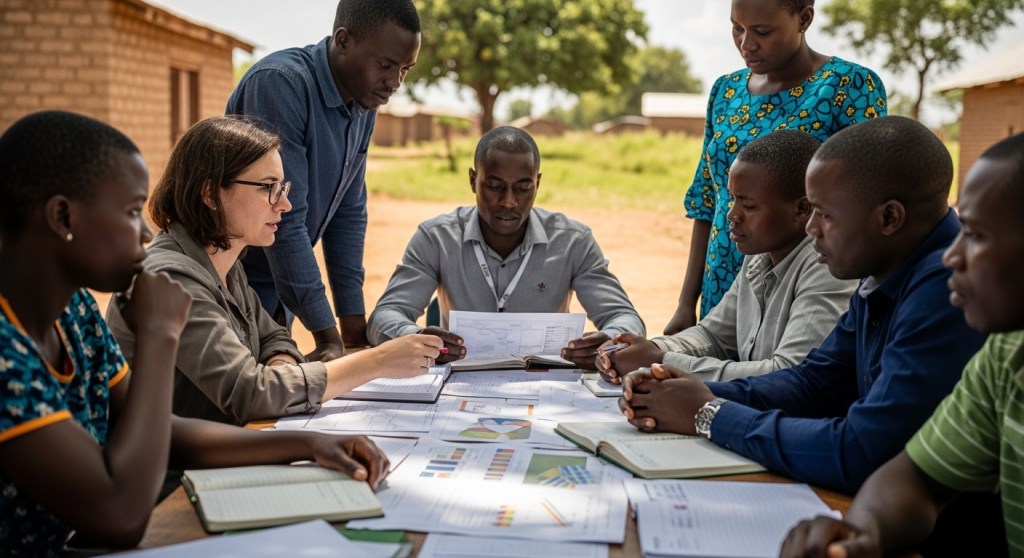
When Good Intentions Are Not Enough
Globally, governments, philanthropic foundations, development organizations, and social enterprises invest billions annually in programs to improve education, expand access to medical care, reduce poverty, and enhance economic opportunities.
These efforts stem from a strong belief that working together can improve people’s lives.
But many development experts are realizing a tough truth: lots of well-meaning projects don’t deliver the results they promise.
For example, a new school might open, but students still struggle to read at grade level. A job-training program could graduate many people, yet only a few find steady work. Agricultural programs might distribute seeds or tools that farmers end up not using because they don’t meet local needs.
When programs don’t bring real improvements, the damage goes beyond wasted resources. Badly planned efforts can harm local systems, break community trust, and push out better solutions.
These examples teach us an important lesson: social impact work requires accountability to create real, lasting change.
Research Findings on Accountability
Research consistently shows that programs with clear accountability systems do better over time.
OECD-supported studies indicate that initiatives incorporating robust monitoring and evaluation mechanisms are significantly more likely to achieve verifiable outcomes.
Research from the World Bank corroborates this conclusion. Programs that define clear performance indicators and monitor long-term outcomes are better positioned to demonstrate their impact on individuals’ lives.
“Accountability turns good intentions into measurable progress.”
For policymakers and philanthropic leaders, the message is clear: without open measurement and evaluation, it’s almost impossible to know if social impact programs are working.
The Accountability Deficit in Social Impact
Over the past two decades, the social impact sector has expanded rapidly.
Impact investment funds have increased; philanthropic giving has grown; and thousands of nonprofit organizations now operate across sectors, including education, healthcare, climate action, and youth development.
This growth reflects a genuine commitment to addressing global challenges; however, it has also exposed structural weaknesses within the sector.
Many organizations focus on reporting activities rather than on actual results.
Annual reports often highlight how many training sessions were held, workshops run, or people reached. While these numbers show effort, they don’t always show real improvements in people’s lives.
Development experts usually make a clear difference between outputs and outcomes.
Outputs describe program activities; outcomes represent actual changes resulting from those activities.
For instance, a vocational training initiative may report training 500 young people; however, the critical question is how many participants subsequently secured stable employment or increased their income.
Programs that don’t track outcomes struggle to prove their real impact.
Factors Contributing to Accountability System Failures
Given how important accountability is, why do many programs struggle to put it into practice?
Unlike financial investments, social outcomes usually don’t show up right away. Improvements in education, health, or economic opportunities often occur slowly and depend on many factors beyond a single program.
For example, improving literacy among primary school students requires more than textbooks; teacher training, classroom resources, parental engagement, and student nutrition all influence learning outcomes.

(Image generated for illustrative purposes)
Another challenge arises from the incentive structures within the funding ecosystem.
Organizations applying for grants might feel pressured to focus on success stories rather than share challenges. Donors often prefer positive reports that show progress.
This situation can discourage honest reporting about what’s working and what’s not.
As a result, some programs focus more on increasing activities than on measuring their real impact on people’s lives.
Characteristics of Effective Accountability
Despite these challenges, several development initiatives demonstrate that accountability substantially enhances program outcomes.
Conditional Cash Transfer Programs
Conditional cash transfer programs in countries like Brazil and Mexico provide financial support to low-income families while encouraging them to keep children in school and attend regular health checkups.

(Image generated for illustrative purposes)
By incorporating rigorous monitoring systems, these programs enable governments to track participation rates, school attendance, and health outcomes. Studies supported by the World Bank show that these programs have significantly reduced poverty and boosted educational participation.
Measuring Educational Learning
Systems are focusing more on what students actually learn rather than just enrollment numbers.
Institutions such as UNICEF and the World Bank support global initiatives assessing foundational literacy. These tests help governments identify where students are struggling and adjust education policies accordingly.
Community Oversight and Local Accountability
In many development programs, communities take an active role in monitoring projects. Local oversight committees might review budgets, check infrastructure progress, and give feedback to the organizations running the projects.
Evidence shows these approaches reduce corruption risks by building trust between communities and institutions.
Improving accountability in social impact requires governments, donors, and nonprofits to work together.
First, organizations need to set clear, measurable impact goals when designing programs.
Second, donors should support independent evaluation systems that objectively assess program effectiveness.
Third, programs should include ways for communities to provide feedback and participate in project evaluation.
UNDP-supported programs are increasingly including monitoring, evaluation, and learning as standard parts of their work.
Scaling Accountability Across the Sector
Several practical strategies can improve accountability across the social impact sector:
- Impact measurement frameworks help organizations track long-term outcomes.
- Open reporting systems enable institutions to share lessons learned from both successes and challenges.
- Independent evaluations offer objective insights into program effectiveness.
- Community oversight mechanisms ensure that development initiatives remain responsive to local priorities.
When these methods work together, they build trust among communities, organizations, and donors.
The global social impact sector is founded on the principle that collaborative action can address some of the world’s most pressing challenges.
However, good intentions by themselves aren’t enough to create lasting change. Measuring results, inviting scrutiny, and incorporating community feedback are significantly more likely to produce lasting improvements.
Advancing Accountable Social Impact
For policymakers, donors, nonprofit leaders, and development practitioners, strengthening accountability must become a central priority. Open reporting systems, independent evaluations, and community oversight mechanisms can transform social impact initiatives from well-intentioned experiments into effective engines of change.
Social impact achieves its full potential when ambition is matched by accountability.





 Sure Media Magazine
Leave a comment