
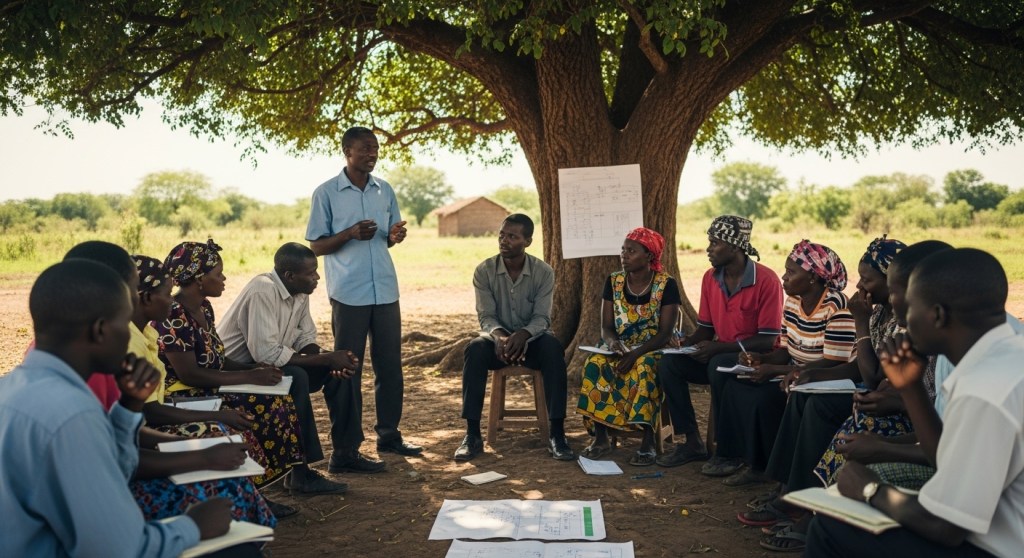
When Development Programs Fail to Reach the Communities They Intend to Serve
Annually, governments, development banks, and philanthropic foundations invest billions of dollars in programs to improve education, expand access to medical services, strengthen agricultural systems, and reduce poverty.
These projects usually start far from the communities they aim to help. Policies are created in national ministries or international agencies. Funding plans get approved, and implementation strategies are shared across regions.
Even with these resources and good intentions, the results often fall short.
For example, a school building may be completed while classrooms remain underutilized. An agricultural program may distribute improved seed varieties that farmers ultimately choose not to plant. A health facility may open only to find that families continue relying on informal local care networks.
These examples are common and highlight a bigger problem in development work: programs designed without real local input often don’t fit the realities communities experience.
Over the last 20 years, researchers and practitioners have come to recognize that communities often have the insights needed to create better solutions.
Evidence Behind Community-Driven Development
More and more research shows that involving communities in development projects really makes a difference.
• A review of community-based development programs in more than 60 countries found that local participation significantly improves project sustainability and accountability.
• Development projects incorporating community supervision systems demonstrate higher adoption rates and improved maintenance of infrastructure, including schools, water systems, and rural roads.
• Research on participatory development initiatives indicates that community participation enhances program transparency and reduces fund misuse.
• In rural health programs, community health worker models have substantially improved maternal and child health outcomes, especially in disadvantaged regions.
Development experts often sum this up like this:
“Development works best when communities are treated as partners, not recipients.”
When locals get involved, accountability improves, interventions become more relevant, and programs are more likely to continue after outside funding ends.
The Structural Limits of Top-Down Development
Centralized development planning has its benefits. National governments and international groups can quickly gather resources, coordinate efforts across sectors, and roll out programs to whole populations.
But centralized strategies often struggle to handle the complex realities of local areas.
Communities vary widely in geography, economic activities, cultural norms, and institutional capacity. A policy that works effectively in one region may perform poorly in another.
Agricultural policy exemplifies this challenge. A seed variety recommended by national programs may thrive in one climate zone but fail in areas with differing rainfall patterns or soil conditions. Farmers encountering these mismatches often revert to traditional crops they trust.
Infrastructure projects face similar challenges. A water system designed by external engineers may neglect traditional community methods for managing water access or resolving disputes over shared resources.
If development programs ignore these local details, they might end up tackling problems that communities don’t see as urgent.
Why Local Knowledge Matters
Local communities have knowledge that often doesn’t show up in national policies but plays a big role in whether development programs succeed.
Farmers track rainfall patterns and soil conditions that determine planting decisions. Teachers and parents understand the factors that influence whether children attend school regularly. Local leaders often know which communication channels communities trust when public health drives are introduced.
Take vaccination campaigns as an example. In some areas, public health teams struggled to raise immunization rates even though vaccines were widely available. It was only after working with community leaders and adjusting outreach to local communication channels that coverage improved.
Local knowledge doesn’t replace technical expertise; it complements it. When development experts blend scientific research with community experience, programs respond much better to real conditions.
Why Community-Driven Development Often Performs Better
Research often points out several benefits of community-led initiatives.
Higher participation. Community members are more likely to support projects they helped design.
Better accountability. Local oversight makes it clearer how resources are spent.
Better program design. Solutions show everyday realities, increasing adoption rates.
Sustained long-term viability. Communities regularly maintain projects after donor funding ends.
Evidence from the World Bank’s study of community-driven development programs shows that these factors significantly improve project durability.
Real-World Examples of Local Solutions
Across sectors and regions, locally led initiatives demonstrate how community engagement can strengthen development outcomes.
Community Health Workers Expanding Access to Healthcare
In many rural regions, access to healthcare remains limited due to the distance between clinics and communities. This problem can be addressed by training local residents to provide basic healthcare services, health education, and referrals.

(Editorial illustration generated using AI for educational storytelling)
Since these workers reside in the communities they serve, they understand local languages, customs, and barriers to care. Evaluation shows that community health worker programs can considerably improve maternal and child health outcomes, notably in underserved areas.
Community Participation in Education
Educational systems also benefit from community participation.
In several countries, school management committees comprising parents and community representatives monitor school budgets, promote attendance, and facilitate communication between teachers and families.
These committees strengthen accountability within schools and foster stronger relationships between educational systems and the communities they serve. Multiple education reforms show that schools with strong community oversight frequently experience enhanced attendance and better learning outcomes.
Farmer Cooperatives Enhancing Agricultural Markets
Agricultural cooperatives constitute another compelling example of locally led development.
When farmers organize collectively, they acquire greater bargaining power in markets, share knowledge regarding climate conditions, and jointly invest in equipment or storage facilities.

(Editorial illustration generated using AI for educational storytelling)
These cooperatives enable communities to experiment with agricultural strategies adapted to their specific environmental conditions.
In many regions, collective models have increased farmer incomes and strengthened local food systems.
Policy Implications for Development Leaders
Recognizing the value of local leadership does not imply abandoning national development strategies.
Instead, policymakers must design systems that integrate national resources with community participation. Policy priorities emerge consistently from development research.
First, programs should incorporate formal mechanisms enabling community participation in planning and decision-making. Structures should be flexible enough to allow projects to adapt to local conditions.
Third, monitoring systems should incorporate feedback from local stakeholders to promptly identify implementation challenges.
Development agencies increasingly emphasize these principles. Programs supported by the World Bank and UNDP increasingly include community participation as a central design element.
Scaling Local Solutions Without Losing Local Ownership
One concern frequently raised by policymakers is whether locally driven initiatives can scale.
However, scaling does not necessitate replicating identical projects universally.
Successful models typically scale by replicating underlying principles rather than exact designs. A community-led water management program may use a similar governance structure across multiple regions while allowing each community to adapt its infrastructure to its environment.
This approach maintains the flexibility that renders local initiatives effective while enabling governments to expand successful frameworks.
Rethinking Development Partnerships
Large development programs often aim to address complex issues at national or global scales. However, many durable solutions originate from smaller initiatives grounded in community leadership.
Communities comprehend their challenges in ways that external institutions cannot fully capture.
When development strategies recognize this knowledge and incorporate it into program design, interventions become more practical, trusted, and lasting. For policymakers, philanthropic organizations, and development agencies, the path forward is becoming clearer.
Communities should no longer be regarded as passive recipients of development assistance.
Instead, they must be recognized as partners in identifying challenges, shaping solutions, and sustaining progress.
Investing in locally led development enhances accountability, improves program effectiveness, and increases the likelihood that development efforts will produce lasting change.





 Sure Media Magazine
Leave a comment