
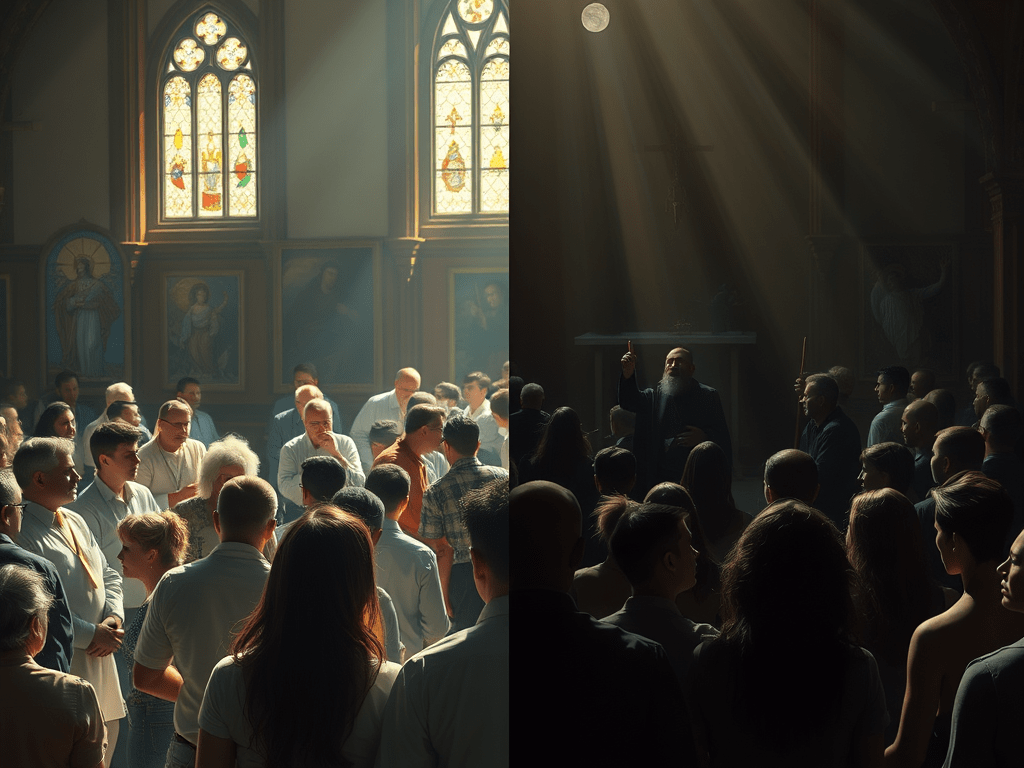
Understanding the Differences and Warning Signs
RELIGION VERSUS CULT: THE DIFFERENCE One of the most contentious issues when it comes to groups holding shared beliefs is the difference between religion and cult. While the two share similar characteristics such as belief system, charismatic leader and a close-knit group of followers, there are some very distinct differences between them that set them apart. In this article we shall look at the characteristics of each, the criteria for defining them and give examples of both.
Freedom of Belief and Behavior:
Religions and cults are distinguishable on the basis of beliefs and behavior and the amount of religious freedom that is allowed to its members. Religious teachings and practices of the majority are open to questioning and members are allowed to hold their own set of beliefs. They have the option to stay or leave the religion as they please. Cults suppress individual questions and freedom of belief and religion. They exert strong control over the beliefs and behavior of the cult members and use strong-arm tactics.
Scientology the cult of L. Ron Hubbard has been criticized for the degree to which it seeks to control its adherents, including allegations of forcing them to be totally devoted to the organization by isolating them from others, and threatening them with “disconnection” (the cut-off from all family and friends) if they do not comply. The world’s major orthodox religions, on the other hand, generally allow a wider degree of individual interpretation and freedom of inquiry of doctrine and of religious texts.
Leadership Structure and Authority:
A major difference between a religion and a cult can be the structure of leadership in that group. While religions are organized with established institutions and traditions, a cult can be thought of as an organization led by a cult leader, with either clear or ambiguous claims to divinity. These charismatic figures who found these groups claim direct knowledge of divinity, and possess a knowledge of what is right, wrong, good, and bad, which makes them an authority and a role model. These religious groups believe the founder to be more than human. It is not unusual for these cult leaders to accumulate unlimited authority in a single individual or at the very least for there to be clear single authority figures for devotees to follow. Collective leadership decisions are also an uncommon trait for cults.
Every cult has one thing in common: a charismatic leader who presents himself/herself as the absolute authority, the sole architect of truth and the supreme guide. This one element, which may seem innocuous to some, guarantees the existence of a power imbalance between the cult leaders and the common members, and turns the latter into unconditional followers. The unconditional recognition of the cult leader as the supreme authority is the trigger for the typical cult characteristics of blind obedience and complete abolition of the member’s personal freedom.
One of the most infamous examples of a cult with a single leader is the People’s Temple, which was founded by Jim Jones. Jim Jones was able to dominate thousands of followers through means of creating a highly dependent and isolated environment. After the move of the cult to Jonestown in the country of Guyana, over 900 people in the cult died in Jonestown in one of the largest mass murder-suicides in history.
Control and Isolation:
One of the primary methods by which cults achieve domination over their members is through control and isolation. Members are often asked to sever all relationships outside the cult, to forego outside study and information, and to rely almost exclusively on the cult as a source of emotional and psychological nourishment.
That culture can be incredibly damaging to individuals because it essentially cuts them off from external sources of support and rational perspectives, which can have very damaging consequences for members’ mental health. Because cults create a highly esoteric system of beliefs that are virtually incomprehensible to outsiders and serve to legitimize the authority of cult leaders and institutions, they generally actively suppress dissenting perspectives and make it extremely difficult for outsiders or rebels to successfully infiltrate or disrupt the group.
A cult that practiced control and isolation was the religious sect known as the Branch Davidians. The cult was led by David Koresh who kept his followers tightly under control, maintaining an extremely isolative atmosphere and imposing rigid controls and rules on their behaviors. These controls played a significant part in the standoff which occurred in 1993 in Waco, Texas.
Navigating the Thin Line:
Whatever the criteria may be, it seems that all can agree that there is a vast difference between a religion and a cult. Yet sometimes it appears that the distinction between the two can be fairly ambiguous. Sometimes a group is defined as a cult that later on evolves into being more commonly recognized as a religion. Conversely, the very same group that acts out cult behaviors that strongly red flag mind control and abusive manipulation can simultaneously identify itself as a religion with all the legitimacy that label provides.
Before joining a new religious group, one must consider and carefully scrutinize the teachings and practices of that group. Information regarding manipulative and coercive tactics of the group and possible warning signals should be sought and carefully noted. Every individual must consider these factors and examine whether the religious group falls into the category of a beneficial religious group or a dangerous cult.
In examining the legitimacy of a particular group, one has to ask if the religion frees man or enchains him. A valid religion allows for self-improvement, the use of intellect and the full exercise of individual freedom of choice and action. A cult, on the other hand, necessarily restricts the right to free thinking and conduct in the service of the self-interest of the cult leader.
Religion vs Cult is a topic that is often open to debate and there are a variety of points that need to be taken into account when trying to define and locate the boundaries of each. The issue most commonly revolves around freedom of religion and the extent to which belief and behavior are allowed in each respective grouping, as well as issues of leadership and authority and the extent to which control and isolation are enforced within the cult.
To remain aware of potential red flags and to know how to recognize and combat forms of manipulation, coercion and psychological or physical abuse is important, whether in secular or spiritual settings. Criticism of such settings and especially an awareness of personal freedom is key to protecting oneself against the danger of so-called destructive cults, while at the same time preserving meaningful spiritual relationships. Ultimately, it is the individual’s decision whether he/she chooses to empower or to enslave himself.





 Sure Media Magazine
Leave a comment