

In many public systems, investments usually come too late, only after problems have turned into crises.
Governments spend billions on incarceration, emergency healthcare, remedial education, and housing instability. These efforts are important because they help stabilize communities and support people in crisis. However, by the time these systems step in, social and economic problems have often been growing for years.
Research in economics, education, and public health shows that a better approach is to invest earlier.
Programs that support early childhood development, create opportunities for youth, improve behavioral health, and stabilize families consistently lead to better life outcomes and lower long-term public costs. In this way, prevention is not just a social good but a smart economic policy.
For leaders working to expand economic mobility, whether in government, philanthropy, or the nonprofit sector, the challenge is becoming clearer. How can systems move from reacting to crises toward strengthening the conditions that prevent them?
Rethinking How Social Systems Invest
The prevention economy offers a helpful framework. Rather than spending most resources on late-stage interventions, it focuses on tackling risks early, before they worsen.
This idea is backed by a growing amount of research.
Economist James Heckman’s long-running work on early childhood programs shows that high-quality early education can yield annual returns of about 13 percent per child through higher educational attainment, higher earnings, and better health outcomes later in life.
The message is clear: the earlier societies invest in human development, the greater the long-term benefits.
For decision-makers with tight budgets and philanthropies aiming for long-term impact, prevention offers a unique chance to improve both economic efficiency and social outcomes.
Systems Built to Respond
Many public institutions were never designed with prevention as their primary function.
Schools often focus on helping students catch up after they fall behind. Criminal justice steps in only after crimes happen. Healthcare spends a lot treating illness instead of preventing it.
These responses are necessary but come at a high cost.
Long-term studies of early childhood interventions have shown that children who receive early development support are less likely to require special education services, less likely to experience chronic unemployment, and less likely to encounter the criminal justice system later in life.
Without early support, small problems add up. Academic gaps grow, mental health issues worsen, and economic stress spreads through families and communities.
By the time public systems step in, fixing the problems costs much more.
Why Prevention Remains Difficult
If the evidence for prevention is so strong, why does public spending still focus mostly on reactive systems?
Part of the answer lies in how institutions are organized.
Children’s lives don’t fit neatly into one system. A student having trouble in school might also face housing instability, family financial stress, or untreated behavioral health issues.
But the institutions that handle these issues, education, housing, healthcare, and social services, usually operate separately.
This separation creates real gaps in support.
A teacher might notice changes in a student’s behavior but have limited access to mental health support. A healthcare provider might spot developmental issues but find it hard to connect families with community programs. Nonprofits often fill these gaps, but many have limited funding and aren’t well-connected to public systems.
The way budgets are set up also makes prevention harder.
Prevention programs need early funding, but their financial benefits might not show up for years. Lower incarceration, higher employment, and more tax revenue take time. Yet political timelines usually favor short-term results.
The Economic Case for Early Investment
Despite these challenges, the economic case for prevention is hard to ignore.
Many studies show that high-quality early childhood education programs return between $7 and $13 for every dollar spent. Some estimates go as high as $17 per dollar, depending on the program and who it serves.
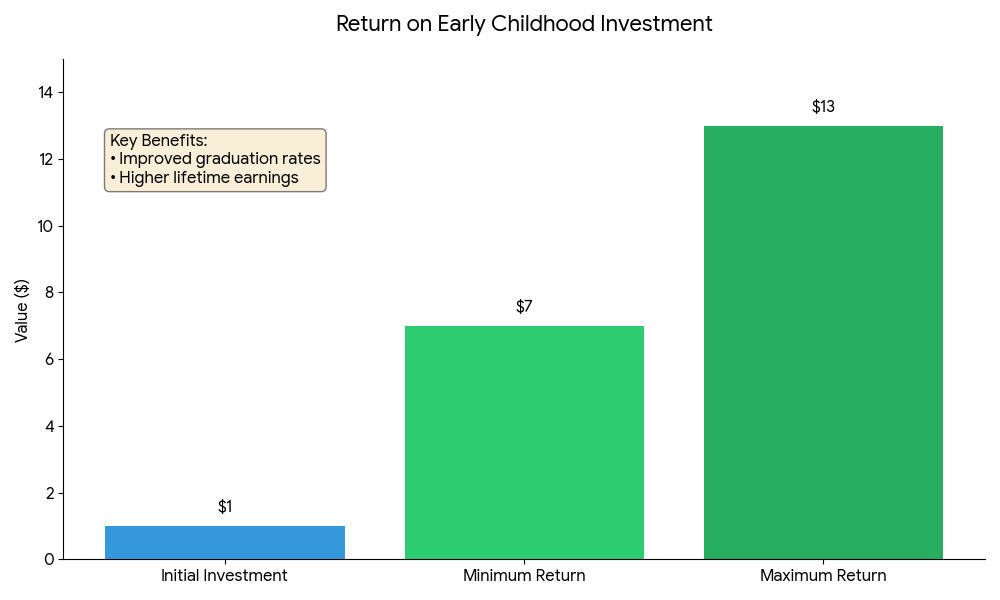
These benefits come from better education, higher lifetime earnings, stronger workforce participation, and less need for public assistance.
Research on youth employment shows another challenge. The OECD says young people are three times more likely to be unemployed than adults, even in developed countries. Early investments in skills, mentorship, and career exposure help close this gap.
Simply put, prevention boosts both personal opportunity and economic productivity.
Prevention in Practice
Prevention-focused initiatives across communities already show what this approach can accomplish.
Early childhood education programs are a clear example. Children in high-quality early learning enter school with stronger thinking and social skills. Over time, these advantages lead to higher graduation rates and steadier jobs.
Mentorship initiatives offer another powerful intervention.
For young people lacking professional networks, mentorship opens doors to opportunity. Regular support from mentors helps students stay in school, explore careers, and build confidence about their future.
Behavioral health services represent a third key pillar.
Mental health challenges often start early. When communities offer easy access to behavioral health support through schools and local groups, families can address problems before they escalate into crises requiring hospitalization or involvement with the justice system.
These interventions might seem small on their own, but together they build a support network that improves the path for children and families.
Aligning Systems for Greater Impact
Building prevention systems requires coordination across sectors.
Education systems need to collaborate with healthcare providers, housing agencies, workforce groups, and community nonprofits. When these partners share data, pool resources, and coordinate services, they can spot risks sooner and respond better.
International policy groups are increasingly emphasizing this approach. For example, the OECD promotes “whole-of-government” strategies that bring sectors together to boost youth opportunity and social mobility over time.
Philanthropy plays a key role in making these joint efforts possible.
Strategic philanthropic investments enable communities to pilot innovative programs, test new partnership models, and generate evidence to scale successful approaches through public systems.
In this way, philanthropy often acts as the bridge between trying new ideas and making lasting system changes.
Building Scalable Prevention Systems
Communities wanting to build stronger prevention systems can focus on several proven strategies.
Expanding access to high-quality early childhood education remains one of the most effective investments societies can make.
Mentorship and career pathway programs help young people translate education into real economic opportunity by connecting them with mentors, employers, and skill-building experiences.
Including behavioral health services in schools and community organizations allows families to access support early, before challenges escalate.
Programs that stabilize families, through housing support, childcare access, and workforce participation, reduce stressors that can negatively affect children’s development.
When these interventions work together, they support each other. The result isn’t just one program but a whole ecosystem of opportunity.
Looking Ahead
A prevention economy means changing how we think about investment.
Instead of waiting for crises, communities need to invest earlier in the conditions that help children and families thrive.
Crisis response systems will always be needed. Emergencies happen, and sometimes lives fall apart even with the best support.
But when prevention is a primary strategy rather than an afterthought, fewer people reach those crisis points to begin with. For policymakers, philanthropic leaders, and nonprofit organizations, the way forward is clear. Expand early childhood education. Strengthen mentorship and career pathways. Integrate behavioral health support into community institutions. Stabilize families before economic stress becomes instability.
Investing earlier won’t solve every social problem, but it will build stronger foundations for economic mobility and social resilience.
Over time, these early investments could turn out to be the most cost-effective choices societies make.





 Sure Media Magazine
Leave a comment