
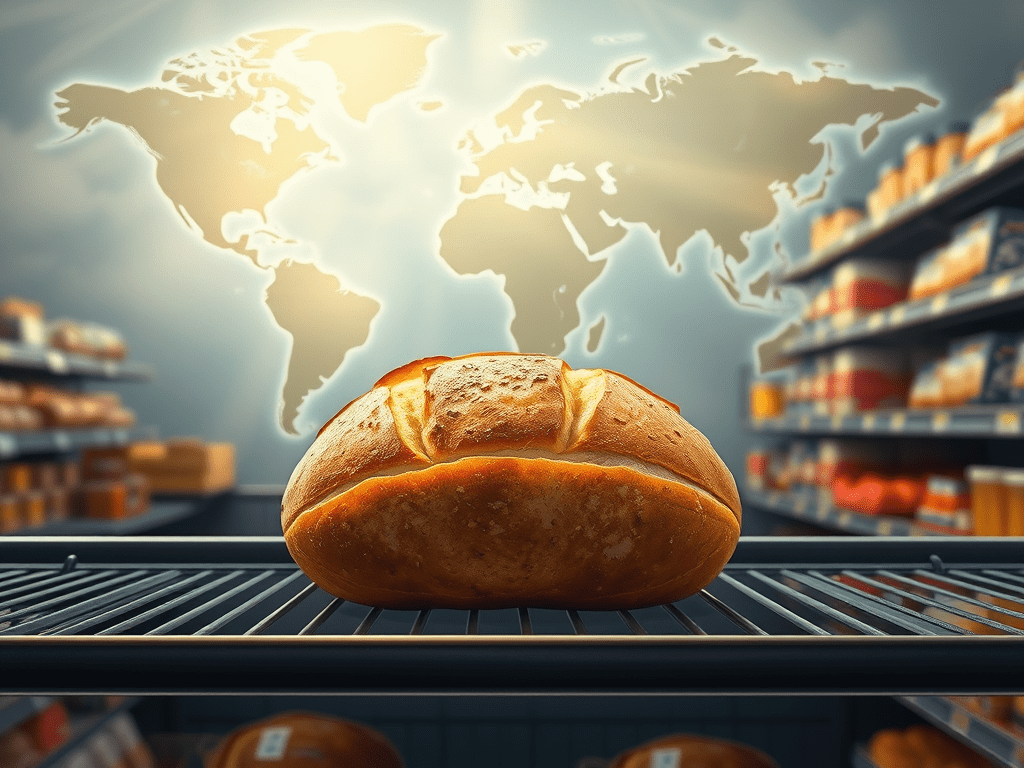
One evening, I stood in a small grocery shop staring at a loaf of bread. It looked ordinary—soft, golden, wrapped in plastic. Yet the price had risen again.
The shopkeeper shrugged when I asked why.
“Transport is expensive,” he said. “Fertilizer prices went up. Wheat is scarce somewhere.”
Somewhere.
That word stayed with me. Because the bread on that shelf did not begin in that shop. It had traveled thousands of kilometers across farms, factories, ports, and highways. And at any point along that journey, something could go wrong.
That is the story of the global food chain—a vast, invisible network that feeds billions of people every day but is far more fragile than most of us realize.
A Meal That Travels the World
A simple meal today is rarely local.
The wheat might come from Ukraine or Canada. The fertilizer that helped it grow may have been produced in the Gulf. The machinery used to harvest it might have been built in Germany. The grain then travels through shipping routes, milling factories, trucking networks, and retail stores before reaching someone’s plate.
This enormous system works because every link holds together. But when just one breaks, the ripple spreads across continents.
Researchers describe the global food system as a highly interconnected network, where shocks in one region can quickly affect many others through trade and production chains. (arXiv)
It is a system designed for efficiency—but not always for resilience.
When One War Affects the World’s Dinner Table
History repeatedly shows how fragile the system can be.
When the Russia-Ukraine war disrupted agricultural exports, the world felt the shock immediately. Ukraine is one of the world’s largest suppliers of sunflower oil, maize, and wheat. When its production dropped, shortages spread through global markets. Studies show such shocks can cause dramatic losses in food availability for other countries dependent on those exports. (arXiv)
More recently, tensions in the Middle East have threatened global fertilizer supply chains. The Strait of Hormuz—a critical shipping route—handles large shares of the raw materials used to produce fertilizers. When disruptions occur there, fertilizer prices rise, farmers struggle to plant crops, and food prices follow soon after. (Financial Times)
In other words, a missile strike thousands of kilometers away can quietly influence the price of bread in a neighborhood shop.
Hunger in a World of Plenty
What makes this fragility even more troubling is that the world actually produces enough food to feed everyone.
Yet hunger continues to rise.
According to the Global Report on Food Crises, more than 295 million people in 53 countries experienced acute hunger in 2024, the highest level recorded since monitoring began. (World Food Programme)
Conflict, climate disasters, and economic shocks are the main drivers.
But the deeper problem lies in how food moves—or fails to move—through the global system.
When supply chains break, food may exist somewhere but cannot reach the people who need it.
The Day Food Stops Moving
In 2024, Haiti offered a painful example.
Violence by armed gangs blocked roads and markets, preventing trucks from transporting food across the country. Farms still existed. Food was still produced. But the roads were too dangerous to travel.
The result was catastrophic: millions of people faced severe hunger, and famine conditions were officially declared in some areas. (Wikipedia)
The lesson was clear.
Food shortages are not always about lack of food. Often they are about broken systems.
Climate: The Quiet Disruptor
Beyond war and politics, climate change is steadily testing the global food chain.
Droughts damage crops. Floods destroy farmland. Heat waves reduce harvest yields.
Each event might seem local, but because countries depend on each other’s production, these shocks travel quickly.
Researchers studying global food networks warn that disruptions affecting major agricultural producers—such as the United States or India—could trigger widespread systemic collapse in food supply systems. (arXiv)
The chain is strong, but only as long as its key links remain stable.
The Hidden Cost of Cheap Food
Modern food systems are built on efficiency.
Large farms specialize in single crops. Global trade concentrates production in regions where it is cheapest. Food travels long distances because transport is relatively inexpensive.
But this efficiency hides risk.
When fertilizer prices spike, crops suffer. When shipping routes close, supplies shrink. When energy prices rise, transport becomes costly.
Even a short disruption can ripple through the system.
Recent global food price increases illustrate this sensitivity. The United Nations’ Food and Agriculture Organization reported that international food prices rose again in early 2026 due to supply disruptions and weather risks affecting cereal production. (Reuters)
For many households, that translates directly into higher grocery bills.
A Personal Reminder of the System’s Fragility
One morning, I watched a farmer loading sacks of maize onto a pickup truck heading toward a local market.
The road was rough. Rain had turned parts of it into mud. Transport costs had doubled in the past year because fuel prices had risen.
He laughed when someone asked if farming was profitable.
“We grow the food,” he said, “but we are the first to feel the shortages.”
His statement captures a painful paradox.
Farmers produce food, but global disruptions—fuel costs, fertilizer shortages, climate extremes—often hit them first and hardest.
Why the Food Chain Matters to Everyone
The global food system is one of humanity’s greatest achievements.
It feeds billions of people every day. It allows cities to exist far from farmland. It connects farmers and consumers across continents.
Yet it also carries enormous risk.
Food systems today face simultaneous pressures: conflict, economic shocks, climate extremes, and infrastructure weaknesses.
When these pressures combine, the chain weakens.
And when the chain weakens, the consequences appear on dinner tables everywhere.
Building a Stronger Food Future
The fragility of the food chain does not mean collapse is inevitable.
Experts suggest several ways to strengthen the system:
- diversifying food sources rather than relying on a few major suppliers
- improving local agriculture and storage systems
- investing in climate-resilient farming
- reducing food waste, which could significantly lower global hunger levels.
These changes may sound technical, but they all lead to the same goal: making sure food keeps moving even when crises occur.
The Bread on the Shelf
The next time I returned to that grocery shop, the price of bread had stabilized—for the moment.
I picked up a loaf and imagined its journey.
From soil to seed.
From farm to port.
From ship to factory.
From truck to shelf.
So many hands had touched it. So many systems had worked together to make that simple loaf possible.
And that is the quiet truth about food.
Every meal we eat is not just a product of agriculture. It is the result of a fragile global chain that stretches across oceans, politics, climate, and human cooperation.
Break that chain in one place, and the world begins to feel it everywhere.



 Sure Media Magazine
Leave a comment