
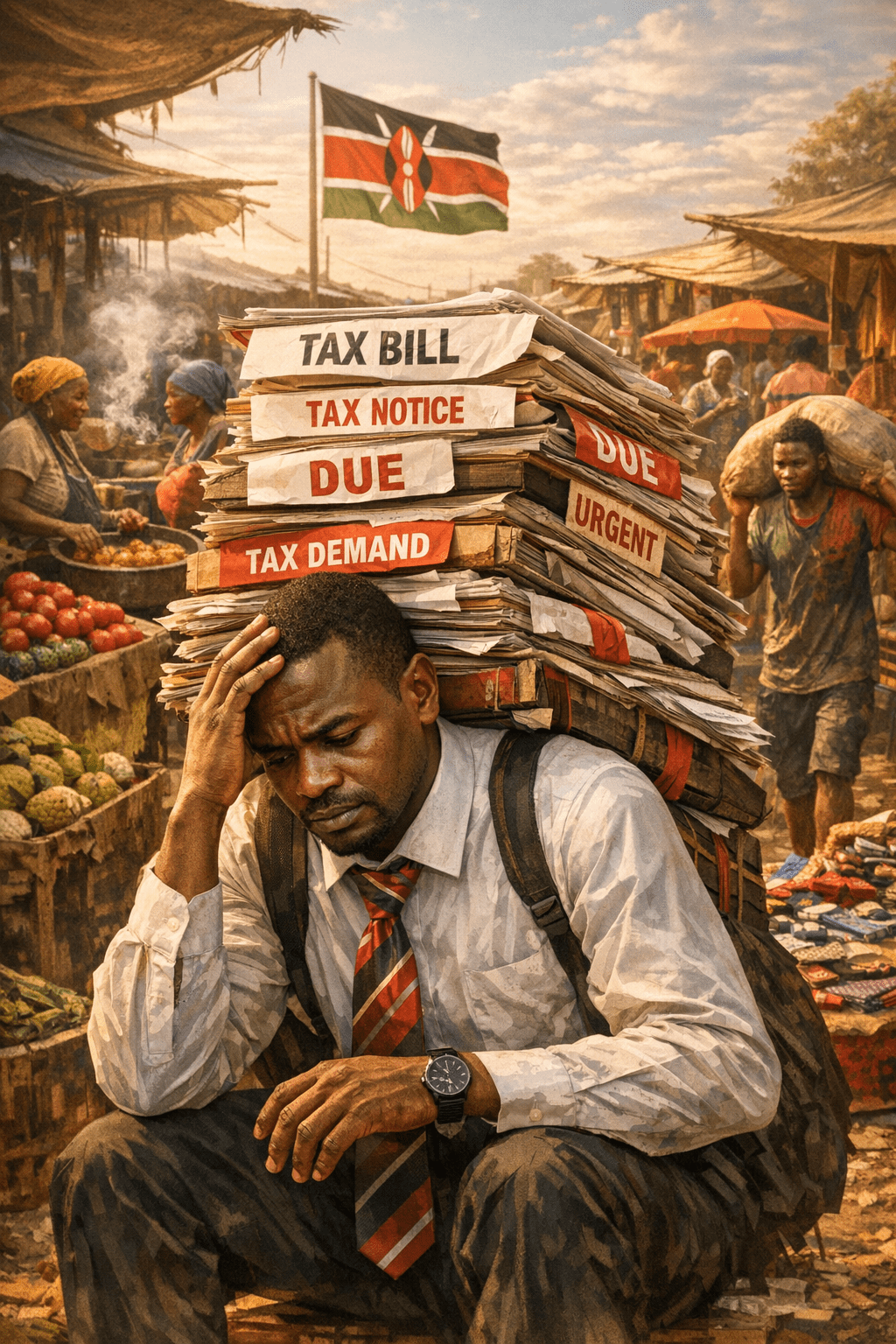
In the past three years, it has become increasingly evident that the working man has also become the complaining man, and with good reason.
In Kenya today, the government, for lack of a better analogy, has become our second family. By virtue of simply being Kenyan, we have inherited the responsibility of breadwinning for the state through relentless and often excessive taxation.
When nearly 40% of our salaries go to the state in the name of taxes and statutory deductions, it becomes clear that we are not merely working for ourselves; we are also working for the government.
In many ways, it feels as though we have become slaves to it.
Ironically, a worker in the informal sector often has a better chance of surviving economically than a worker in the formal sector who follows the rules. This is because the government itself has become an affair, one that quietly drains the family unit financially, emotionally, and socially.
The High Cost of Promises
The real tragedy of high taxation lies not only in the deductions themselves, but also in how this heavily taxed money is spent.
What is collected in the name of national development often ends up lining the pockets of individuals, wrapped neatly in promises such as:
- national transformation
- better infrastructure
- improved education
- good governance
- a better Kenya
For decades, these promises have functioned as political gambits, carefully crafted narratives that continue to lure citizens into the butcher’s pen.
Unless wisdom becomes part of our national anthem, the cycle will continue.
The Silent Crisis of Civic Ignorance
The state of the nation today paints a troubling picture.
Civic education has eluded many Kenyans, and ignorance has become the very sword upon which we fall.
The constitution exists, yet it is rarely used as a tool of accountability. Public participation is enshrined in law, yet many citizens ignore it in practice.
Instead, we thrive in private participation, what many would casually call story za jaba.
These are heated debates in:
- living rooms
- social media threads
- matatu conversations
- barbershops and bars
Everyone leaves satisfied that they have “solved” the nation’s problems.
Yet nothing changes.
“Bunge la wananchi” has gradually become a gossip hub and a critique corner, far removed from what its name implies, a legislative platform for the citizen.
An informed citizen is more dangerous than a thousand protesters.
When Work Becomes Modern Slavery
If the current trajectory continues, taxation risks creeping toward 50% of income.
At that point, work will no longer feel like a path to prosperity; it will resemble modern economic servitude.
The irony is painful.
A house girl working in Saudi Arabia may statistically have a better chance of upward mobility than an accountant working in Kenya.
This is not merely unfortunate; it is deeply demeaning to the nation’s labour force.
In a functional economy, high taxation should correspond with visible benefits:
- a lower cost of living
- efficient public services
- better infrastructure
- improving GDP
Yet in Kenya, the relationship appears reversed.
The very citizens building the nation have become the government’s perpetual milk cow.
A Different Kind of Resistance
There must come a moment when we say enough is enough.
Not in hushed voices.
Not behind closed doors.
And not with stones, masks, or toothpaste smeared on our faces in the streets.
The streets are no longer effective grounds for change; the system has already learned how to neutralize that arena.
The real instruments of change lie elsewhere:
The Constitution.
Civic education.
Policy awareness.
These are the true weapons of a functioning democracy.
An informed population cannot easily be manipulated. Knowledge becomes the baton of effective change, a glimpse of a better nation and a hope for the coming generation.
The Power of an Informed Citizen
No government can permanently withstand:
- The power of informed citizens
- The voice of an educated electorate
- The accountability demanded by constitutional awareness
Through this awakening, we can ensure:
- Money works for us, not us for money
- Elected leaders work for the people, not the other way around
- Policies serve citizens rather than enslave them
- Taxation benefits the nation rather than enriching a few
The Wolf in Sheep’s Clothing
No Kenyan fundamentally opposes taxation as a principle.
Taxes are necessary for:
- infrastructure
- education
- healthcare
- national development
The real problem is what taxation has become.
Instead of functioning as a civic duty, it increasingly resembles soft robbery disguised as development.
The rally, therefore, is not against taxes.
The call is against the masquerading taxman, a wolf in sheep’s clothing.
Let the people arise.
Let the people be informed.
Because once a nation understands its constitution, its policies, and its rights, the balance of power quietly shifts back to where it always belonged: And please let’s vote wisely; VIVA



 Sure Media Magazine
Leave a comment