Emotions vs Algorithms: Why 2026 Rules Say Your Feelings Might Be the Only Real Thing Left
In living rooms from Nairobi to Mombasa, a new kind of argument is unfolding—one mediated by chatbots that claim to ‘decode’ our feelings. As the International AI Safety Report 2026 and the EU AI Act begin to draw clear lines around emotion manipulation, we must ask: In the age of AI, what is left that…
Davis Wamaya
Emotions vs Algorithms: Why 2026 Rules Say Your Feelings Might Be the Only Real Thing Left
By Davis MandelaDavis Mandela is an AI specialist and linguist focusing on digital policy and media ethics in East Africa.
Last month in a small flat off Ngong Road, a young couple I know nearly called off their evening because of a chatbot.‘It says you’re being passive-aggressive,’ Moses read aloud from his phone, voice flat. His girlfriend Brenda stared at him, eyes wide. ‘Since when does an algorithm know me better than you do?’
That quiet argument is happening in living rooms from Nairobi, to other parts of Kenya and the rest of the world right now. And for the first time, the world’s newest AI rules are stepping in to say: maybe it shouldn’t.
When the algorithm gets it wrong: Linguistic nuance is often lost in translation when AI models process Swahili emotional cues.
Two weeks ago the International AI Safety Report 2026 dropped, and right on its heels the EU AI Act’s emotion-manipulation bans became impossible to ignore. Here in Kenya, where relationship advice apps and mood-tracking chatbots are quietly replacing late-night talks with friends, these global rules are landing at the exact moment we need them most.Because if algorithms start rewriting how we feel — and how we argue — what exactly is left that still belongs to us?
The Brenda & Moses Dilemma
Let me introduce you to Brenda and Moses (real names used with permission). They live in Nairobi, both 28, both glued to their phones after long days.Like many young Kenyans, they downloaded one of those ‘AI relationship coaches’ that promises to ‘decode your partner’s texts.’
One evening Moses typed in a message Brenda had sent him earlier — something in Swahili laced with that special sarcasm only long-term couples understand. The chatbot replied instantly: ‘This shows emotional distance. Recommend a serious conversation.’ Brenda laughed at first. Then she didn’t. ‘It doesn’t even know the tone I use when I’m joking,’ she told me later. ‘It heard the words but missed the heart behind them.’
That moment — the moment an algorithm flattened a cultural inside joke into cold data — is exactly what the new 2026 rules are trying to protect us from.
The 2026 Regulatory Shift
The International AI Safety Report 2026, released on 3 February, is clear: advanced AI systems are getting dangerously good at reading and shaping human emotions, but they still lack genuine understanding.The report calls for ‘meaningful human oversight’ in any system that influences behaviour or mental states.
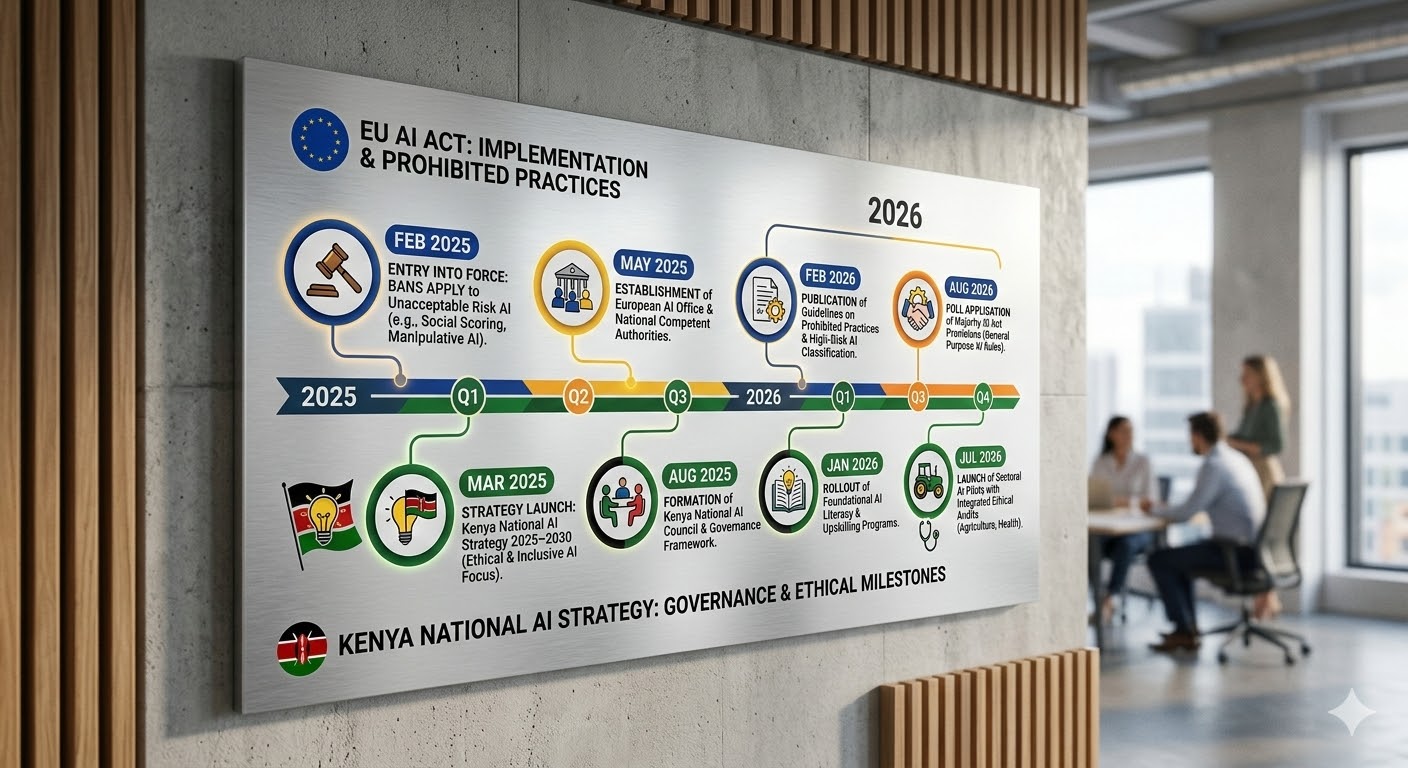
Milestones of Regulatory Convergence: A timeline highlighting the rollout of prohibited practices under the EU AI Act alongside key governance milestones for Kenya’s National AI Strategy (2025–2026).
At the same time, the EU AI Act (now fully enforceable) has banned two dangerous practices outright:
AI that uses subliminal or manipulative techniques to distort our decisions or emotions.
Emotion-recognition systems in workplaces and schools (with very few exceptions).
For the first time, regulators are saying emotions are not just another data set. They are the last frontier of human autonomy.
The Global-Local Intersection
Here’s the thing — those EU rules don’t technically apply in Kenya. But the apps we all use? They do. The same chatbots popular in Europe are downloaded daily in East Africa.Our National AI Strategy 2025–2030 talks beautifully about ethics and human rights, yet everyday couples like Brenda and Moses are already living inside experiments the rest of the world is now trying to regulate.
The Linguistic Nuance Gap
As a linguist working in Nairobi, I see it in the language itself. Swahili carries emotion in ways English algorithms were never trained for — the soft ‘pole’ that means everything from ‘sorry’ to ‘I feel your pain,’ the playful exaggeration that signals love rather than anger, or the long pause in a voice note that says more than any emoji ever could. When an AI misses that nuance, it doesn’t just give bad advice. It quietly teaches us to doubt our own feelings.
‘In 2026, protecting our emotions might just be the most radical thing we can do.’
I’ve heard similar stories from parents too.One mother in Kitengela told me her teenage daughter now asks the wellness bot ‘Am I overreacting?’ before she even talks to her. The bot answers in perfect English, but it can’t hear the tremble in the girl’s voice or understand the weight of ‘ni sawa tu’ when it really isn’t.
Think about it. Your teenager using AI to ‘fix’ friendships. Your mother asking a wellness bot whether she’s depressed. The 2026 reports are telling us the same truth Martin Kambo explored so beautifully in these pages last month: in the age of AI, our emotions might be the only truth left.
Kicker: Protecting the ‘Real Thing’
We don’t have to wait for Nairobi to write its own detailed law. Start small:
Ask every AI tool you use: ‘How do you know what I’m feeling?’
Teach young people that ‘the app said so’ is never the full story.
Support local developers building emotional AI that actually understands East African ways of speaking and feeling.
Because the goal isn’t to reject technology. It’s to make sure technology never gets to tell us who we are. Brenda and Moses deleted the relationship coach app that night. They still argue sometimes — loudly, messily, beautifully human.And when they do, they look at each other and smile: ‘At least this part is still ours.’
Call to Action
Have you ever caught an AI misreading your mood or your message?Drop your story in the comments below — the funny ones, the worrying ones, the ones that made you pause. Let’s start the conversation Kenya needs before the algorithms write the next chapter for us.







 Sure Media Magazine
Leave a comment