
Ndio Tunaweza: Why Science and Innovation Are Gen Z Kenya’s Greatest Superpower
By sashacelia — February 2026
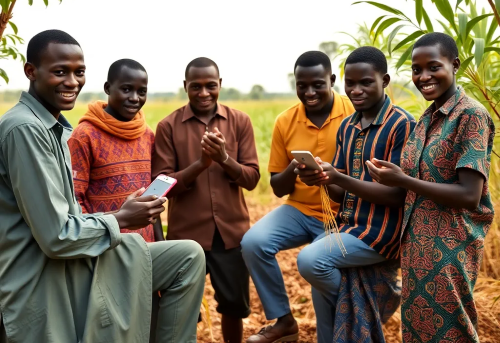
There is a particular kind of electricity in the air when a young Kenyan solves a problem that has stumped older generations. You’ve seen it — the university student who builds a solar-powered irrigation pump from scrap parts in Eldoret, the 19-year-old in Kibera who codes a waste-collection app that actually works, the girl from Kakamega who wins an international science olympiad and returns home to teach her community. These are not feel-good stories for the evening news. They are signals. And if Kenya listens carefully, they point to exactly the path Vision 2030 demands we take.
The Vision That Is Waiting for You
Kenya’s Vision 2030 was not written as a government document to gather dust. It was written as a dare — a dare to transform this country into a newly industrializing, middle-income nation offering a high quality of life to all its citizens by the year 2030. That is four years away. And the honest truth is that whether the vision is realized, partially realized, or quietly abandoned will depend enormously on what Kenya’s Gen Z — the largest, most educated, most connected generation in the country’s history — decides to do with its talent.
The Vision rests on three pillars: economic, social, and political. But running through all three, like an electrical current through a wire, is science, technology, engineering, and innovation. The economic pillar calls for a knowledge-based economy. The social pillar demands advances in health, education, and environmental management. None of these things happen by inspiration alone. They happen through research, invention, data, and relentless problem-solving — the very things that science and innovation make possible.
Why Gen Z Is Different — and Why That Matters
Let us be honest about something that older Kenyans sometimes resist acknowledging: Gen Z is fundamentally different in ways that are advantages, not deficits.
You are the first generation of Kenyans to grow up with the internet not as a novelty but as the air you breathe. You have access to MIT OpenCourseWare, YouTube tutorials, GitHub repositories, and global research papers that your parents would have had to travel to Nairobi or London to access. The barriers between a curious young Kenyan and world-class knowledge have never been lower.
You are also the first generation to grow up with M-Pesa as normal — meaning you have internalized, at a cellular level, the truth that Africa does not have to import solutions from the West. M-Pesa was not invented in Silicon Valley. It was invented here, for conditions here, by people who understood this place. That is a mindset — the mindset that the best solutions to African problems will come from Africa — and Gen Z carries it more naturally than any generation before.
You are skeptical of institutions, which is appropriate given their track record, but you are also deeply collaborative. The peer-to-peer networks, WhatsApp groups, Twitter Spaces, and TikTok communities you build are horizontal, fast, and information-rich. That is exactly the architecture that drives innovation ecosystems.
The Sectors Where Your Innovation Is Needed Most
Vision 2030 identifies specific sectors for transformation. Here is where science and innovation by young Kenyans can make the most direct impact:
Agriculture. Kenya still derives enormous economic activity from agriculture, yet millions of smallholder farmers operate with little data, poor market access, and devastating vulnerability to climate shocks. Precision agriculture — drones for crop monitoring, soil sensors, AI-driven weather advisories delivered via SMS — is not science fiction. It is happening. But it needs more builders, more agronomists, more data scientists who understand both code and soil. If you are from a farming family, you already speak the most important language. Add the science, and you become transformative.
Healthcare. Kenya loses lives daily to diseases that are detectable and treatable — if you catch them early enough, if you can reach people in remote counties, if health workers have the right tools. Telemedicine, AI diagnostic tools, low-cost medical devices designed for African contexts, and data systems that give County health officers real visibility into what is happening in their area — these are all gaps waiting for young Kenyan innovators.
Energy. The goal of affordable, clean, and reliable energy access is inseparable from Kenya’s economic ambitions. Kenya already leads Africa in geothermal energy, and solar access has expanded dramatically. But there is still enormous work in storage technology, mini-grids for off-grid communities, and smart energy management systems. This is rich territory for engineers, physicists, and tech entrepreneurs.
Manufacturing and the Blue Economy. Vision 2030 explicitly wants Kenya to move up the value chain — to stop exporting raw materials and start exporting finished goods and services. That requires manufacturing capability, which requires engineering skill, which requires young Kenyans to pursue technical education with pride and purpose. Similarly, Kenya’s vast coastline and the Blue Economy represent an under-exploited frontier that needs marine scientists, climate researchers, and fisheries technologists.
The Ecosystem Is Growing — But It Needs You
The infrastructure for innovation is more developed than many Kenyans realize. The Konza Technopolis project — Kenya’s Silicon Savannah — is taking shape. iHub in Nairobi has incubated hundreds of startups. Universities like the University of Nairobi, Strathmore, JKUAT, and Kenyatta University are producing graduates in STEM fields at scale. The Kenya National Innovation Agency exists specifically to support innovators. The government’s Digital Economy Blueprint and the Ajira Digital Programme are creating formal structures for technology-driven employment.
But an ecosystem is only as alive as the people who inhabit it. Incubators without innovators are empty buildings. Policies without practitioners are good intentions. Research institutions without researchers are expensive furniture. The ecosystem is waiting for you to walk through the door — with your ideas, your energy, your willingness to try things that might fail, and your determination to try again.
The Cultural Barrier We Must Honestly Name
There is something Kenyans need to stop doing, and Gen Z has the cultural leverage to make this change: we need to stop treating science as a fallback and treat it as a calling.
For too long, the hierarchy has been medicine and law at the top, engineering somewhere in the middle, and the pure sciences — biology, chemistry, physics, mathematics — treated as what you study when you cannot get into something more prestigious. This is backwards. The people who discover new drugs work in biochemistry labs. The people who build the next M-Pesa are mathematicians and computer scientists. The people who will solve Kenya’s water crisis are environmental engineers and hydrologists. The hierarchy needs to flip, Gen Z, for what it is worth or not, is easier to flip it than any other generation with respect to the inherited status system you could come across. Parents are also crucial. If your daughter admits to you now that she wants to study astrophysics or computational biology, the correct answer should not be “but where will you get a job”. The correct response is curiosity and encouragement. The world is rapidly running out of problems that do not require deep scientific thinking to solve.
Failure Is Not the Opposite of Innovation — It Is the Process
One of the most damaging ideas in Kenyan professional culture is the fear of public failure. Innovation requires experimentation, and experimentation means many things will not work the way you hoped. Silicon Valley built its reputation on making failure survivable and even instructive. Kenya needs to develop the same tolerance.
This does not mean being reckless with resources or dismissive of accountability. It means creating a culture where a young researcher who attempts a hypothesis and then fails to get a good answer is celebrated for his/her work (not considered silly about wasting time) and not blamed for what he/she did wrong. This is why startups get investors who know that a startup that pivots and learns is a positive result. And universities reward students with disruptive questions, not just students that get the correct answer on an exam. Gen Z already has a head start here. And its internet culture— you post, you get feedback on it, you re-post again— is in effect the scientific method with social content. Apply that same fearless iteration to research, product development, and problem-solving, and you are already thinking like an innovator.
A Call to Action, Not a Lecture
This is not a lecture. Kenya has had enough lectures about its potential. This is a call to specific, concrete action:
If you are a student choosing your path, choose science or technology without apology. Not because someone told you to, but because Kenya’s future is technical, and you have the ability to shape it.
If you are already in a STEM field, find a community — a research group, a coding cohort, a maker space — and contribute to it. Innovation is rarely solo work. The breakthroughs come from people thinking together.
If you are an innovator or entrepreneur, anchor your work in real Kenyan problems. The temptation is to build for a global market first. But the most durable and meaningful innovations will come from deep understanding of Kenyan conditions, Kenyan users, and Kenyan challenges.
If you are in a position to mentor, mentor. The most valuable thing an experienced scientist or engineer can give a young Kenyan is their time and candor — not money, not connections, but honest guidance from someone who has walked the path.
And if you are anyone reading this who has ever dismissed a young person’s scientific curiosity as impractical or beside the point — reconsider. That curiosity is Kenya’s most renewable resource.
The Clock Is Running
Vision 2030 is not a distant horizon. It is four years away. Some of its targets will be met. Others will fall short. But the generation that will do the most to determine the outcome is not the generation that designed the vision. It is the generation reading this right now.
The question is not whether Kenya has the talent. It does. The question is whether that talent will be channeled, supported, celebrated, and unleashed into the problems that matter most.
Science is not just what happens in laboratories. It is a way of thinking — rigorously, creatively, humbly, and persistently — about how the world works and how it could work better. Innovation is not just a tech buzzword. It is the practice of turning that thinking into something real that changes lives.
Kenya needs more of both. And Gen Z, equipped as no previous generation has been, is the most credible answer to that need.
Twende kazi.
Views expressed are those of the author. Share this post if you believe Kenya’s future is scientific.




 Sure Media Magazine
Leave a comment