
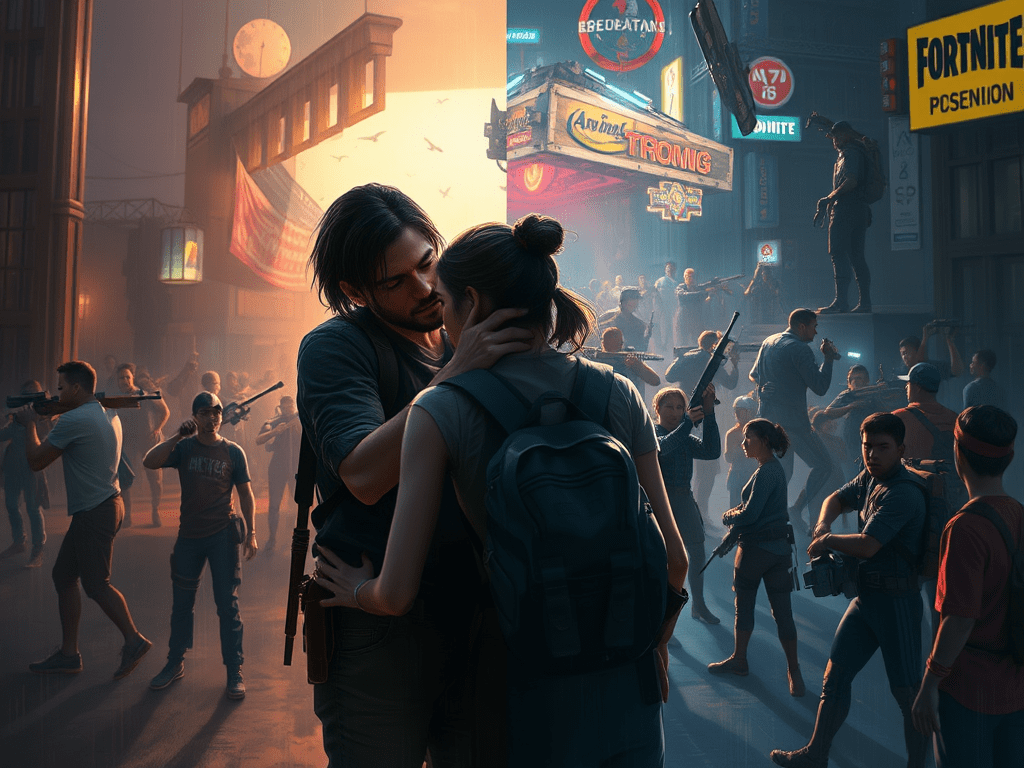
Are Live-Service Games Killing Storytelling?
For decades, video games followed a simple promise: start, struggle, climax, end. You bought a cartridge or disc, sat down, and committed to a finite journey. Whether it was the emotional devastation of The Last of Us Part II or the sprawling, choice-driven epic of Baldur’s Gate 3, you moved through a deliberate arc shaped by writers, designers, and directors. The story ended. Credits rolled. You put the controller down changed, satisfied, maybe even haunted.
That structure is quietly disappearing.
In its place is something else: the live-service model. Games that don’t end. Games that update indefinitely. Games built not around narrative closure, but engagement metrics. Think Fortnite, Destiny 2, or Call of Duty: Warzone. These titles aren’t designed to conclude; they’re designed to retain.
And that shift—from authored arc to perpetual engagement—raises a serious question: is the live-service model fundamentally incompatible with strong storytelling?
The Structural Problem: Stories Need Endings
Traditional storytelling depends on tension and release. Rising stakes. A climax. Resolution. Even tragedy requires finality to carry emotional weight.
Live-service games resist that structure by design.
Their financial model depends on player retention. Battle passes, seasonal events, limited-time cosmetics, rotating modes—these systems create constant incentive to log back in. The story, if it exists, must remain open-ended. Nothing can truly conclude because the platform must remain alive.
Look at Destiny 2. It has lore. It has characters. It has galactic stakes. But its narrative is delivered in seasonal fragments, often removed or overwritten in future updates. Key plot developments disappear into “vaulted” content. Emotional arcs are stretched thin across years. Instead of a cohesive narrative experience, players receive serialized lore drops tied to engagement cycles.
Contrast that with The Last of Us Part II, which was controversial precisely because it committed to its narrative decisions. It took risks. It ended relationships. It forced consequences. You may not have liked it—but it said something, definitively.
Live-service games rarely afford that luxury. Permanent consequences are risky when your audience expects indefinite continuity.
Engagement Over Expression
The core metric driving live-service design is not narrative coherence. It’s Daily Active Users. Retention curves. Average revenue per user.
This changes design priorities.
Instead of asking, “What story needs to be told?” studios increasingly ask, “What keeps players logging in?” Narrative becomes a delivery mechanism for seasonal content rather than the spine of the experience.
Take Fortnite. Its world has technically experienced cataclysms, invasions, multiverse collapses, and collaborations with every franchise imaginable. But these events function more as marketing beats than thematic arcs. The story serves the spectacle, and the spectacle serves player retention.
That doesn’t mean live-service games lack creativity. On the contrary, some execute ambitious world-building experiments. But the economic incentive structure pushes storytelling toward modularity. Flexible. Reversible. Marketable.
And that flexibility often undermines narrative gravity.
The Disappearing Author
Another subtle shift: the diminishing role of the singular creative vision.
Story-driven games often carry a clear authorial fingerprint. Whether you love or hate Metal Gear Solid or BioShock, you can feel the creative intent behind them. They reflect strong narrative direction.
Live-service games, however, operate more like evolving platforms than authored works. Teams rotate. Storylines pivot based on player data. Content is reactive. The “vision” is iterative, shaped by analytics and monetization strategies as much as artistic ambition.
This creates a strange tension. Players invest in characters and arcs, but the infrastructure resists decisive narrative movement. If a character becomes popular, they persist. If a storyline underperforms, it quietly fades.
The result isn’t necessarily bad storytelling. It’s storytelling subordinated to systems.
The Psychology of the Infinite Game
There’s also a player-side dimension.
Live-service ecosystems thrive on FOMO—fear of missing out. Limited-time skins. Seasonal rewards. Exclusive cosmetics. The narrative often becomes secondary to progression mechanics. You’re not logging in to see what happens next in the story; you’re logging in to complete objectives before the season resets.
This subtly rewires the player’s relationship to narrative.
In a traditional game, you move forward because you want to know what happens. In a live-service environment, you often move forward because the clock is ticking.
That time pressure fragments immersion. When storytelling competes with daily challenges, XP boosts, and rotating events, narrative cohesion becomes collateral damage.
But Is This Really New?
It’s worth being honest: serialized storytelling isn’t inherently weak. Television has thrived on ongoing narratives for decades. Long-running franchises evolve over time. Even MMOs like World of Warcraft have delivered expansions with meaningful arcs.
So what’s different now?
Scale and monetization pressure.
Earlier online games expanded through periodic, substantial releases. Modern live-service titles often operate on relentless seasonal cycles, with revenue directly tied to cosmetic economies and battle passes. Narrative becomes part of a content treadmill rather than a milestone event.
The cadence matters. Stories need breathing room. Live-service pipelines rarely allow it.
The Counterargument: Evolution, Not Death
To say live-service games are “killing” storytelling may be overstating it. It may be more accurate to say they’re transforming it.
Some developers are experimenting with hybrid models—structured narrative seasons that attempt to combine serialized storytelling with meaningful stakes. Others separate multiplayer live-service modes from single-player narrative campaigns, preserving both revenue streams and creative freedom.
And the success of games like Baldur’s Gate 3 demonstrates something crucial: audiences still crave authored, complete experiences. That game launched without battle passes, without aggressive microtransactions, and still dominated sales charts and awards conversations.
Its success sends a signal. There is still economic viability in narrative-driven design.
The Real Risk: Cultural Drift
The bigger concern may not be that live-service games erase storytelling altogether. It’s that they normalize a different expectation of what games are for.
If younger players grow up primarily in ecosystems built around endless progression loops, cosmetic economies, and seasonal resets, their baseline expectation shifts. The “end” of a game becomes unfamiliar. Closure becomes optional.
That cultural drift affects funding decisions. Publishers follow behavior. If engagement models consistently outperform finite narratives, investment tilts accordingly.
And once mid-budget narrative games disappear—a trend already visible in parts of the industry—the ecosystem narrows. You’re left with ultra-expensive AAA blockbusters on one side and lean indie experiments on the other. The middle space for tightly written, moderately scoped story games shrinks.
So, Are Live-Service Games Killing Storytelling?
Not outright.
But they are reshaping the conditions under which storytelling happens. They prioritize continuity over closure, retention over resolution, and systems over singular vision.
In some cases, that leads to creative stagnation. In others, it sparks experimentation with new forms of evolving narrative. The outcome isn’t predetermined.
What is clear is this: business models shape art. Always have. When revenue depends on endless engagement, design philosophy adapts.
The tension between authored storytelling and perpetual service models will define the next decade of game development. Some studios will lean fully into platformization. Others will double down on crafted, complete experiences as a differentiator.
Players, ultimately, will decide which model thrives.
But if you’ve ever finished a game, sat through the credits, and felt that rare, quiet sense of completion—the kind that lingers long after the console powers off—you already understand what’s at stake.
The question isn’t whether live-service games can tell stories.
It’s whether they can ever truly let one end.






 Sure Media Magazine
Leave a comment