
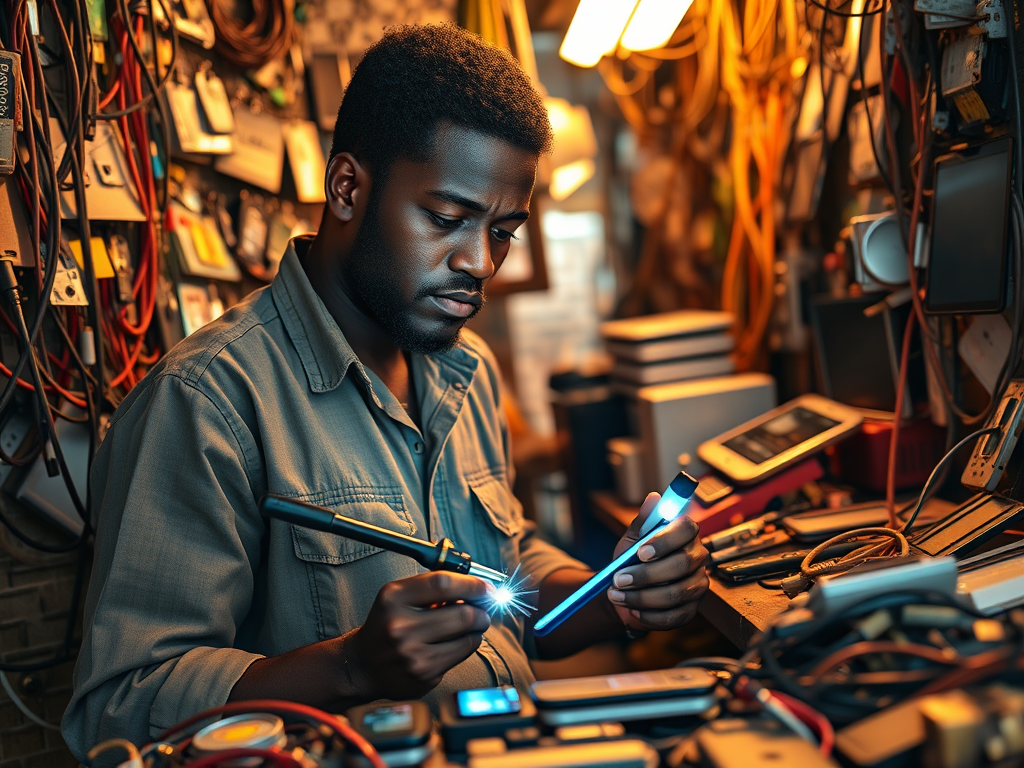
In the dusty heart of Nairobi’s Luthuli Avenue, where the air hums with the chatter of hawkers and the whine of matatus, I handed my cracked three-year-old smartphone to a technician named Juma. His stall was a cramped cubicle overflowing with gutted gadgets: tangled wires, salvaged screens, and bins of “dead” devices waiting for resurrection. With a soldering iron glowing like a tiny forge, Juma pried open my phone, reattached frayed circuits with steady hands, and swapped in a battery scavenged from another relic. The whole fix took 20 minutes and cost me 500 Kenyan shillings—about $4, less than a new charging cable at an Apple Store in New York. My phone buzzed back to life, ready for another year of WhatsApp calls, M-Pesa transactions, and late-night scrolling.
This isn’t a story of ingenuity born from poverty; it’s everyday reality for billions. Yet in the glossy world of Western tech launches, where executives unveil sleeker, sealed devices promising “revolutionary” speed, my experience feels like a relic from another era. Fast tech—the relentless cycle of annual upgrades, planned obsolescence, and disposable designs—isn’t global progress. It’s a luxury-market obsession, engineered for those who can afford to toss functional gadgets like yesterday’s fashion. For the rest of us in the Global South, it’s exclusion dressed up as convenience.
Consider the iPhone, that icon of modern innovation. Each new model boasts marginal improvements: a faster chip, a sharper camera, a battery that lasts… until it doesn’t. But these devices are built to resist repair. Glued-in batteries, proprietary screws, and software locks make DIY fixes a nightmare. Apple argues this ensures security and reliability, but critics—and a growing chorus of regulators—see it as a strategy to funnel users back to the store. In 2023, the European Union pushed for right-to-repair laws, mandating easier access to parts and tools. Yet Big Tech lobbies hard against it, claiming it compromises intellectual property. Meanwhile, in places like Nairobi, Lagos, or Mumbai, repair isn’t a right—it’s survival.
Here in Kenya, where the average income hovers around $1,700 a year, upgrading isn’t a choice; it’s an impossibility for most. Phones aren’t status symbols; they’re lifelines. A smartphone connects farmers to market prices via apps like Mkulima Young, enables gig workers to navigate Uber routes, and lets students access free online courses. When it breaks, you don’t upgrade—you improvise. Luthuli Avenue’s repair ecosystem is a testament to this: hundreds of stalls form a bustling circular economy, where one person’s e-waste becomes another’s treasure. Technicians like Juma train informally, passing skills through apprenticeships, and source parts from global gray markets—often recycled from the West’s discarded tech.
This isn’t romanticizing hardship. It’s highlighting a system that works because it has to. In contrast, fast tech perpetuates waste. According to the United Nations, the world generates 62 million metric tons of e-waste annually, with only 22% recycled properly. Much of it ends up in dumps in the Global South, leaching toxins into soil and water. Agbogbloshie in Ghana, once dubbed the world’s largest e-waste site, is a graveyard of Western gadgets, where young scavengers risk health for copper and gold. Fast tech’s “innovation” exports pollution to places least equipped to handle it.
But why does Big Tech cling to this model? Profit, plain and simple. Rapid upgrade cycles drive recurring revenue. Samsung, Google, and others follow suit, releasing flagships with features that scream “must-have” but deliver diminishing returns. A 2022 study by the University of Cambridge found that smartphone performance gains have plateaued; the real push is marketing hype. For affluent consumers in Silicon Valley or London, this cycle feels exhilarating—a fresh gadget every year, subsidized by trade-ins and financing. It’s convenience, sure, but at what cost?
From my vantage in Nairobi, it looks like exclusion. Fast tech assumes a world where everyone can keep pace, ignoring the digital divide. Over 3 billion people lack reliable internet, let alone the means for yearly upgrades. In sub-Saharan Africa, smartphone penetration is around 50%, but many devices are second-hand or refurbished—exactly the kind Big Tech designs against. Sealed batteries die after 500 cycles, forcing replacements that aren’t feasible here. Software updates often brick older models, rendering them obsolete overnight.
Yet the Global South’s repair culture offers a blueprint for sustainability. In India’s Dharavi slum, Mumbai’s massive informal recycling hub, workers dismantle and repurpose everything from laptops to refrigerators. In Vietnam’s Hanoi, street-side fixers use 3D-printed parts to extend device lifespans. These aren’t fringe practices; they’re the norm for the majority. If billions already thrive in a circular economy—reusing, repairing, and recycling—why does Big Tech insist on linear designs that prioritize disposal?
The answer lies in power dynamics. Fast tech reinforces a hierarchy: innovators in the North, consumers in the South. It dismisses indigenous knowledge as backward, while peddling “progress” that widens inequalities. But cracks are showing. Movements like Right to Repair are gaining traction globally, inspired partly by these resilient systems. In Kenya, organizations like WEEE Centre advocate for better e-waste management, training locals in safe recycling. Back Market, with its focus on refurbished tech, bridges this gap by making quality devices accessible without the upgrade treadmill.
Imagine a world where tech is designed for longevity from the start: modular phones with swappable parts, universal standards for batteries, and software that supports older hardware. Companies like Fairphone are pioneering this, but they’re outliers. Big Tech could learn from Nairobi’s stalls: prioritize repairability over razzle-dazzle. It wouldn’t just reduce waste; it would democratize technology, making it truly global.
As I pocketed my revived phone that day on Luthuli Avenue, Juma grinned and said, “Hii itafanya kazi kwa miaka mingi”—this will work for many years. In a fast-tech world, that’s radical. But for most of humanity, it’s just common sense. It’s time we all caught up.
(Word count: 1,120)





 Sure Media Magazine
Leave a comment