
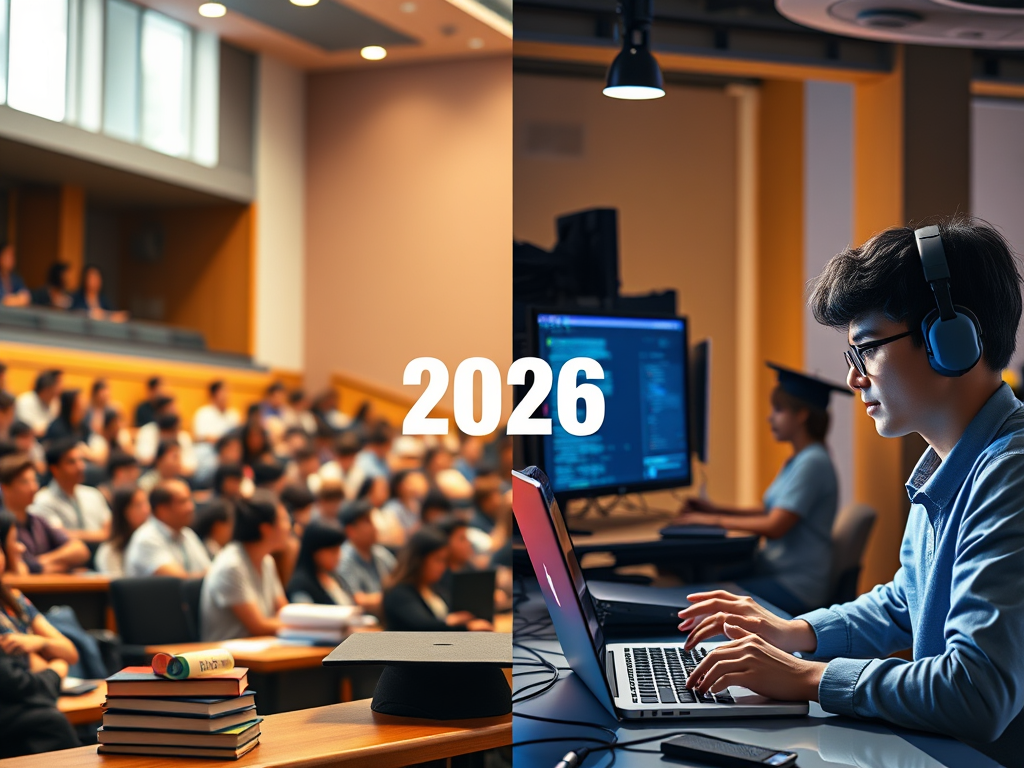
Degree or Digital Skill? The 2026 Money Race No One Wants to Talk About
For years, the script was simple: go to university, graduate, get employed, build a life. It sounded safe. Predictable. Respectable.
But here we are in 2026 — and young people are quietly asking uncomfortable questions.
What if the fastest way to earn is no longer through a lecture hall?
What if income speed matters more than academic prestige?
This is not a war against degrees. It’s a confrontation with economic reality.
The Traditional Route: Slow Build, Structured Path
A university degree still matters — especially in regulated fields like medicine, law, engineering, and architecture. No one wants a self-taught surgeon.
But here’s the part many families avoid discussing:
A degree typically delays full earning power by 3–5 years.
Tuition costs. Accommodation. Transport. Daily expenses. Then graduation — followed by months (sometimes years) of job searching.
Even the World Economic Forum acknowledges that the labor market is shifting toward skills-based hiring, emphasizing adaptability and technical competence alongside credentials (World Economic Forum, “Future of Jobs Report” – https://www.weforum.org/reports/the-future-of-jobs-report-2023).
So yes, degrees open doors.
But do they open them quickly?
The Digital Skill Surge: Speed Meets Oppotunities
Consider, 20-year-old learns video editing in 6 months.
By month 8, she lands a remote client paying $300 per project.
She completes 5 projects a month.
That’s $1,500 monthly — before some of her peers finish second year.
Is this hypothetical? Not entirely.
Platforms like Upwork and Fiverr have enabled thousands of freelancers to monetize skills globally. Meanwhile, the World Bank notes that digital platforms are expanding income opportunities for youth in developing economies (World Bank Digital Development Overview – https://www.worldbank.org/en/topic/digitaldevelopment/overview).
Digital skills compress the earning timeline.
Coding, UI/UX design, social media management, virtual assistance, AI automation, content creation — many can be learned within 3 to 12 months, not four years.
So ,
If income begins in under a year, does that change the equation?
The Speed vs Stability Debate
- Degree path: 3–5 years before stable income.
- Digital skill path: 3–12 months before first earning opportunity.
- Average entry-level graduate salary (varies globally): Often modest and competitive.
- Freelance digital income: Variable — can be $500, $1,000, or $3,000+ monthly depending on skill and market.
But speed comes with trade-offs.
Freelancers face:
- No guaranteed salary
- No health benefits
- Income fluctuations
- Global competition
Graduates often receive:
- Structured career progression
- Professional networks
- Institutional credibility
- Clear qualification pathways
So which is smarter — fast cash or long-term positioning?
Two Friends, Two Paths
Let’s imagine Brian and Kevin.
Brian enrolls in a 4-year business degree. He focuses fully on academics. By graduation, he secures a junior marketing role earning $700 monthly.
Kevin, meanwhile, enrolls too — but in his first year, he starts learning digital marketing online. By second year, he manages two small brands remotely, earning $800 monthly while still studying.
By graduation:
- Brian has a degree and entry-level experience.
- Kevin has a degree, 3 years of freelance income history, client testimonials, and a portfolio.
Who enters the job market stronger?
This isn’t about intelligence. It’s about leverage.
Kevin used skill to generate early income and experience. Brian relied solely on credentials.
Now imagine multiplying that strategy across millions of young people globally.
The Hybrid Generation Is Winning
The smartest young professionals in 2026 are not choosing sides.
They’re combining both.
Engineering students are building apps before graduation.
Medical students are monetizing educational content online.
Law students are offering legal research services remotely.
Design students are freelancing internationally.
This hybrid model does two things:
- Generates early income.
- Builds practical competence before graduation.
And in a world where employers increasingly scan portfolios before transcripts, that combination matters.
The Hard Economic Truth
Youth unemployment remains a major challenge globally. According to international labor reports, young people are significantly more likely to be unemployed compared to adults.
At the same time, digital transformation is accelerating. Artificial intelligence, automation, and remote collaboration tools are reshaping job markets.
The market now rewards adaptability faster than tradition.
But here’s the caution:
Not every digital skill guarantees success.
Not every graduate struggles.
Discipline, consistency, and strategy determine outcomes — not just the path chosen.
So, What Pays Faster in 2026?
Digital skills often pay faster.
Degrees often pay steadier — depending on the industry.
But speed alone should not drive life decisions.
Ask yourself:
- Do I want predictable income or flexible opportunity?
- Am I comfortable with financial risk?
- Does my dream career legally require certification?
- Can I build a skill alongside my studies?
Because here’s the uncomfortable reality:
A degree without practical skill can slow you down.
A skill without structure can burn you out.
The Bigger Picture
The future does not belong to degree holders alone.
It does not belong to freelancers alone.
It belongs to those who understand three key truths:
- Skills create immediate earning potential.
- Credentials create professional access.
- Strategy creates long-term wealth.
The 2026 economy is not asking whether you studied.
It’s asking what you can do.
So maybe the real question isn’t:
“Degree or digital skill?”
Maybe it’s:
Why are you choosing only one?
Build credibility.
Build competence.
Build income streams.
Because in this new era, the smartest move isn’t picking a side.
It’s building an advantage.





 Sure Media Magazine
Leave a comment