
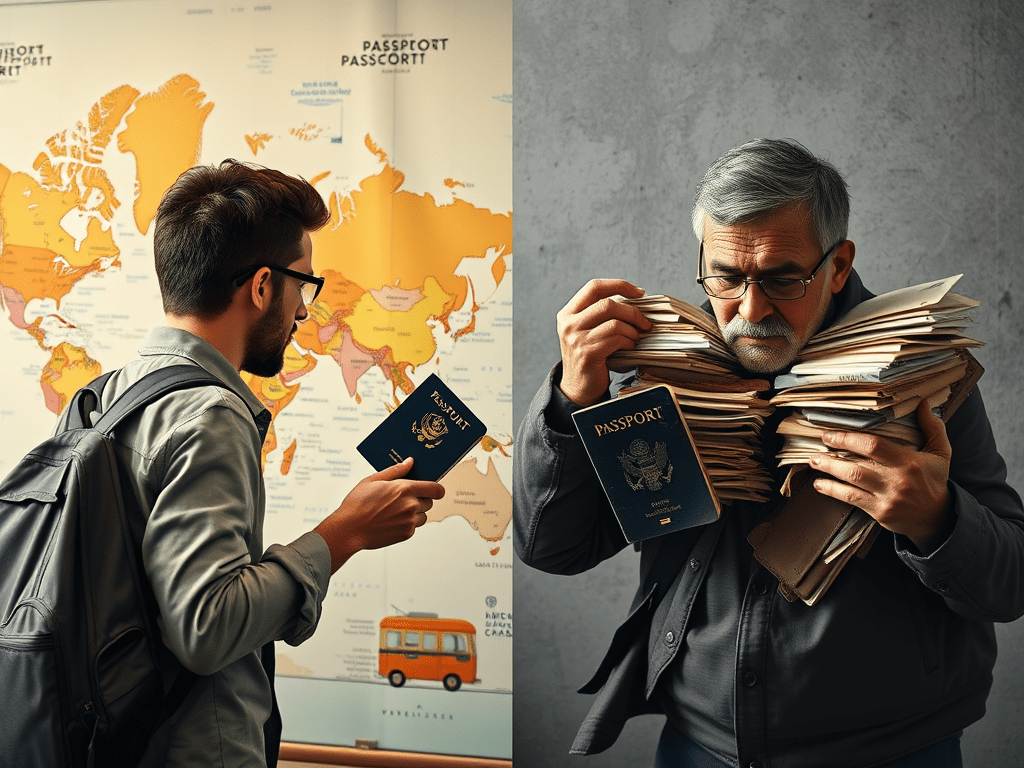
Let’s stop pretending the world is equally accessible.
We love to say, “The world is yours. Travel. Explore. Dream big.” But for millions of people, that statement is a lie wrapped in a motivational quote.
Because in reality, your passport is not just a travel document — it is a privilege badge. And some passports open doors effortlessly, while others slam them shut before you even knock.
This is the uncomfortable truth about passport privilege: where you are born determines how freely you can move.
The Numbers We Don’t Talk About Enough
According to the Henley Passport Index — one of the most widely recognized global mobility rankings — passports are graded based on how many destinations their holders can access without a prior visa.
And here is the staggering reality:
- Singapore’s passport allows access to 192 destinations without a prior visa.
- Afghanistan’s passport allows access to just 24 destinations.
- The gap between the strongest and weakest passports is 168 countries.
Let that sink in.
One person can spontaneously book almost anywhere in the world. Another must fight for permission nearly everywhere.
You can explore the following rankings:
https://www.henleyglobal.com/passport-index
And this one https://www.iata.org/en/publications/store/passport-and-visa-information/
These are not abstract statistics. They represent real lives, real ambitions, and real barriers.
Freedom of Movement Is Not Equal
If you hold a powerful passport — from Singapore, Japan, Germany, France, or South Korea — international travel often feels simple. You book a ticket. You land. You explore.
There are no embassy queues. No months of uncertainty. No humiliating interrogations about your bank account balance.
But if you hold a passport from many African, Middle Eastern, or economically struggling nations, travel becomes a bureaucratic marathon.
You are required to submit:
- Bank statements
- Employment letters
- Invitation letters
- Proof of accommodation
- Detailed itineraries
- Visa fees that can cost hundreds of dollars
And even after all that?
You can still be rejected.
Not because you are unqualified.
Not because you lack purpose.
But because of nationality risk profiling.
Let’s call it what it is: mobility discrimination rooted in geopolitics and economic inequality.
Passport Privilege Is Economic Power
This isn’t just about tourism selfies in Paris.
It’s about opportunity.
In a global economy that depends on connection, mobility is currency.
- Business owners with strong passports can attend global trade fairs on short notice.
- Researchers can collaborate internationally without endless visa delays.
- Students can accept foreign scholarships without fear of embassy rejection.
- Entrepreneurs can build networks across borders.
Meanwhile, those with weaker passports often lose contracts, miss deadlines, and forfeit scholarships because their visa applications are delayed — or denied.
Passport power directly influences economic mobility.
And that means global inequality is reinforced every time a visa is rejected.
The Myth of “Just Work Harder”
We love the narrative that success is about hustle. That if you want it badly enough, you can achieve it.
But passport privilege exposes the flaw in that thinking.
Two equally talented young professionals can apply for the same conference in London. One receives instant entry clearance. The other must prove they will return home — as if ambition automatically equals migration risk.
That suspicion is built into the system.
Countries with strong economies negotiate reciprocal visa-free agreements because they are perceived as “low risk.” Countries battling economic instability are labeled “high risk.”
This isn’t personal — but it is profoundly unequal.
The global mobility system rewards stability and punishes vulnerability.
Africa and the Mobility Ceiling
Across Africa, young people are ambitious, creative, and globally minded. Yet many are trapped by visa barriers.
Yes, there has been progress. Regional agreements within Africa aim to improve intra-continental travel. Some countries have climbed mobility rankings through diplomatic efforts.
But globally? The imbalance remains stark.
For many African passport holders, the world is technically visible — but administratively restricted.
And that breeds frustration.
Because in a so-called globalized era, freedom of movement should not be determined by birthplace.
Security vs. Equality
Governments defend strict visa regimes as necessary for national security and immigration control. And yes, border management matters.
But here is the deeper question:
At what point does security become structural exclusion?
When entire nationalities are viewed as migration threats, individuals are reduced to statistics.
A student becomes a risk profile.
A tourist becomes a suspicion.
A businessperson becomes a liability.
Passport privilege reveals how global systems categorize human beings long before they are known personally.
A World Divided by Paper
We often debate inequality in terms of income, healthcare, and education. But mobility is rarely included in that conversation.
It should be.
Because mobility shapes access to:
- International networks
- Cultural exchange
- Professional growth
- Education
- Innovation
A powerful passport expands your horizon before you even buy a ticket.
A weak passport shrinks your options before you even try.
Freedom of movement is a form of modern capital.
And like most forms of capital, it is unevenly distributed.
So What Now?
Is change possible?
Yes — but slowly.
Diplomatic negotiations, regional travel agreements, and digital visa reforms are helping narrow some gaps. Countries are increasingly recognizing the economic benefits of tourism and mobility.
But until global economic disparities are addressed, passport privilege will remain a quiet yet powerful divider.
And perhaps the first step toward change is acknowledging that:
Travel freedom is not simply about wanderlust.
It is about power.
It is about perception.
It is about politics.
Your passport is not just a booklet.
It is a reflection of how the world sees your country — and, by extension, you.
And until mobility becomes more equitable, the phrase “the world is yours” will remain true for some — and aspirational for many others.





 Sure Media Magazine
Leave a comment