
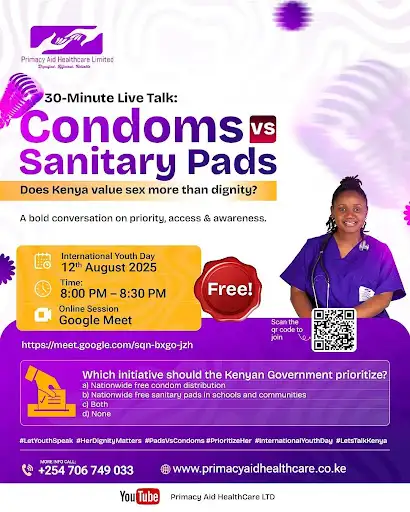
What condoms get right, while sanitary pads fight for in Kenya.

Kenya’s government policy on sexual and reproductive health (SRH) reveals a glaring inconsistency that undermines gender equity and public health priorities.
Male condoms are distributed freely through public health facilities, NASCOP (National AIDS and STI Control Programme), and community outreach programs as a core strategy for HIV prevention and unintended pregnancy reduction.
This zero-cost access is rightly framed as a life-saving public good, subsidized by the Ministry of Health and donors to curb HIV transmission and support family planning.
Yet sanitary pads, essential for menstrual hygiene, school attendance, and dignity, remain a taxed commodity.
Despite Kenya’s pioneering move in 2004 to repeal VAT (16%) on sanitary pads, and later exemptions on raw materials (2016), recent policy shifts have reintroduced or threatened new burdens. As of 2024–2025, sanitary pads are classified as exempt rather than zero-rated under VAT rules in some proposals, meaning manufacturers cannot reclaim input VAT, costs rise, and prices are passed to consumers. Periodic budget announcements have allocated funds for free pads in schools (e.g. $3 million annually since 2011), but supply remains inconsistent, patchy, and insufficient leaving many girls and women paying out-of-pocket or missing school during menstruation.
This creates a stark double standard. Condoms, used primarily by men(male condoms) and for HIV/STI prevention, are fully subsidized as a public health imperative. Sanitary pads, used exclusively by women and girls for a natural biological process, are treated as a taxable “luxury” or partially supported item. The result? Period poverty persists at 65% of Kenyan women and girls cannot consistently afford sanitary pads leading to school absenteeism, infections from improvised materials, and reinforced gender inequality. Free condoms save lives from HIV while free pads save girls’ education, health, and futures.
This policy gap is not just logistical, it’s systemic and gendered. It reflects priorities that value men’s sexual health risks over women’s routine biological needs. Kenya must align its SRH commitments; if condoms are free to prevent harm, sanitary pads should be free (or zero-rated with guaranteed supply) to prevent exclusion. True reproductive health equity demands no less.
https://www.youtube.com/post/UgkxfmyP-C8xbsuS0ZnZEPEVPAqO2Rdx1KB9





 Sure Media Magazine
Leave a comment