
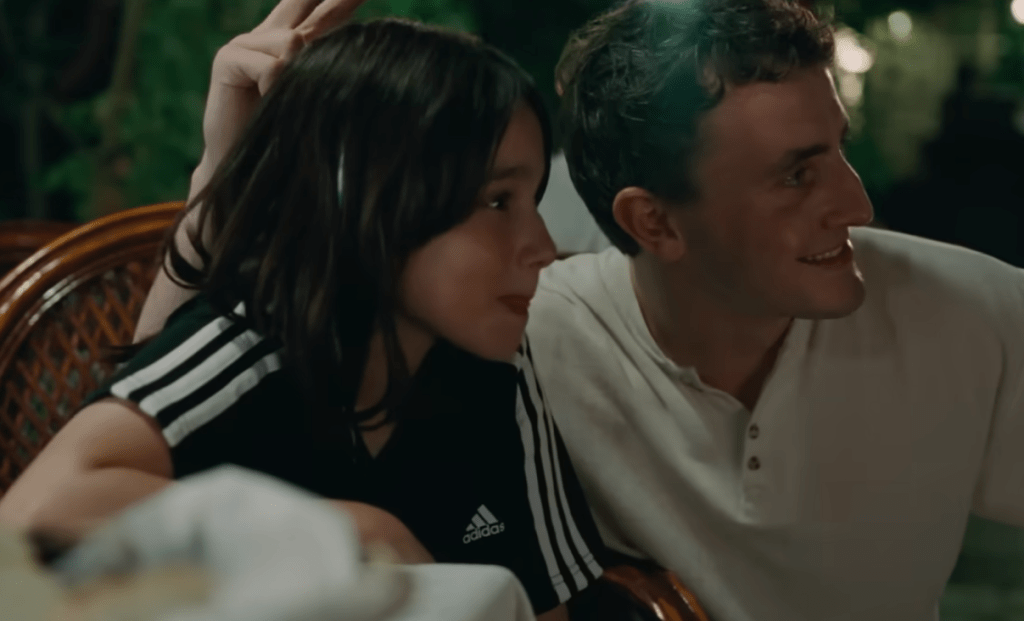
Aftersun does not present memory as a sequence of events. Charlotte Wells builds the film from impressions: a hand resting briefly on a shoulder, a conversation that trails off, a moment that feels ordinary at the time and weighted only later. The film moves the way memory often does, indirectly, without clear edges, shaped as much by absence as by recall.
At its center is a holiday shared by a father and his young daughter. The child watches her father closely, noticing his moods without understanding their source. The camera remains close, but understanding does not arrive with it. What matters is not what the father feels, but how little of it can be grasped in the moment.
Wells is careful about what she withholds. Emotional information appears at the margins: a delay before answering a question, a look that lingers too long, a smile that feels practiced rather than spontaneous. Scenes repeat without emphasis, small details resurfacing before they register as important.
Time does not settle into a single register. The past is periodically interrupted by flashes from a later present, brief and disorienting. These intrusions do not clarify the holiday so much as complicate it. Only later does it become clear what some of these moments were carrying. The film never names or diagnoses this weight. Instead, it allows his opacity to remain intact. The refusal to explain him is not evasive; it is ethical. It respects the limits of what the child and the audience can know.
Visually, Aftersun avoids emphasis. The camera favors static frames and natural light. The film lingers in places designed to pass unnoticed: a hotel room after the lights are off, a balcony used more for waiting than looking, a public pool where nothing happens except time. Nothing is stylized to signal importance. Meaning emerges through repetition and return, through the slow realization that certain moments are being held onto precisely because they are unstable.
What distinguishes the film is its discipline. It does not revise the past with hindsight or impose judgment after the fact. Uncertainty is preserved rather than resolved. The adult perspective does not correct the child’s misunderstanding; it lives alongside it. Memory is treated as something carried, not clarified.
The film ends without a revelation. No moment reorganizes what came before. Instead, it leaves the viewer with a recognition that some relationships are understood only partially, and often too late. Love, the film suggests, does not guarantee access.
Aftersun lingers because it resists instruction. It does not tell the viewer what to feel or how to interpret what was missed. It trusts that recognition will arrive on its own, unevenly, the way memory itself does quietly, and with consequence.





 Sure Media Magazine
Leave a comment