
By Ninara
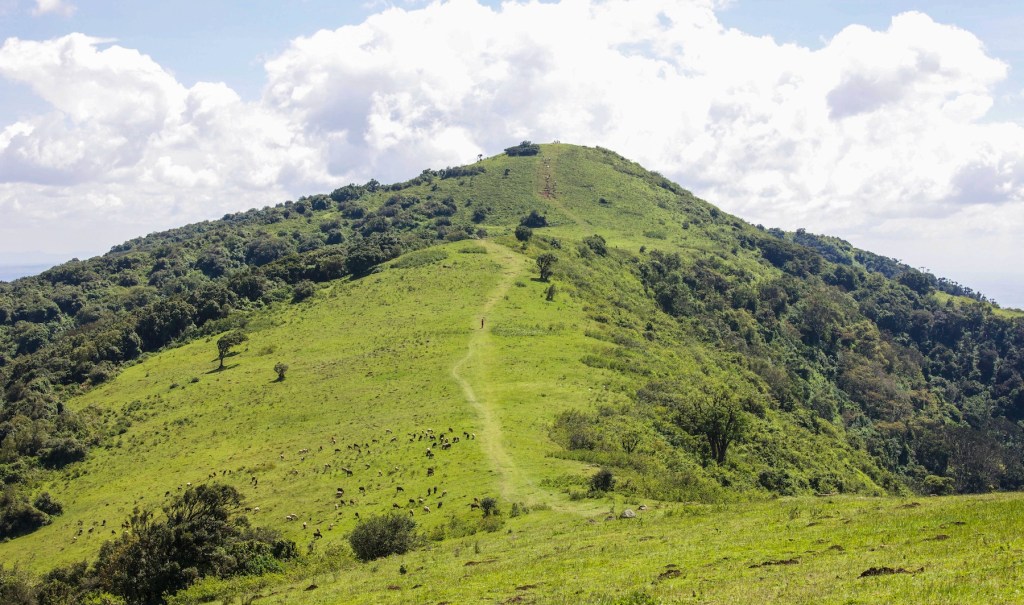
Just outside Nairobi’s western edge, the city begins to loosen its grip. Traffic thins, the air cools, and the horizon opens into a long line of rolling hills where wind moves without interruption. Ngong Hills does not rely on spectacle. What it offers instead is distance from congestion, from urgency, from the compressed pace of the capital below.
The hills sit between Nairobi and the Rift Valley, rising gently but persistently, their open grasslands shaped more by weather than by development. On clear days, the city’s skyline appears far off, reduced to glass and concrete forms that feel detached from the quiet unfolding at this elevation. People come here less for landmarks than for rhythm: walking, pausing, looking outward.
The wind carries the smell of grass and distant rain, bending trees and cutting conversations short. Walkers move steadily, heads tilted into the breeze, stopping now and then as the view shifts. Nairobi spread out to the east, the Rift Valley stretching westward.
Unlike Kenya’s more famous landscapes, Ngong Hills resist romantic framing. Its appeal lies in that restraint. Nothing competes for attention.
The experience is communal but unforced. Small groups walk together, some talking, others quiet. Solo walkers pass with brief nods. The hills attract a cross-section of Nairobi life: professionals stepping away from the city for a few hours, students, runners, and regulars for whom the path is familiar rather than novel.
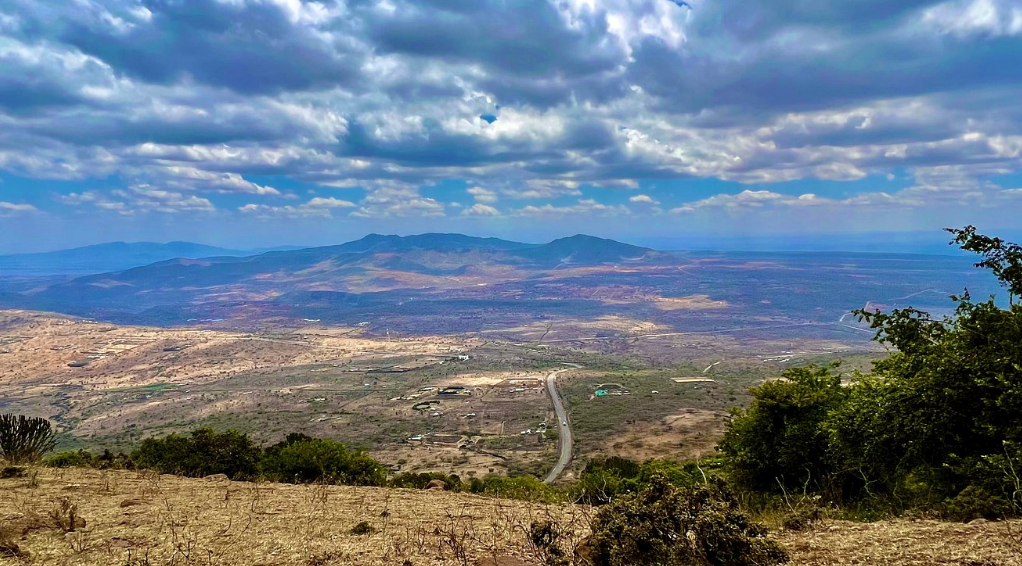
As the trail climbs, the wind strengthens. Sound thins out. From the highest points, the city’s scale collapses, roads become lines, and buildings flatten into shapes. What remains is movement: grass bending, clouds shifting, people advancing slowly along the ridge. The hills impose their own tempo, one that resists compression.
Ngong Hills also occupy a place in Kenya’s cultural memory, referenced in literature and conversation as a space of openness and reflection. On the ground, though, the experience is practical. Shoes gather dust. Jackets come out. Conversations pause for breath. The hills are less symbolic than practical. People come to walk, to spend energy, to let their thoughts run without interruption.
As the afternoon light softens, shadows stretch across the grass, and the wind begins to settle. Walkers turn back one by one, following the same narrow paths toward the city. Nairobi reappears gradually, not all at once, but in layers: a distant outline, then sound, then traffic.
By the time you reach the edge of the hills, the city feels closer again. Louder. More insistent. But something has already shifted. You’ve seen it from a distance, and for a few hours, that was enough.





 Sure Media Magazine
Leave a comment