For years, we’ve been told that science and faith are contrary—locked in an ancient conflict, like oil and water. But I’ve come to rethink that divide. Maybe it’s not a canyon after all; a small crack, perhaps, in the shell of perception.
Science is no different from faith. In fact, one is the brainchild of the other. And like any family dynamic, the child—science—often seeks emancipation, forgetting the parent that birthed it. Many who champion science overlook a simple truth: there could be no science without faith, just as there could be no son without a parent.
Yet painfully, science is often understood as the denial of faith. As if belief is a tyrant, and science its rebellious heir. But what really is science?
We tend to define it by what can be seen, measured, and explained. It’s the realm of the tangible—the works of men. Faith, on the other hand, is often cast as the opposite: unseen, intangible, immeasurable. The realm of God.
This imagined chasm between faith and science has divided many. But perhaps the divide only exists for those unwilling to ask the unaskable. What if science is man’s attempt to explain the complexity of faith? What if science is the physical embodiment of the spiritual? Or better still, what if faith is the greater science?
Not two ideas, but one. Science is the canvas on which faith is crafted. Faith, the ghost haunting the corridors of ignorance, screaming to be heard—if only someone would awaken from the stupor.
But how can the spiritual be understood by the physical? That’s the paradox. Understanding what cannot be seen from what can be seen is no simple task. Faith demands a certain disregard for the physical to accept the spiritual.
“Now faith is the substance of things hoped for, the evidence of things not seen.” — Hebrews 11:1
In trying to understand the science of faith, we often birth another paradox—the faith in science. Science cast as the ungrateful son of faith: proud, self-exalting, living off applause, while denying the meek nature of the very faith that birthed it.
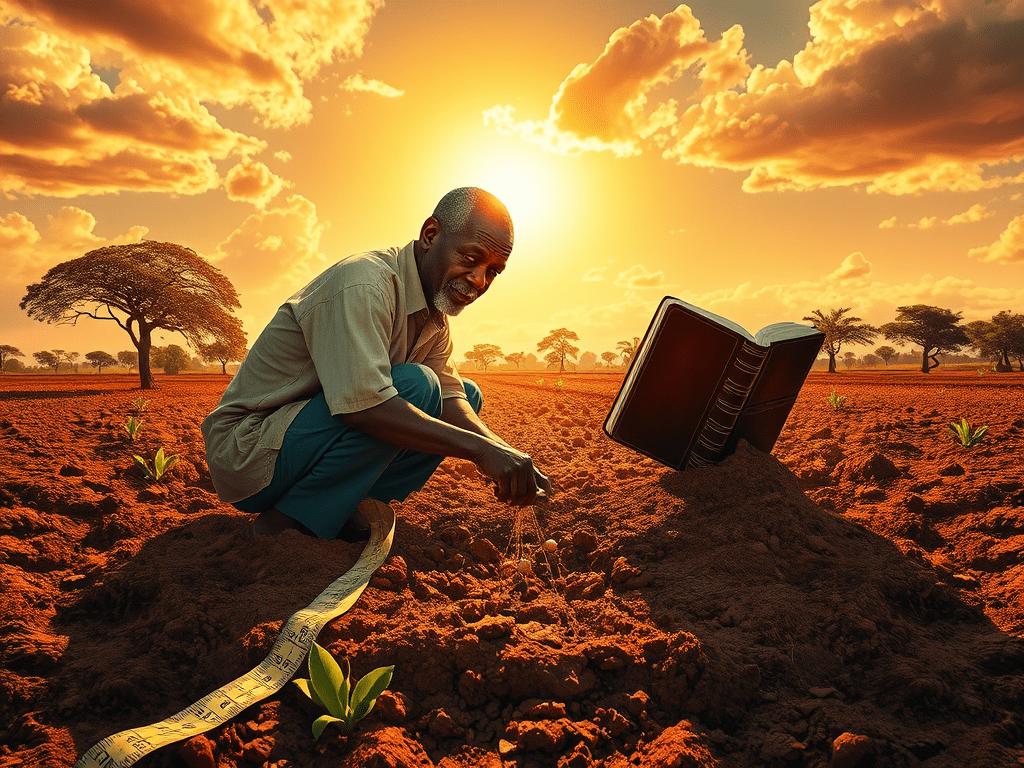
Picture a farmer tilling the ground before the rains in the absence of clouds, he plants in hope; That is faith. And when the rains come, and the soil yields fruit, then science steps in to measure the harvest, analyze the soil, and optimize the process. But that first act—the planting—was never scientific. It was spiritual.
So then, what do we make of this relationship? Is science trying to fit into its father’s shoes? Or is faith quietly proving science wrong—a father disappointed by his son’s rebellion?
Even Wangari Maathai, in her environmental crusade, did not separate science from spirit. She saw trees as sacred and data as divine. Her activism was rooted in both ecology and belief—a reminder that the physical and spiritual are not enemies, but allies.
Skeptics argue that faith is blind. Scientists scoff at what cannot be measured. But blindness is not the absence of vision—it is the reliance on inner sight.
However you answer, it reveals where you lean—whether toward the physical or the spiritual. Conclusively, the two, despite their paradoxical framing, are mutually inclusive. Because faith needs science. And science—without faith—is dead.

East African Living
Is science the brain-child of faith??
For years, we’ve been told that science and faith are contrary—locked in an ancient conflict, like oil and water. But I’ve come to rethink that divide. Maybe it’s not a canyon after all; a small crack, perhaps, in the shell of perception. Science is no different from faith. In fact, one is the brainchild of…





 Sure Media Magazine
Leave a comment