
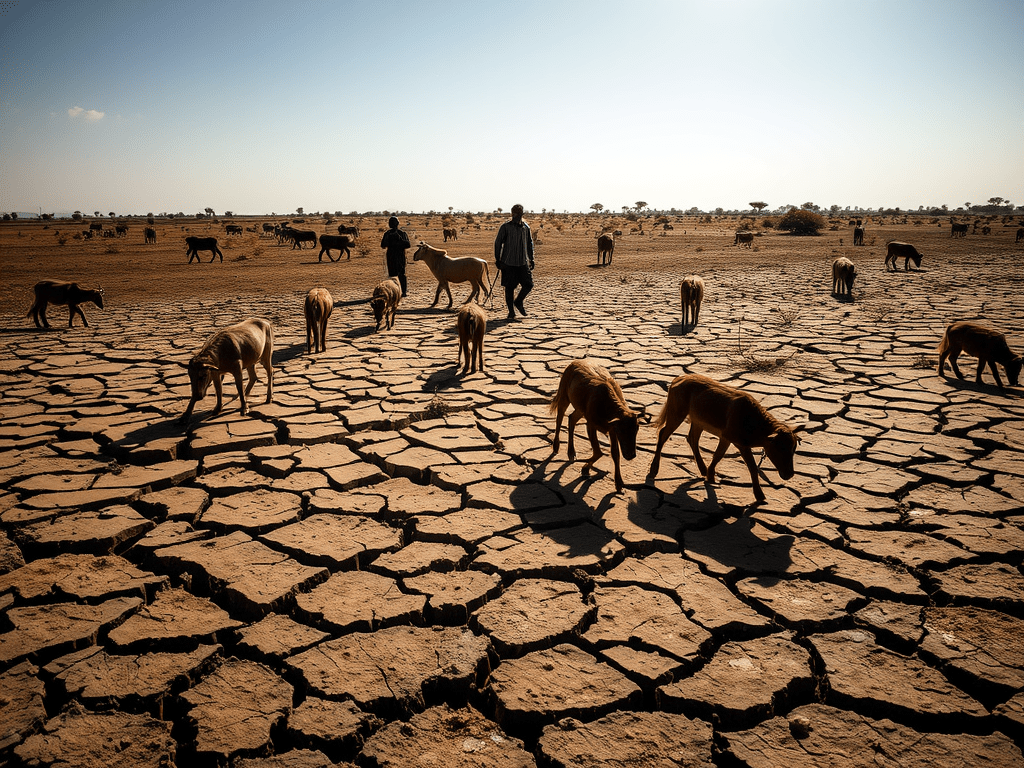
1. Severe Drought Deepens Crisis for Pastoralists
Kenya is facing an expanding drought emergency as dry conditions spread beyond traditionally arid regions into areas such as Kajiado County, near Nairobi. The situation has devastated pastoralist communities, with herders reporting massive livestock losses — in some cases more than 100 cattle and 300 goats per household — and forcing families to trek into Tanzania in search of grazing land. Livestock prices have crashed, and forecasts suggest inferior March–May rains, raising fears of resource conflicts and heightened food insecurity across affected counties. Scientists and humanitarian groups warn this drought reflects the growing intensity of climate change impacts in the Horn of Africa.
2. New EV Incentives Aim to Accelerate Green Transport
In a bid to accelerate sustainable mobility, the Kenyan government has announced tax incentives for electric vehicle (EV) parts and charging infrastructure under its National Electric Mobility Policy. Starting in July, VAT and excise duty exemptions on EV components and exemptions or reductions in stamp duty for EV charging stations are expected. The policy supports Kenya’s climate commitments to reduce emissions and strengthen local manufacturing and job creation. Kenya has seen rapid growth in EV registrations, with the number rising from under 1,000 in 2022 to nearly 25,000 by 2025.
Complementing policy, private sector players are already contributing: Bolt now represents nearly a quarter of all electric vehicles in Kenya’s fleet, showing how ride-hailing companies are helping scale adoption.
3. Kenyan Job Seekers Exploited into War Zones
A major international investigation has revealed a troubling trend: hundreds of Kenyan men were recruited under false pretenses to work overseas — only to be sent into combat in the Ukraine conflict. Recruiters promised civilian employment but instead transferred recruits into Russian linked military operations with little training, language support, or clear contracts. Families of missing or deceased men have struggled to get information, and attempts at diplomatic intervention remain limited. This exposes a grave human trafficking issue intertwined with the harsh realities of unemployment and economic desperation in Kenya.
4. Public Opinion Turns Pessimistic
Recent survey data indicates a growing sense of pessimism among Kenyans about the country’s direction. In a national poll by TIFA, a majority — 68% of respondents — believe Kenya is heading in the wrong direction, compared with just 17% who are optimistic. The sentiment is particularly strong in the politically influential Mt Kenya region, reflecting widespread economic concerns and political dissatisfaction.
5. Media and Information Trends Shift
New data from the Communications Authority of Kenya shows a surprising regional media pattern: Siaya and Kisumu counties lead the country in newspaper readership, with nearly 22% of adults regularly reading printed newspapers in the 2025/26 financial year. Meanwhile, newspaper readership remains lowest in the Coast and North Western Kenya. Analysts say this reflects a transitional media landscape where traditional outlets still matter locally, even as digital platforms grow elsewhere.
Additionally, social media patterns are evolving — a recent report shows Facebook has overtaken TikTok as Kenya’s most-used social media platform, partly due to its embrace of short-form video and personalised content.
6. Government Service Upgrades & Public Convenience
The Affordable Housing platform Boma Yangu — a key government initiative helping low and middle-income households access housing — is migrating its services to the e-Citizen portal. The move is expected to improve system reliability, access, and user experience, though the migration is temporarily disrupting service. Officials urge citizens to plan around the outage window from Friday evening to Monday morning.
7. Education Milestone: First KJSEA Results Released
In a historic shift for Kenya’s education system, 1.1 million Grade 9 learners have received their first-ever Kenya Junior School Education Assessment (KJSEA) results under the Competency-Based Curriculum (CBC). Instead of traditional exam rankings, students are placed into performance bands to help guide career pathways and future school placements. Parents can access results via SMS, marking a major innovation in how learning outcomes are communicated.





 Sure Media Magazine
Leave a comment