
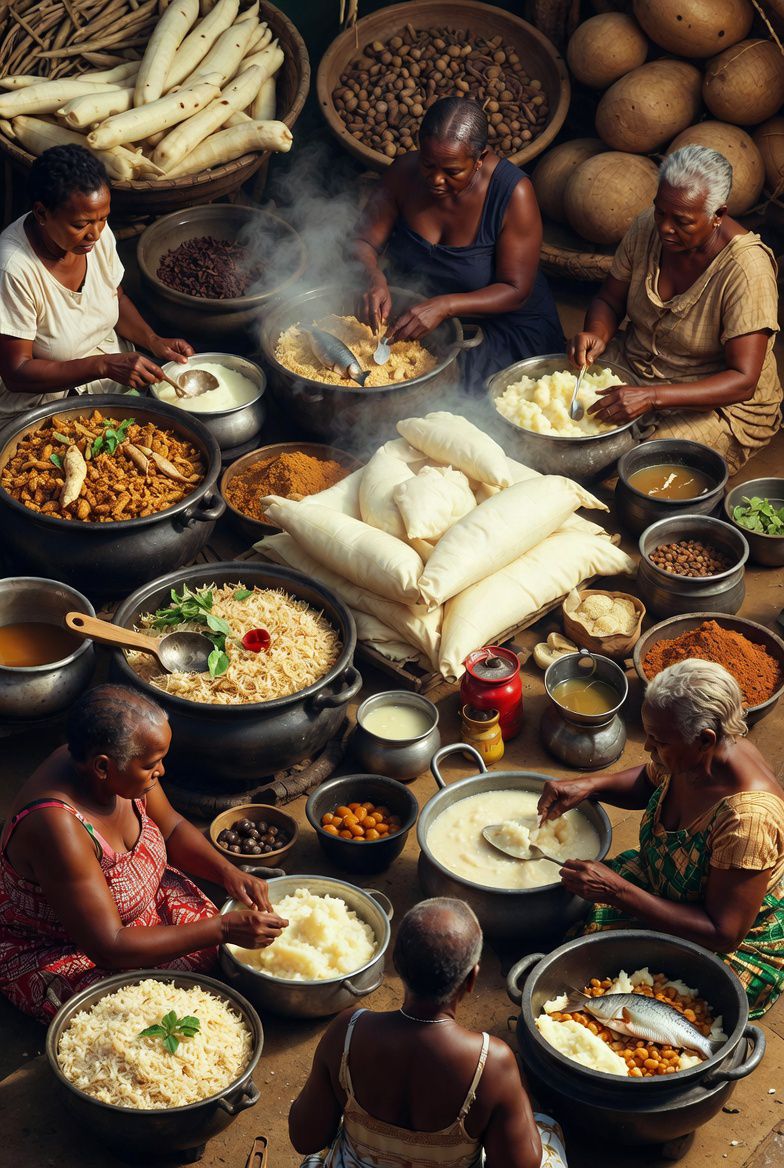
Archives are often imagined as institutional fortresses, sterile rooms filled with documents, artifacts, and images, all neatly governed by systems of classification and authority. But what if the true guardians of history are not locked in vaults or digitized databases? Across much of African history, cultural knowledge has thrived far beyond these formal structures. Cooking, frequently dismissed as mundane domestic labor, has long served as one of the continent’s most resilient and subversive archival systems.
African foodways operate as living, breathing archives, preserving knowledge through embodied practice rather than rigid written instruction. Long before colonial powers imposed their paper trails, culinary techniques were passed down orally: learned by watching elders grind spices, tasting the balance of flavors, and repeating the rhythms of preparation until they became second nature. Measurements were not dictated by scales or cups but by intuition, a handful here, a splash there, adjusted for the season or the soil’s yield. Memory resided not in ledgers but in hands, senses, and communal storytelling. This system proved indispensable under colonial rule, when European administrations elevated written documentation as the benchmark of legitimacy while dismissing oral and sensory knowledge as informal or inferior. Domestic expertise, largely stewarded by women, rarely entered official records, sidelined by narratives of conquest and commerce.
Yet it is precisely within this dismissal that food’s archival power emerges. A single dish can unravel layered histories that formal records ignore. Take ugali, the maize porridge ubiquitous across East and Southern Africa: its simplicity conceals a colonial past in which European empires imposed maize cultivation, displacing Indigenous grains such as millet and sorghum. Or consider the spiced pilau of Kenya’s Swahili coast, fragrant with cardamon and cloves, markers of Indian Ocean trade routes intensified by Arab and European merchants. Ingredients reflect regional ecologies as well as imperial disruption: cassava introduced through Atlantic trade networks, sugarcane entwined with plantation economies, rice transformed into jollof as it moved across West Africa. Substitutions tell even more intimate stories of adaptation, diasporic cooks in London or New York replacing scarce vegetables, adjusting techniques while preserving flavor logic. Preparation methods encode collective knowledge too: the slow fermentation of Ethiopian injera teaching patience and microbial expertise, or the communal pounding of fufu embedding lessons about labor, rhythm, and social cohesion. These practices did not preserve history by fixing it in place; they sustained it through repetition and use.
In diasporic contexts, cooking became a portable archive, surviving rupture and displacement. Enslaved Africans in the Americas improvised with unfamiliar crops while retaining the structural logic of ancestral dishes, the sequencing of steps, the layering of flavors, the tactile knowledge that resisted erasure. Today, African migrants continue this work, adapting recipes amid ingredient shortages and cultural misrecognition. A stew’s aroma can summon distant villages; a shared meal can reconstruct fractured kinship. Food becomes a bridge across oceans, transforming survival into remembrance.
African culinary traditions also challenge object-centered archival models dominant in Western institutions. A clay pot, wooden mortar, or bundle of herbs acquires meaning only through action, grinding, simmering, and tasting. These objects are not inert artifacts to be cataloged; their significance emerges through movement, gesture, and relational knowledge. Such traditions resist the archival impulse toward containment, insisting instead on context and embodiment. At the center of this system are women: the largely unacknowledged custodians of culinary memory. From Senegalese grandmothers refining thieboudienne to Zulu matriarchs brewing umqombothi, their unpaid, undocumented labor has sustained cultural continuity even as it was rendered invisible.

As museums and cultural institutions confront demands for decolonization, through repatriation, expanded heritage frameworks, and community collaboration, African foodways demand serious recognition. Not as romanticized traditions frozen in time, but as dynamic systems of knowledge that adapt, resist, and endure. Initiatives documenting oral recipes, intergenerational cooking practices, and sensory histories, such as community-led food archives and narrative cookbooks, offer models for preserving culture without stripping it of life.
History does not always survive because it is meticulously written or carefully digitized. Sometimes, it endures because it is cooked, shared, and tasted, generation after generation. In an era of erasure and commodification, African kitchens remind us that the most powerful archives are not stored behind glass. They live within us, ready to be reawakened with every meal.





 Sure Media Magazine
Leave a comment