
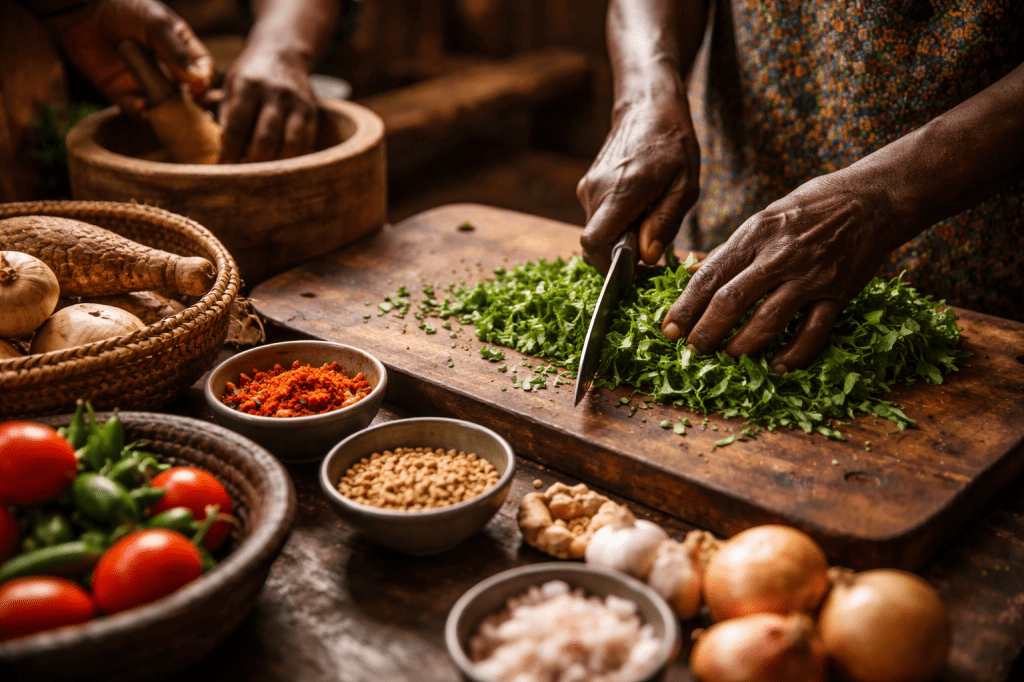
Archives are often imagined as controlled institutional spaces, rooms of documents, catalogued artifacts, and authorized narratives preserved behind glass. They imply permanence, order, and authority. Yet across much of African history, cultural knowledge has flourished outside these formal structures. Long before written documentation became dominant, communities relied on embodied, oral, and sensory systems of preservation. Among the most enduring of these systems is cooking.
African foodways function as living archives. Culinary knowledge has historically been transmitted through observation, repetition, and participation rather than standardized texts. Techniques were learned by watching elders cook, tasting adjustments in seasoning, and understanding timing through experience rather than clocks. Measurements were approximate, guided by memory and intuition rather than fixed units. Knowledge resided in hands, senses, and shared practice, not on paper.
This mode of transmission became especially vital under colonial rule. Colonial administrations privileged written records and European systems of classification, dismissing oral and sensory knowledge as informal, primitive, or unscientific. This hierarchy shaped what was deemed worthy of preservation. Political treaties, economic transactions, and missionary records entered official archives, while domestic expertise, agricultural knowledge, cooking methods, preservation techniques, was largely excluded.
Yet within these everyday practices were encoded sophisticated histories. Farming methods reflected deep ecological understanding. Cooking techniques preserve knowledge of seasonality, trade routes, and adaptation to environmental change. Dishes evolved in response to shifting access to ingredients, labor conditions, and social organization. Food, in this sense, recorded history where institutions failed to do so.
A single dish can hold multiple historical layers. Ingredients often trace regional ecologies or colonial trade legacies, spices introduced through maritime routes, grains shaped by climate and land use. Substitutions tell stories of scarcity, displacement, and resilience. Preparation techniques such as fermentation, slow simmering, or communal cooking encode collective knowledge about time, preservation, and cooperation. These elements form a culinary record maintained not by storage but by repetition.
In African diasporas, food operates as a portable archive. Migration, whether forced or voluntary, frequently disrupted access to familiar ingredients and tools. Cooks adapted, substituting what was available while preserving the underlying logic of dishes: the sequence of steps, flavor balances, and communal context. In doing so, they carried memories across borders. Cooking became a way to reconstitute place in unfamiliar environments, ensuring continuity despite displacement.
African foodways also challenge dominant archival models by blurring the line between object and practice. A mortar, clay pot, or market staple holds limited meaning in isolation. Its significance emerges through use, through the gestures, rhythms, and shared understanding that animate it. These traditions resist object-centered archival frameworks by foregrounding embodiment, relationality, and context.
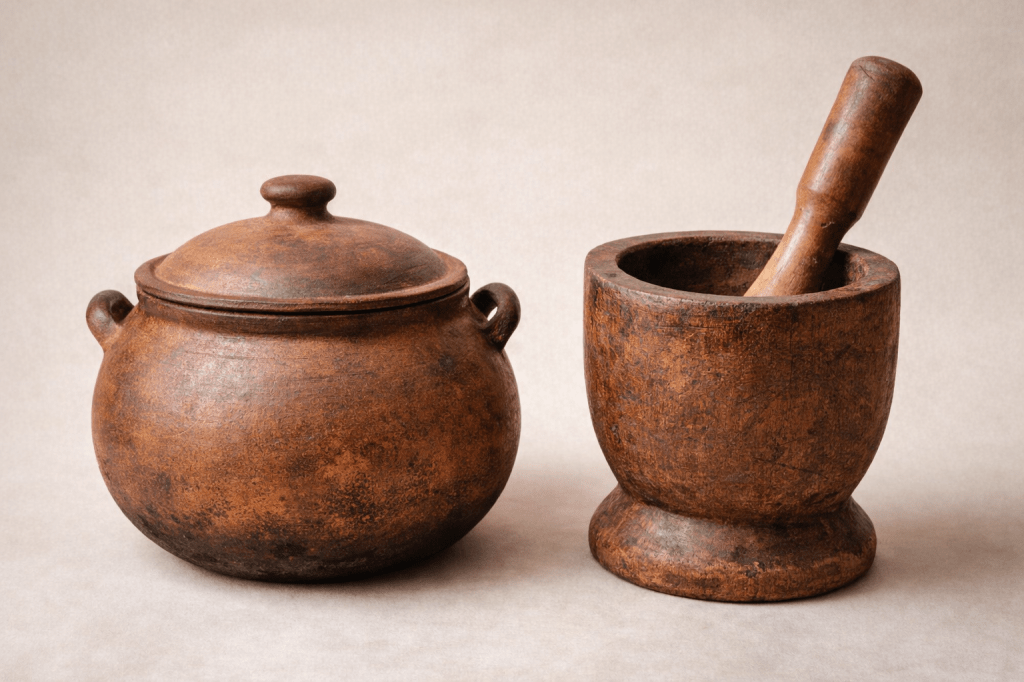
Women have historically served as the primary custodians of these culinary archives. Across many African societies, they transmitted techniques, tastes, and rituals across generations. This labor, often unpaid and undocumented, was essential to cultural survival, yet rarely recognized as knowledge production. To acknowledge cooking as archival practice is to recognize these gendered forms of expertise that conventional archives have systematically overlooked.
Contemporary cultural institutions have begun expanding their definitions of heritage. Museums increasingly collect domestic objects, oral histories, and everyday materials. Digital platforms and open-access initiatives offer new possibilities for documenting food traditions beyond institutional walls. However, African food histories remain underrepresented or framed through ethnographic and exoticizing lenses rather than recognized as dynamic, intellectual systems.
Cookbooks occupy a revealing middle ground. When African culinary knowledge enters written form, it often retains traces of its oral origins, narrative digressions, flexible measurements, and contextual storytelling. These texts resist rigid standardization, merging archive and practice. They raise critical questions about authorship, authority, and whose voice is permitted to record cultural knowledge.
To view African foodways as archives is not to romanticize tradition or freeze it in time. Rather, it is to recognize an alternative preservation system, one rooted in continuity rather than containment, in enactment rather than storage. Kitchens, markets, and shared tables function as historical sites where memory is renewed through repetition and collective experience.
As conversations around archival inclusion, repatriation, and erasure continue, African culinary traditions deserve serious attention. They remind us that history does not survive solely because it is written down or institutionalized. Sometimes, it endures because it is prepared, shared, and savored, again and again.




 Sure Media Magazine
Leave a comment