
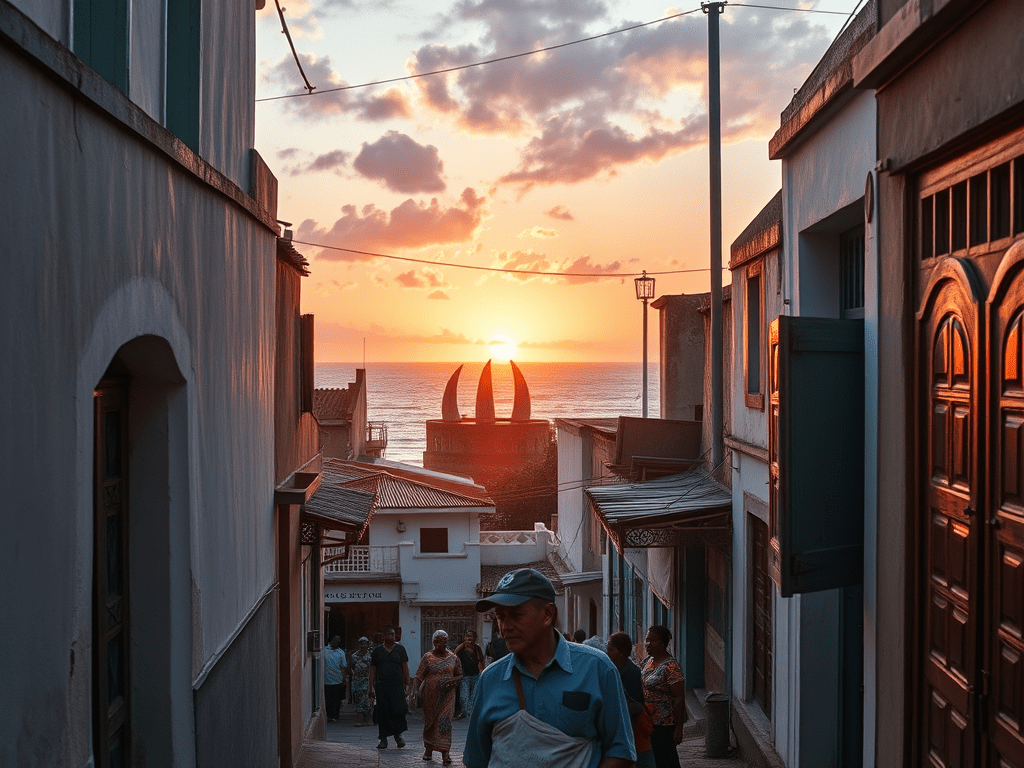
Mombasa the white and Blue city is a historical Island surrounded by water, an ancient city that was started in the 900AD as a trading hub. It is the second largest city in Kenya. The name Mombasa originates from a swahili word “Kisiwa Cha Mvita” Island of war. Around the 13th century the Island was flourishing with trade in gold, ivory and spices making it a link between Africa to India, China and Persia.
Mombasa: A City That Stays With You.
When people hear Mombasa, they often picture white-sandy beaches and turquoise waters of the Indian ocean. And yes, the beaches are beautiful. But Mombasa is much more than a holiday postcard, for me, It’s a feeling.
Life in Mombasa moves at its own pace. There is a certain ease in the air. This coastal city is lively, loud,c olourful and full of character. The locals often say “Mombasa Raha”- which means “Mombasa Joy”-and it’s real. You feel it in the way people talk, in the laughter on the streets and in the calm that somehow exists even in the middle of the city’s noise.
One place that always grounds me in Mombasa’s history is Fort Jesus. Built by the Portuguese between 1593 and 1596, the massive stone fortress stands quietly along the coast, carrying centuries of stories within its walls. Walking through it, I often imagine the traders, soldiers and travellers who once passed through these same grounds all connected by the Indian ocean.
Pembe za ndovu or Mombasa Tusks, a symbol that always catches my eye. Built in 1952 to commemorate the visit of Queen Elizabeth II, they now serve as a gateway into the older parts of the city. Passing beneath them feels like crossing into another side of Mombasa-towards old town, with its narrow streets, swahili doors and vibrant markets full of life.
Not Lazy Just Living
People often say Mombasa is lazy. I’ve heard it many times-from visitors, people who pass through and they think they’ve figured the city out in a weekend. They see the slow walks, long launches, unhurried conversations and they assume nothing much is happening here. But everytime i here that, I smile because I know they are missing out the point entirely.
Mombasa doesn’t rush. The sun climbs too fiercely for anyone to pretend otherwise- the kind of heat that presses against your skin like a living thing, demanding you meet its own term. Life here teaches you young: speed isn’t strength; its often just noise.
By 5am, the city is already breathing. Women move through shadowed doorways,lighting charcoal jikos and stirring uji for family, the faint scent of cardamon drifting into the streets. Fishermen haul dhows ashore along the Old Town Creeks their nets heavy with the night catch-silver kingfish glinting under the first pink light, voices calling in low Swahili as they sort the haul. The streets stretch awake slowly, unapologetically, the call to prayer blending with the flip-flops and distance horn of a matatu.
The pace slows as the heat builds, and honestly, it has to. You learn quickly that rushing here only drains you. People often say “haraka haraka haina baraka,” and in Mombasa those words make sense. Life flows better when you stop fighting it. I have noticed lunch always seems to be ready before I am. The food waits patiently at the corner café, and no one pressures you to eat quickly or move on. Work continues in its own quite way. People are earning, surviving, building lives-just without the noise and stress I’ve seen elsewhere.
What draws me the most is what happens in the small moments. A stranger offering help without hesitation. Someone greeting you warmly even if they never met you before. There is softness to the people here that doesn’t need announcing.
Kindness just exists.
When the evening comes, I often find myself drawn to the old port near Fort Jesus. As the sun begins to sink, people gather without plans or urgency. Some sip coffee others sit in silence, watching the ocean breathe. The breeze arrives gently, cooling the day and reminds you that you made it through another one. Those moments stay with me.
Mombasa has taught me that life doesn’t need to be loud to be meaningful. It doesn’t need rush to prove its worth. The city lives on its own terms, and in doing so, it quietly teaches you how to live on yours.
This city isn’t perfect, and it doesn’t try to be. But it has a soul. In its salty air, the history in its stones, and the warmth of its people. Once you connect with it, a part of you never leaves.
So when people call Mombasa lazy, I don’t argue anymore. I just smile. Because I know this city isn’t slow – its present. And that, to me, feels like wisdom.






 Sure Media Magazine
Leave a comment