
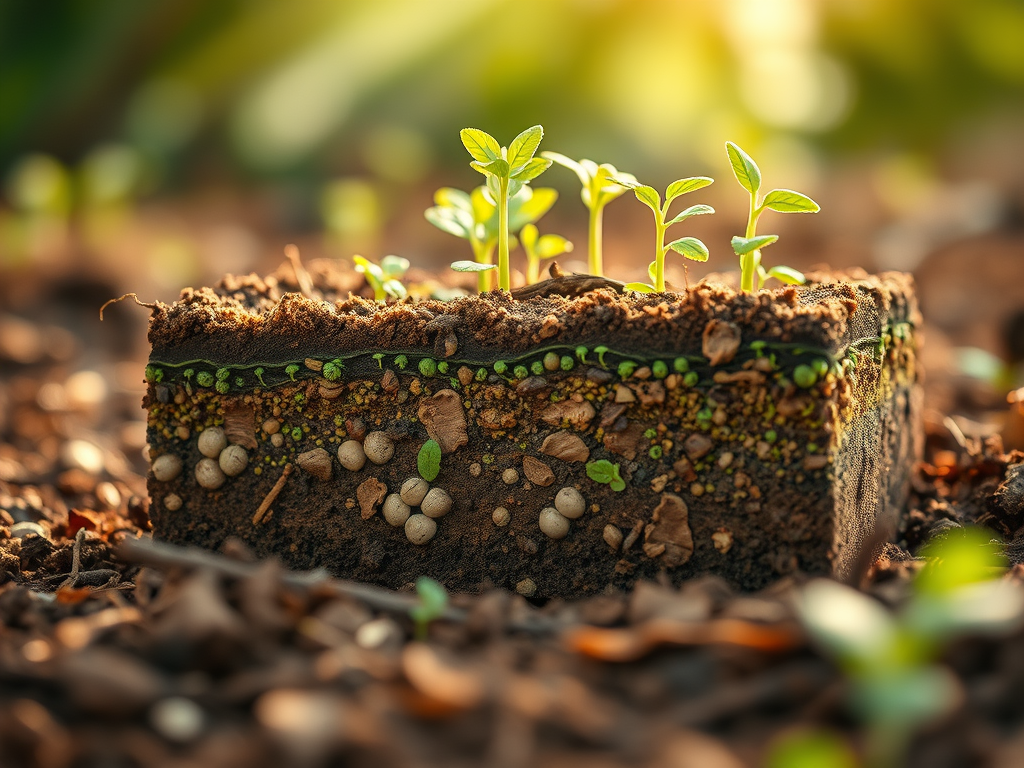
The most important work in agriculture happens quietly. No engines roar, no headlines flash and no harvesters announce progress. It unfolds beneath our boots, under roots and residue in a living layer that we have long mistaken for something inert. Soil does not demand attention yet it holds the future of food, climate stability and rural economies in its dark breathing depths.
For generations farming culture looked upward for answers from bigger machines, stronger chemicals and faster yields. Progress was measured in speed and scale while soil was treated as a background player; that is, a surface to be managed rather than a system to be understood. Healthy soil was assumed not cultivated. Degraded soil was patched with inputs. The silence below was ignored and today that silence is speaking back.
Across farms both large and small a shift is underway. Farmers, scientists, and food systems thinkers are rediscovering a truth that modern agriculture nearly buried that soil is alive and its health determines everything above it. This realization is not dramatic or sudden but patient like soil itself and it is quietly rewriting the future of agriculture.
Healthy soil is not simply dirt with nutrients added. It is a complex living network of bacteria, fungi, insects, roots, air, water and organic matter all interacting in balance. A single teaspoon of healthy soil can contain more living organisms than there are people on Earth. These organisms break down plant residues, cycle nutrients, store carbon and protect crops from disease. They are nature’s original engineers, and soil is their infrastructure.
When soil is alive, plants do not need to be forced to grow. They are supported. Roots travel deeper accessing water during dry spells. Nutrients are released gradually in sync with plant needs. Crops become more resilient, less dependent on synthetic fertilizers and pesticides. Yields stabilize not because farmers push harder but because the system works better.
Yet for much of the last century, agriculture functioned as if soil life were expendable because frequent tillage shattered soil structure, monocropping starved microbial diversity, chemical inputs replaced biological relationships and organic matter declined. Soils became compacted, eroded and vulnerable. Productivity continued but at a cost that was not immediately visible and the bill is now arriving.
Climate volatility, rising input costs, water scarcity and declining land productivity have forced agriculture to confront its foundations and many are discovering that the most effective response is not more technology on the surface but regeneration below it. Healthy soil has emerged as one of agriculture’s most powerful tools not because it is new but because it was forgotten.
At the center of this soil first movement is a change in mindset. Farmers who prioritize soil health measure success differently because they pay attention to how soil smells after rain, how easily it crumbles in their hands and how quickly water infiltrates instead of running off. Earthworms become indicators, cover becomes protection and time becomes an ally rather than an enemy.
What makes healthy soil so powerful is not just what it produces but what it prevents. Fields with strong soil structure resist erosion during heavy rains. They hold moisture during droughts and buffer crops against temperature extremes. In a world increasingly shaped by climate uncertainty, soil becomes insurance quietly absorbing shocks that would otherwise devastate farms.
The economic implications are equally profound. Healthy soil reduces dependence on costly external inputs because fertilizers are used more efficiently and pesticide applications decline as biological balance improves. Irrigation needs drop as water retention increases. Over time, farms built on soil health often experience lower production costs and more consistent yields. Profitability becomes steadier, not spectacular, but durable.
This durability changes how wealth is understood in agriculture. Instead of extracting value season by season, soil-centered farming builds value over time because organic matter becomes capital and soil structure becomes infrastructure. A field’s worth is no longer defined only by last year’s harvest, but by its long-term productivity. In this sense, healthy soil is generational wealth passed down rather than used up.
Beyond the farm the benefits ripple outward. Healthy soils store carbon pulling it from the atmosphere and locking it underground. This positions agriculture not just as a contributor to climate change but as a potential solution. While no single practice can reverse global warming, soil health offers a rare opportunity where food production and environmental repair align.
Food quality also begins to shift. Crops grown in biologically active soils often contain a broader range of nutrients, flavors deepen and shelf life improves. While these changes are subtle they remind us that food quality starts long before harvest. It begins in the relationships between roots and microbes in mineral exchanges invisible to the eye.
Culturally, healthy soil is restoring something agriculture nearly lost: attentiveness. Soil-focused farmers spend more time observing than reacting. They read their land the way one reads weather or history. This slows the pace of farming, not in output, but in approach. It replaces force with understanding, control with cooperation.
This philosophy resonates beyond rural landscapes. Urban gardeners, community farms, and rooftop growers are embracing soil health principles in limited spaces. Composting, mulching, and soil regeneration allow even small plots to become productive ecosystems. Soil health is no longer the domain of vast acreage alone. It is a practice anyone with ground beneath them can adopt.
There is also a deeper lesson embedded in soil’s silence. It teaches patience in a culture addicted to immediacy. Healthy soil does not appear overnight. Organic matter builds slowly. Microbial communities recover over seasons, not weeks. The rewards of soil care are delayed, but they are lasting. This challenges modern ideas of success, reminding us that the most meaningful gains often take time.
Perhaps this is why soil has been overlooked for so long. It does not perform. It does not advertise. It works steadily, invisibly, turning decay into fertility and time into abundance. Its power lies precisely in its refusal to be loud.
As agriculture faces an uncertain future, shaped by climate pressure, population growth, and ecological limits, the answers may not come from above. They may come from below, from a living system that has supported life for millennia, waiting to be respected again.
Healthy soil does not promise miracles. It promises resilience. It does not eliminate risk. It reduces vulnerability. It does not chase growth at any cost. It builds capacity to endure.
The future of agriculture may not arrive with noise or spectacle. It may grow in silence, beneath our feet, where life works patiently, rewriting what is possible one handful of soil at a time.




 Sure Media Magazine
Leave a comment