
I. The Age of Systems
For centuries, human civilization has been structured around two grand ideas: democracy and capitalism. One promised political freedom; the other economic opportunity. Both depended on the same premise — that individuals, as rational agents, could make choices that collectively shaped society.
But what happens when those choices are no longer truly our own?
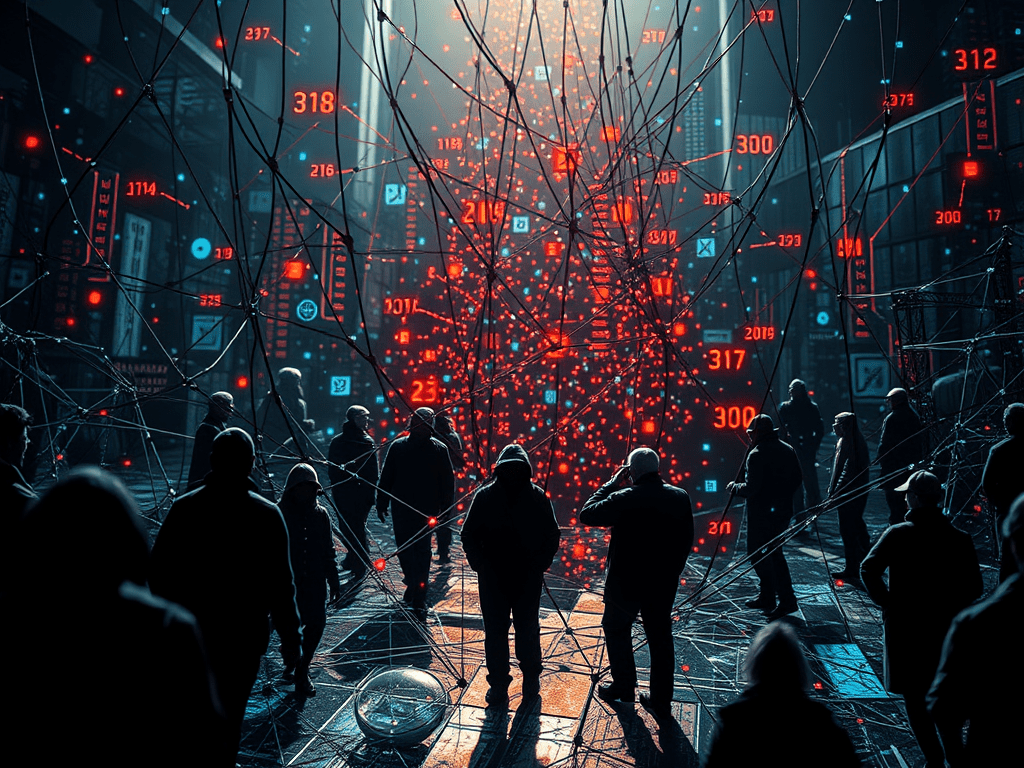
Today, algorithms predict our desires before we feel them, markets trade faster than we can blink, and governments increasingly rely on data to make decisions once guided by debate. The voter and the consumer — the twin pillars of modern civilization — are being quietly displaced by systems that decide for us.
This isn’t dystopia. It’s evolution.
We are not being ruled by tyrants, but by the logic of efficiency — the silent, optimized governance of the digital age.
II. Democracy’s Unraveling
Democracy was built on scarcity: of information, of access, of coordination. Elections once mattered because they provided a rare mechanism to translate scattered public will into collective action. But in a world of constant connectivity and real-time feedback, voting every few years feels archaic — a relic of slower times.
Social media has turned politics into a continuous referendum. Yet, paradoxically, this hasn’t deepened democracy; it has fragmented it. The “public sphere” Habermas once imagined has splintered into algorithmic echo chambers, where truth is personalized and outrage is monetized.
When every citizen lives in a customized information universe, what does “the people” even mean? Democracy requires a shared reality. Algorithms have replaced that with tailored ones.
The result is a hollow democracy — full of noise, empty of consensus.
Elections still happen, but meaning has migrated elsewhere — into systems that analyze behavior, forecast outcomes, and nudge us toward “optimal” decisions.
The voter still votes, but the system already knows the result.
III. Capitalism’s Mutation
If democracy is collapsing from information overload, capitalism is mutating from within. Once driven by human labor and innovation, today’s economy is increasingly automated — not just in production, but in decision-making.
Markets, we were told, were efficient because they aggregated human choices. But what happens when algorithms make most of those choices? When trading bots determine prices, and AI systems allocate capital faster than any human analyst could dream?
The result is a post-human market — one that runs on patterns, not passions.
Even consumption, capitalism’s beating heart, is being automated. Recommendation engines shape what we watch, wear, and want. Our preferences are not so much expressed as engineered.
Capitalism has become recursive: an economy that sells us the illusion of choice while quietly scripting our desires.
We are still consumers — but in the way a simulation consumes data.
IV. The Collapse of Consent
Democracy’s legitimacy comes from consent. Capitalism’s comes from participation. Both now face the same existential crisis: automation undermines both.
If AI can predict what you’ll buy, whom you’ll vote for, and how you’ll behave — what remains of the “free will” those systems depend on?
We are told that data-driven governance will make societies fairer and more efficient. But what if the price of efficiency is agency?
In China, the Social Credit System represents the most explicit version of this tradeoff: political control through data optimization. Yet in subtler ways, Western societies are converging toward the same logic. Surveillance capitalism and algorithmic governance share the same assumption — that the system knows best.
The new legitimacy is predictive accuracy. If it works, it’s right.
But legitimacy built on performance, not consent, leads to quiet authoritarianism — the rule of systems that never need to justify themselves, because they always “optimize.”
V. The Nation-State in Disrepair
As power migrates from parliaments to platforms, the nation-state — the defining political structure of the modern world — begins to fray.
Borders matter less than networks. Taxation struggles to keep up with digital wealth. Policy is reactive, while innovation is exponential.
Even war is being automated, fought increasingly by drones, data, and disinformation.
In this landscape, sovereignty dissolves. Governments still legislate, but the real rules are written in code. Big Tech companies now function as proto-states: they have citizens (users), currencies (data), and laws (algorithms).
Democracy was built for geographic societies; capitalism was designed for material goods. Both now operate in digital space — where neither elections nor markets behave as they used to.
We are governed, but not by governments.
VI. The Algorithm as Philosopher-King
The philosopher Plato imagined a world ruled by wise philosophers — individuals whose intellect and virtue made them fit to govern. What he couldn’t foresee was that, one day, our rulers might be not men, but machines.
The modern algorithm is a kind of philosopher-king: rational, objective, and ruthlessly efficient. It doesn’t lie or feel fatigue. It optimizes for goals — whatever goals we give it.
The danger is not that AI will enslave us, but that we will surrender to it — gradually, willingly, for convenience.
Already, we trust algorithms to decide what news we see, who we date, which routes we drive, and what we believe is true. This is governance by suggestion — soft power embedded in code.
In the name of personalization, we are being politically pacified.
The system doesn’t need to oppress us if it can simply predict us.
VII. A Post-Human Politics
If democracy and capitalism are systems of human choice, what replaces them when choice itself becomes a managed variable?
We may be entering an era of post-human politics, where governance is less about ideology and more about information management.
Future citizens may participate not through elections, but through data streams — feeding the algorithms that shape collective outcomes.
In this world, politics becomes predictive. Decisions are made before problems appear. Crises are modeled, not debated. Governance is a simulation that continuously adjusts itself.
It will feel seamless, efficient, and strangely apolitical — because the friction of disagreement, once the soul of democracy, will be coded out.
But democracy without disagreement is not democracy at all.
It’s maintenance — the smooth functioning of a machine that no longer needs us.
VIII. Reclaiming the Human
And yet — perhaps this is precisely the moment when we must remember what makes us human.
The future of civilization will not be saved by nostalgia for old systems, but by reimagining what agency means in an age of automation.
We can’t “go back” to a simpler democracy or a purer capitalism. But we can build new forms of participation that integrate technology without surrendering to it.
Imagine democratic systems where citizens train algorithms with their values, not just their data. Economies where transparency, not just efficiency, defines success. Platforms where users own their digital selves — their identities, histories, and choices.
Such systems would not reject automation; they would domesticate it — embedding ethics into code, and consciousness into governance.
IX. The Next Enlightenment
Every civilization experiences a shift when its tools outgrow its myths.
The printing press redefined truth; the industrial revolution redefined value. Now, the digital revolution is redefining agency.
We may be living through the early stages of a Second Enlightenment — one that forces us to ask not how humans control machines, but how we coexist with intelligent systems that share our world.
Democracy and capitalism, once radical ideas, could evolve into new forms — ones that reflect the interconnected, post-material realities of the digital age.
Perhaps the next political revolution won’t be fought in parliaments or streets, but in data architectures.
Perhaps freedom will no longer mean independence from systems, but integration with them on our own terms.
X. Conclusion: What Governs?
In the end, the question is no longer who governs, but what governs.
Humanity built systems to serve its needs — now we must ensure they still do.
If we fail, democracy and capitalism will not be overthrown; they will simply evaporate, replaced by a quieter order of algorithmic control.
But if we succeed — if we infuse our systems with reflection, ethics, and humility — we might create a civilization that transcends the limits of both ideology and automation.
The future of democracy is not about saving the voter.
It’s about reinventing what it means to decide in a world where decisions are made before we think them.
The next great revolution will not be political or economic.
It will be cognitive — a reawakening of consciousness in an age of machines






 Sure Media Magazine
Leave a comment