
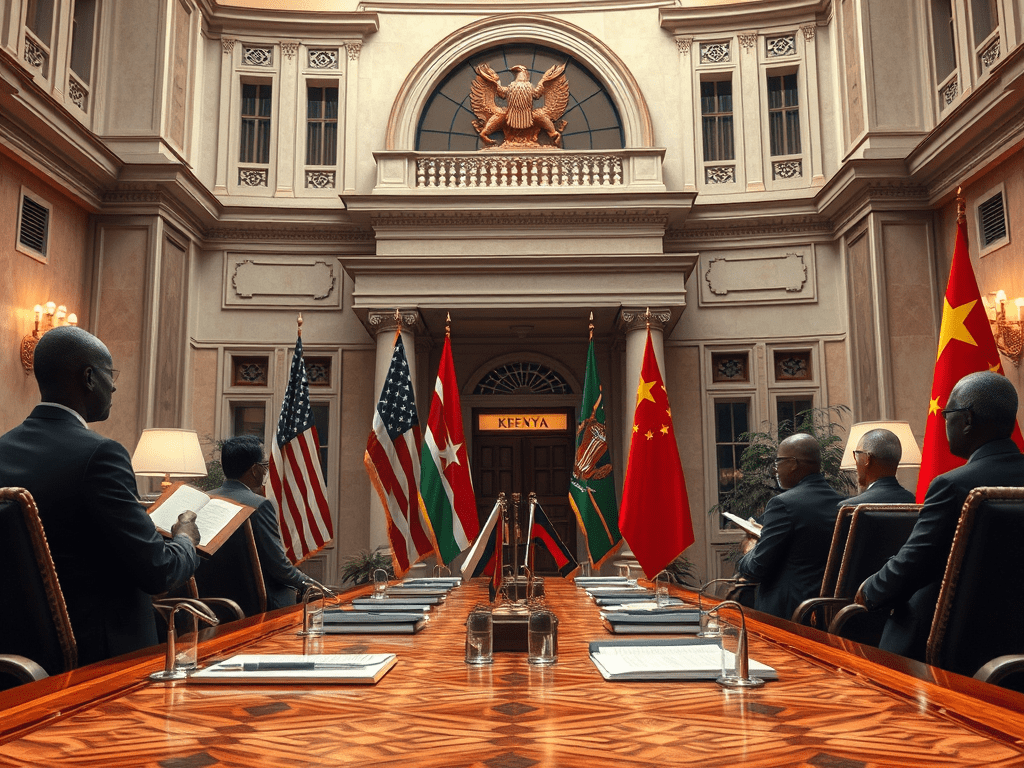
Kenya is no mere bystander as the super powers seek to grab influence; it is changing the game. This discussion shows how the low profile approach of Nairobi gains and remains independent to provide lessons on the changing U.S.-Africa environment.
President William Ruto has been receiving U.S envoys in his State House in Nairobi and Chinese envoys the next with both also signing deals with UAE investors. This is not anarchy; it is rationalized. With international trade anxiety of 2025, Kenya has signed more than 20 agreements with Beijing, pressured Washington to get trade favors, and signed UAE treaties–slipping the U.S. interests such as counterterrorism between competing bids of infrastructure and finance. This diplomacy underscores how Kenya has become the agent of a multipolar world, in which the U.S influence, previously hegemonic, is now competing and African states have to strike a balance between aid and security and sovereignty.
With U.S power transformation in Africa, the Kenya style is important: It demonstrates how middle-range countries claim independence, and they obtain advantages without full subordination. It is based on the recent events along with the policies and knowledgeable opinions that this article will unravel the trade-offs and the consequences of relations between the U.S. and Africa in the age of great-power politics.
The Historical Pivot: From Cold War Ally to Multipolar Player
US relationship with Kenya can be traced back to the year 1963, when it gained independence and became a strategic center in East Africa. Counterterrorism enhanced relationships in the post-9/11 period: Kenya has the largest U.S. embassy in sub-Saharan Africa and the highest quality of aid, more than 1 billion dollars each year on security and health. This was redefined by multipolarity by 2023-2026. The Belt and Road Initiative funded by China financed rails and ports and the Gulf states such as UAE monitored trade hubs.
Write in the quiet diplomacy: Kenya does not go into striking alliances but rather uses pragmatic involvement. A 2024 U.S. state visit by Ruto, the first such visit to an African leader in 16 years, had the benefit of making him a non-NATO ally, increasing military assistance due to Somalia threats. But domestically unstable (e.g., 2024 protests), Kenya used this to gain leverage in the world system, such as spearheading Haiti missions- which matched the U.S. interests, but made demands.
This change represents larger trends: the U.S. aid fell below budget reductions, and Kenya is heading towards diversified partners.
Mechanisms of Agency: Balancing Acts in Trade and Security
Kenya controls by choosing sides. In commerce, it sought an American pact by December 2025, which would grant it apparel and agriculture entry, and five-year renewal of AGOA- important as U.S. non oil business would have reached 3.1B by 2025 with UAE alone. In 2025 Nairobi contracted an American lobbying firm worth 2.1M dollars to help its image, overcoming criticism of image-laundering in the country.
Kenya, as far as its region goes, leads EAC integration, as economic impetuses do in DRC, to demand leadership outside U.S. orbits. It is a quiet form of style according to the analysts but it does not confront, and employs forums such as TICAD and FOCAC to raise a voice.
Proof in the Pacts: Data on Trade-Offs
The balancing act is shown by the numbers, U.S aid: Kenya is number one, and in 2025, Nairobi will be co-funding 1.7B in health deals. However, China trade increased to 6.8B in 2023, which is ten times higher than that of the U.S., and 2025 deals in agriculture and technology will indicate UAE diversification. Gulf investments: UAE had 3.1B non-oil trade in early 2025, which is a sign of diversification.
Human Lens: Ruto’s High-Stakes Gambles
This diplomacy is enshrined in President Ruto. The modernization deals in the 2025 visit to China, when U.S. pressure on Huawei existed, were celebrated by Ruto as win-win deals but critics interpreted U.S. snub. He advocated renewal of AGOA in Washington, but Trump 2025 America First cuts strained relationships. Such analysts as those at Wilson Center remark on the credible voice of Ruto in advancing African interests.
Expert Views: Empowerment or Entrapment?
Pathways Forward: Lessons for U.S.-Africa Ties
To thrive:
- Diversify: Kenya-style balancing keeps growth going- U.S. needs to keep pace with fair deals.
- Invest locally: Reform-conditioned assistance, as CSIS.
- Connect people-to-people: FP Blogs appeal to U.S. attention to investment in East Africa.
- Monitor multipolarity: Track Gulf pivots for equity.
The soft power of Kenya is not inert, rather it is the game of power whereby, in the multipolar Africa, influence is not dominant, but is negotiated. With summits such Africa-France set to be held in 2026, the model of Nairobi can redefine the U.S. involvement.






 Sure Media Magazine
Leave a comment